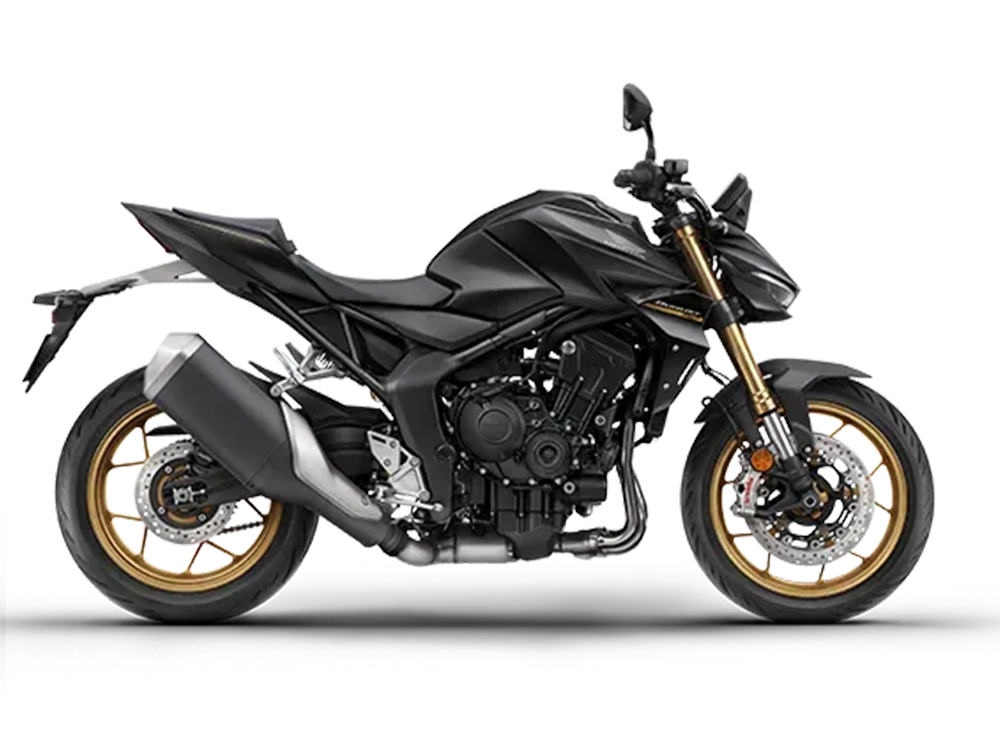



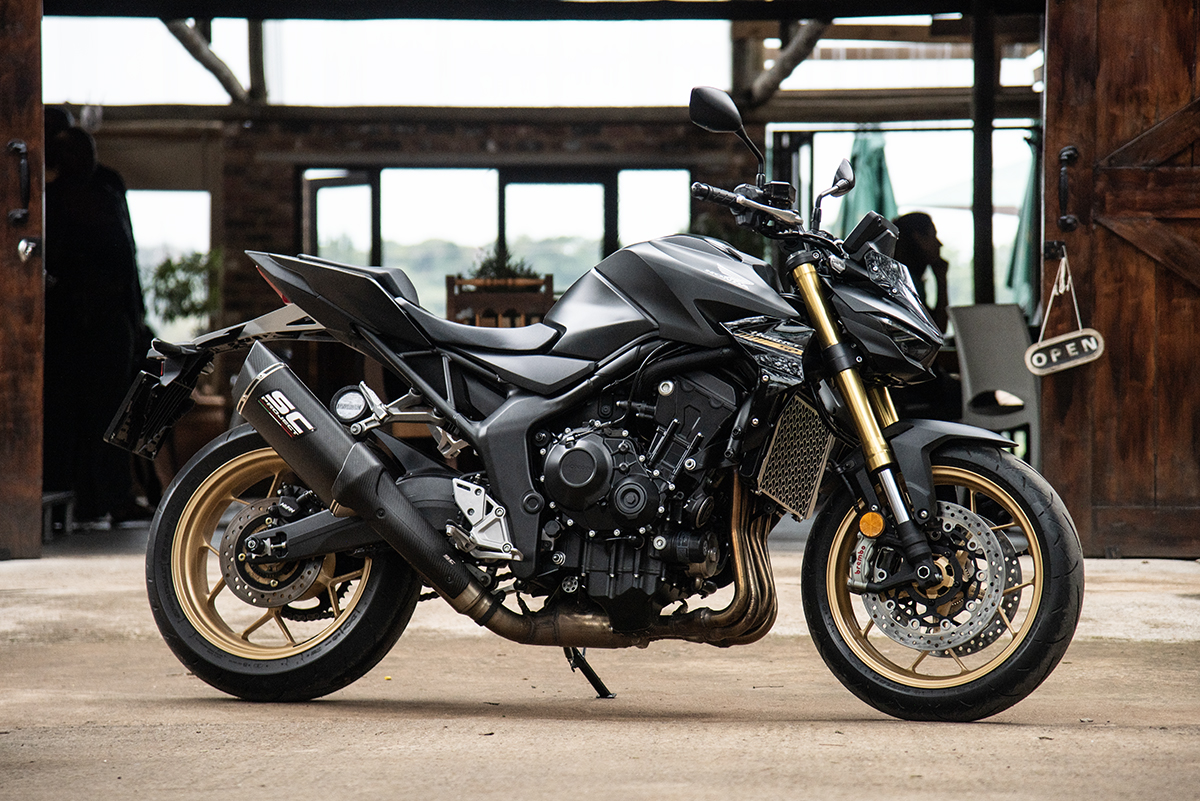
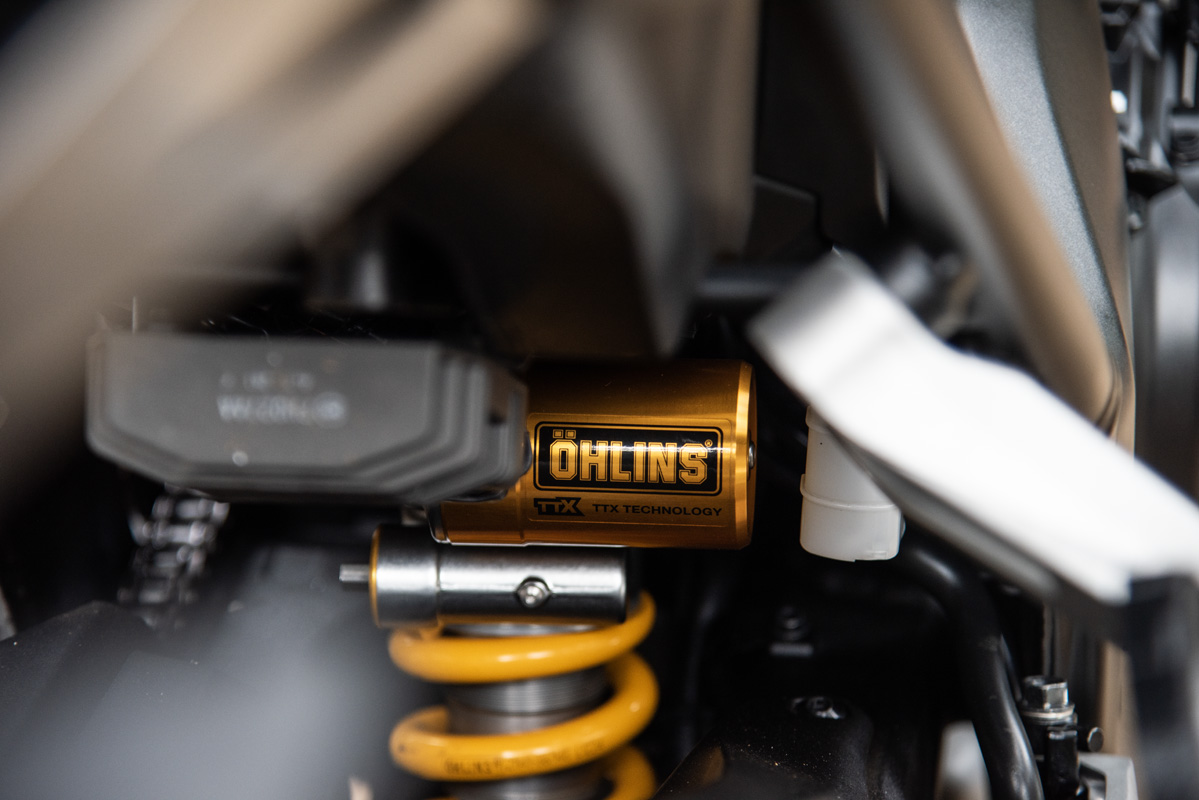
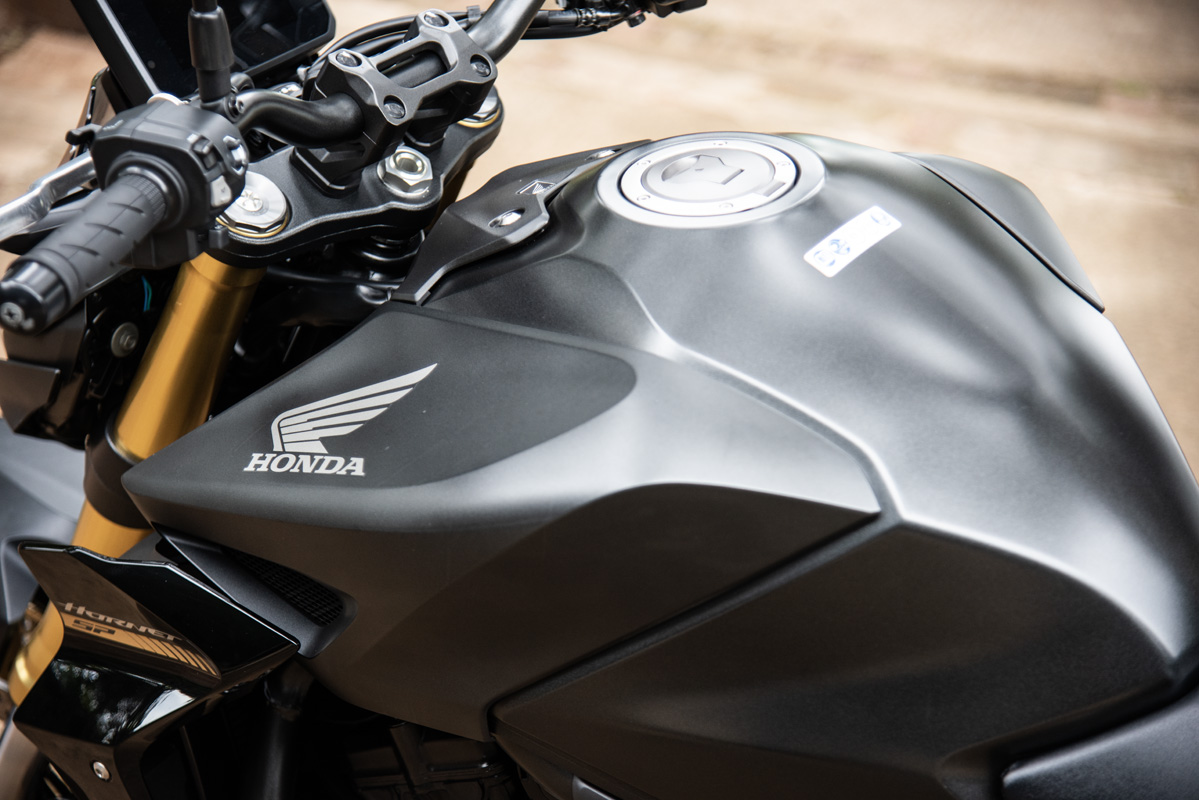
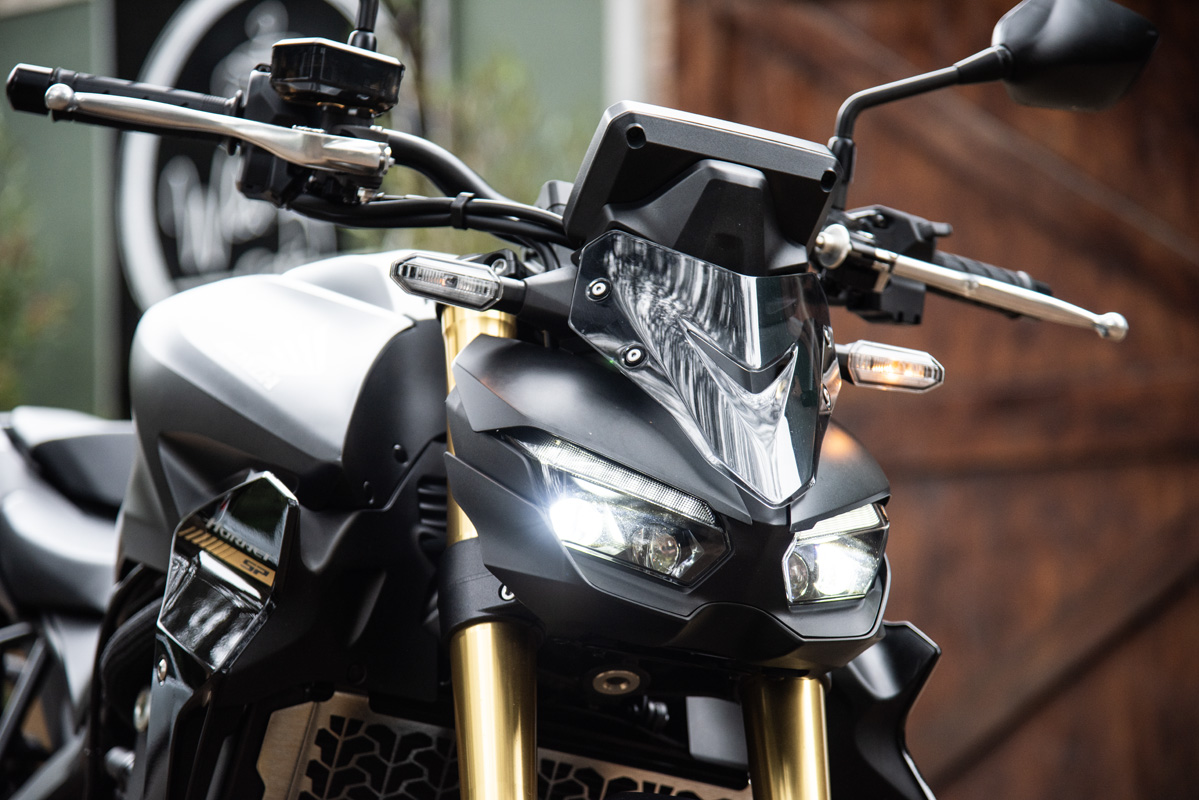
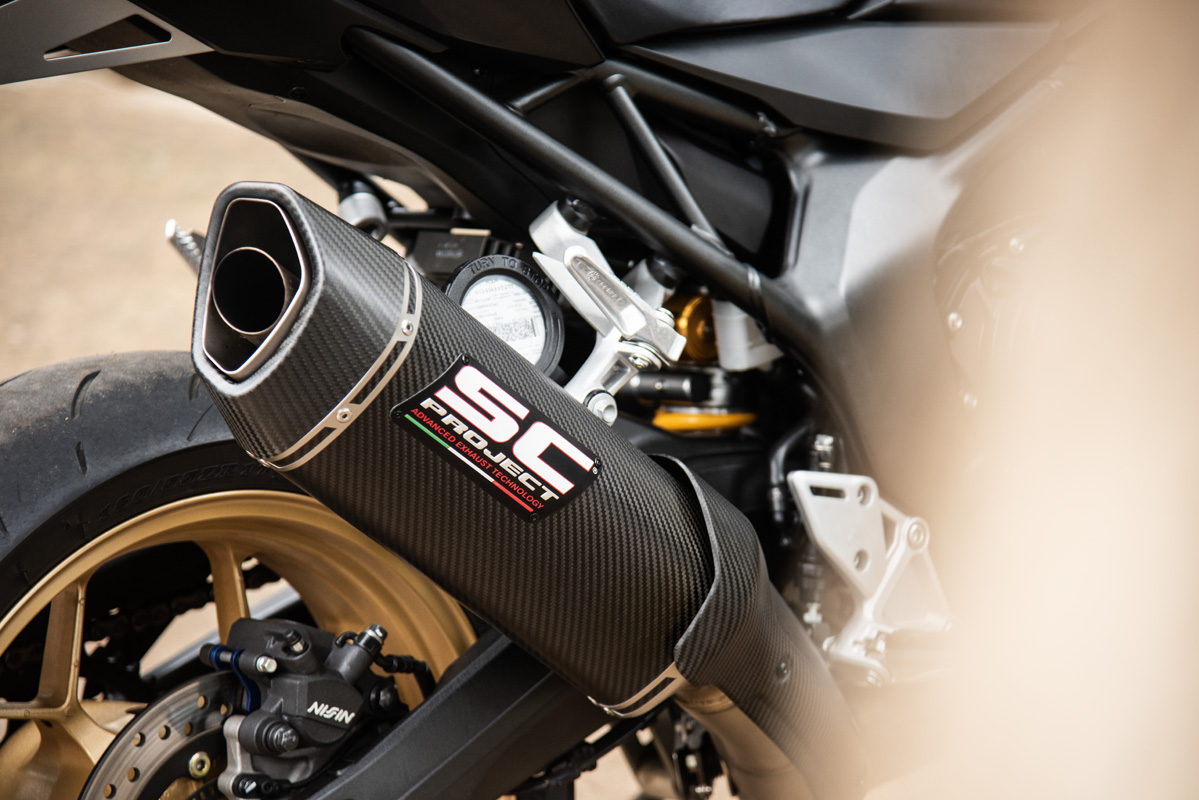
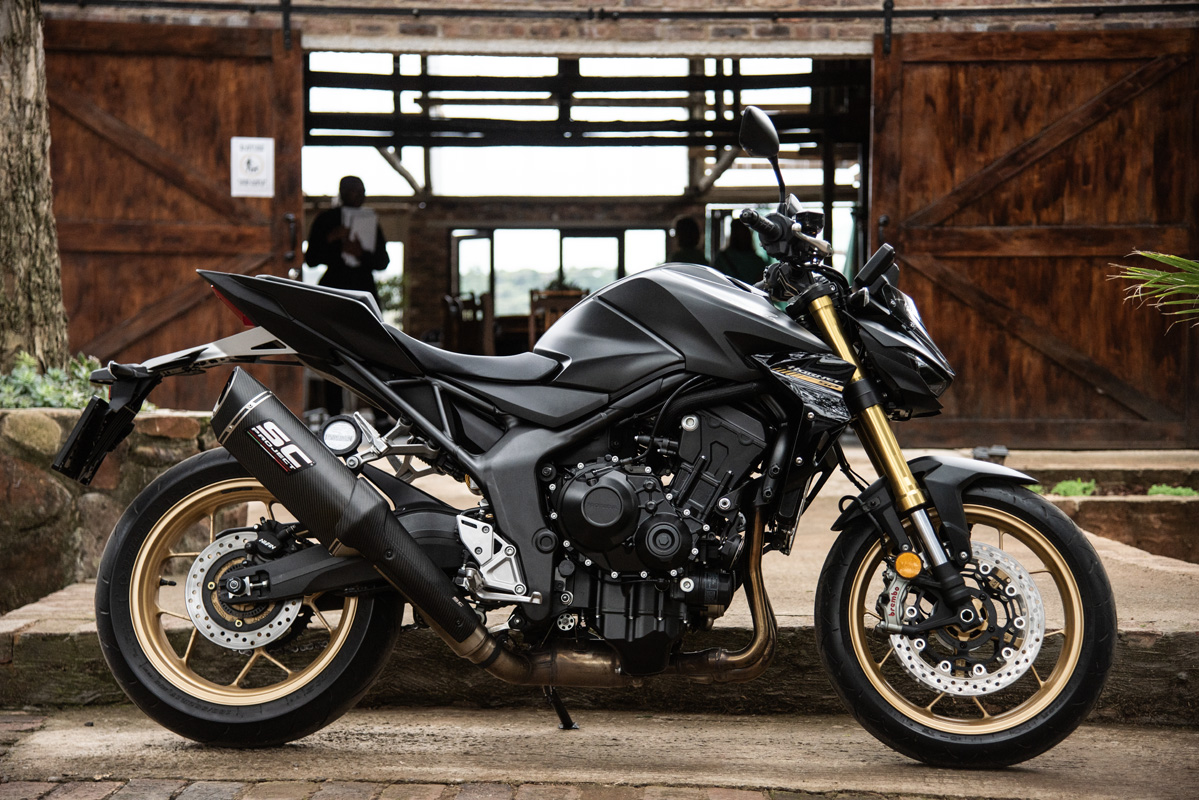
You can have Honda’s potent Hornet in any colour you like as long as it’s metallic black! Which is not a bad thing because it is one handsome beastie, complete with fully adjustable gold 41 mm Showa SSF-BP USD front forks with 118 mm of travel, gold wheels and if you peep at the shock, it is a fully adjustable gold Ohlins TTX36 unit with 139 mm’s travel and complete with its signature yellow spring. My test bike also sported a beautiful and purposeful-looking SC Projects slip-on pipe. Even the steel twin spar frame is painted satin black, so the bike is essentially black and gold with only the passenger footpegs in aluminium. It looks purposeful in the way a F-35 Stealth Fighter looks built for form to follow function.
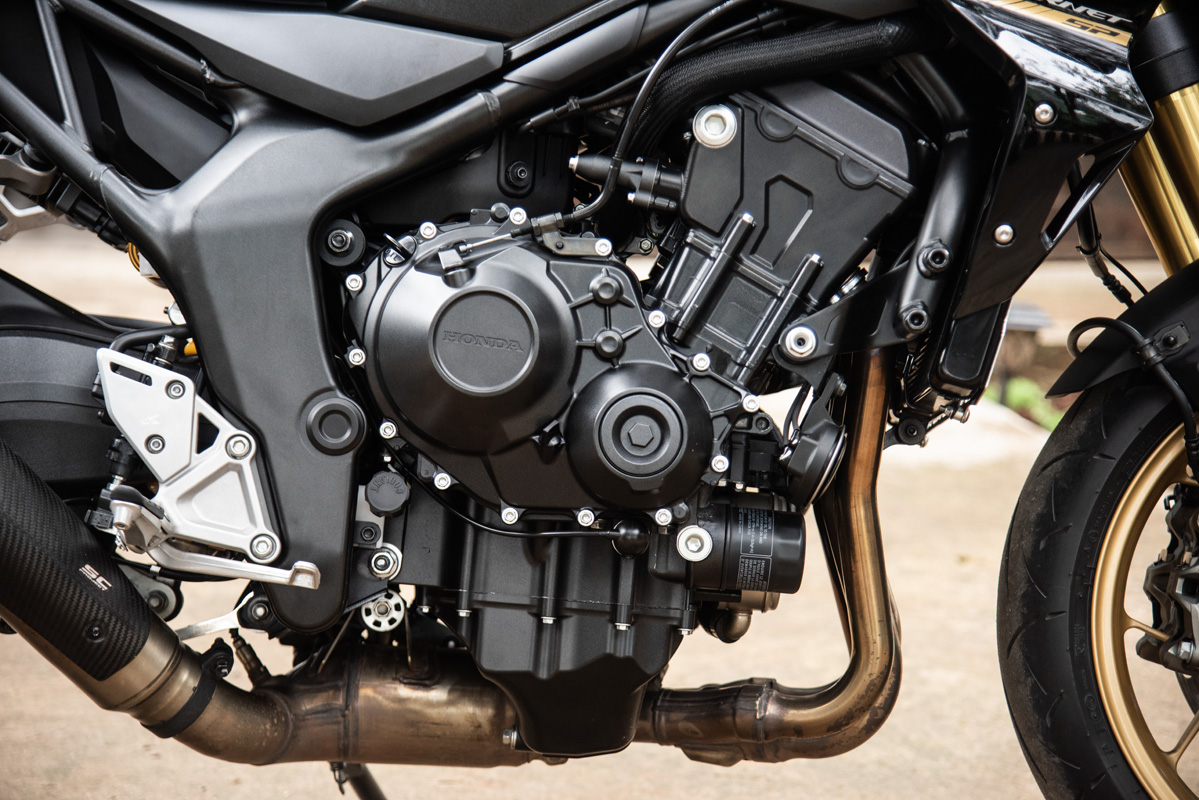
The SP has the inline 4 cylinder, DOHC 4-Valve per cylinder fuel-injected engine derived from the 2017 Fireblade but tuned for more midrange and a bit less top end, totally suited to its naked bike credentials. The motor churns out a healthy 157,2 hp at 11,000 rpm and 107 Nm of torque at 9,000 rpm. The gearbox is a typical 6-speeder with a bi-directional quickshifter. With a bore of 76 mm and a stroke of 55,1 mm, it is designed to rev and rev it does!
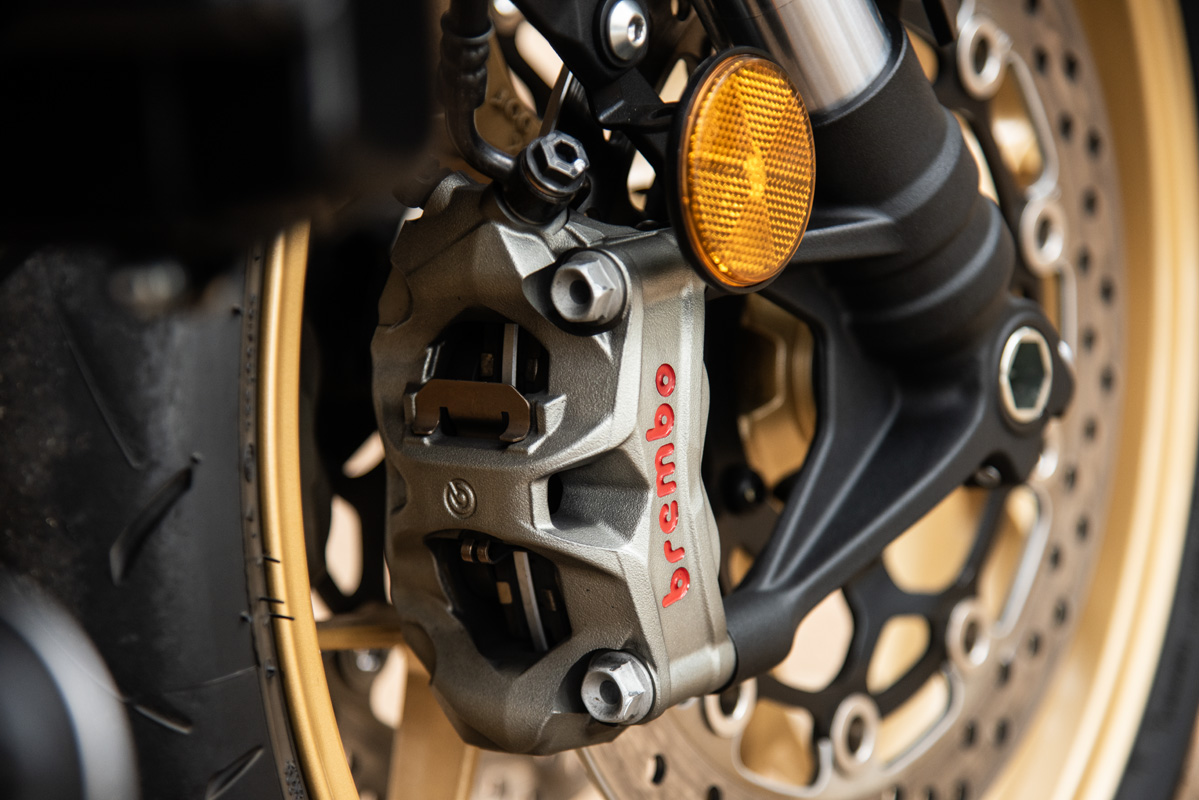
To haul up all that performance is a set of 310 mm front discs chomped on by radially mounted Brembo Stylema callipers with dual channel ABS, complemented by a 240 mm rear disc with a single piston calliper. The wheels are a 120/70×17 front and a 180/55×17 rear, slightly narrower than the 190 rear on the regular Hornet, to aid turning, no doubt.
The Hornet is approachable for a wide range of riders, given an 809 mm seat height and 212 kg wet weight. The tank holds a reasonable 17 litres, which should be good for around 270 km between top-ups, given consumption of just under 17 k’s per litre of motion lotion. The rake angle of 25 degrees complements the quick, but not flighty, steering of the SP.
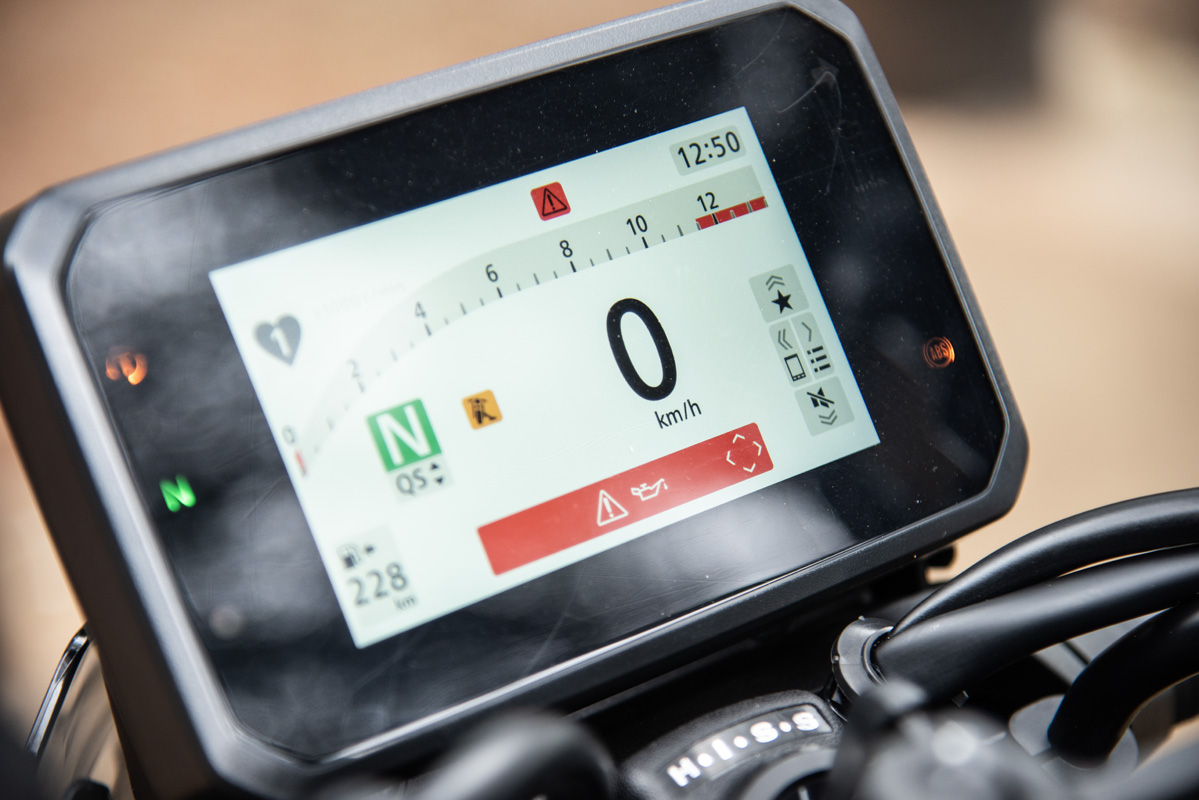
Electronics are quite comprehensive, with 5 engine modes (Rain, Sport, Standard and two ‘user’ modes, which allow you to set the bike up to your preferences). The dash is a 5” TFT display, lights are LEDs, and the SP features Honda’s Roadsync connectivity system. There is a USB port under the pillion seat. I think it would be better situated in the cockpit area, but certainly better than nothing. Unfortunately, the indicators are not self-cancelling, which, quite frankly, I think should be standard on all motorcycles irrespective of price.
Let’s address the elephant in the room. Is a 157,2 hp naked bike relevant in a world where the hyper Nakeds make 25% to 30% more power and torque? We are talking the likes of the KTM Super Duke R Evo or Ducati Streetfighter V4S. Let’s ignore the cost of these bikes and focus on performance. Frankly and realistically, and I’m sorry to break it to you, cupcake, and I know what you are thinking, but there are very few of us mere mortals out there who can adequately wring the neck of a 200-horsepower motorcycle, pushing around 210 kg of weight alone. The torque is a problem all on its own.
Let’s take the KTM, for example. 140 kW at 10,000 rpm and 145 Nm at 8,000 rpm. Those sorts of numbers mean that just a hint of throttle gets the front wheel in the air. You now move into the lap of the electronic gods for survival. Wheelie control and traction control become your very best mates. In practice, you ride these bikes short shifting and leaning on their massive midrange to get the job done. Ridden like this, these bikes are blisteringly quick and highly entertaining. So, where does this leave the Hornet?
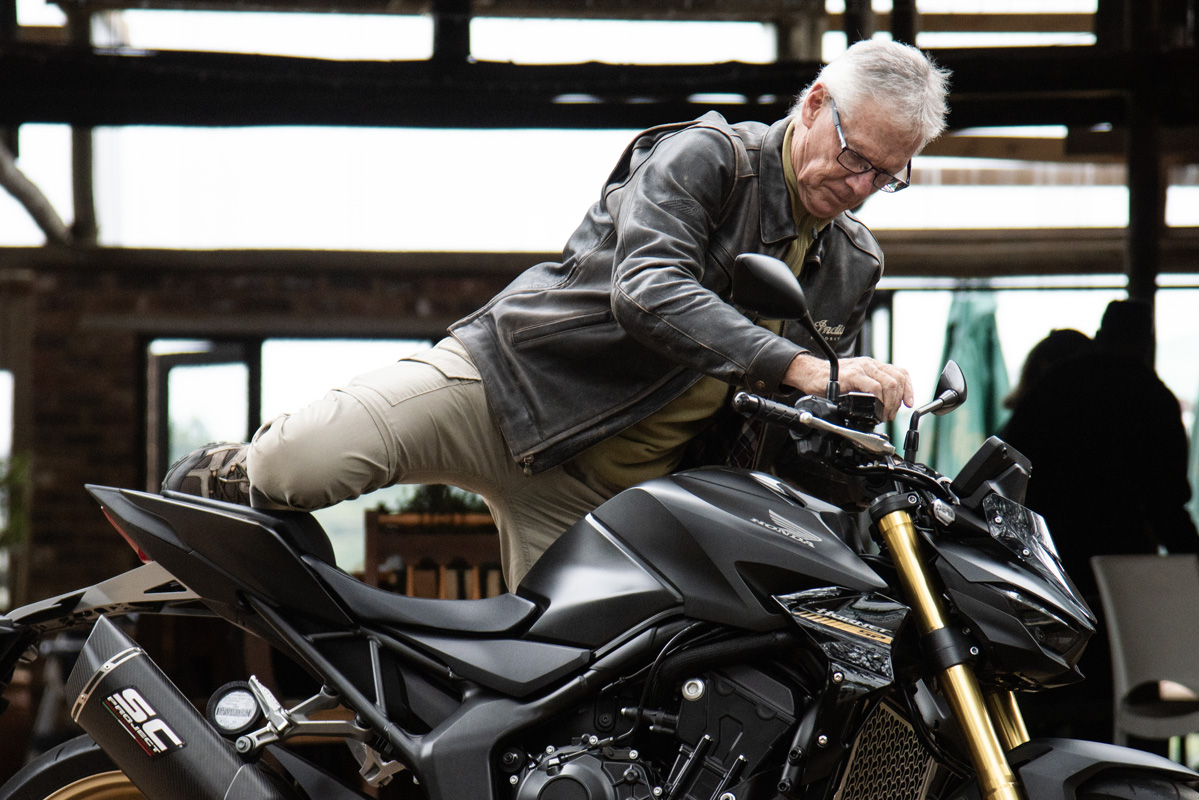
Right in the real-world mix, that’s where! The Hornet is a seriously quick motorcycle, but here’s the thing: You need to really ride it to access that performance. The Ducati and KTM are the cutlasses of the naked performance bike world, hacking their way with massive muscle and force. The Honda, by comparison, is a rapier, cutting and thrusting with poise and dexterity. It floats like a butterfly and stings like a…hornet! Out on the road, the Hornet responds best when ridden with finesse. Don’t get me wrong, like any Honda, it is incredibly easy to ride. You feel at home and in control from the moment you let the clutch out. Short shifting, you make decent progress, but the SP is almost underwhelming for a litre bike, until you feed it a healthy dose of revs. Then the front end gets seriously light, and it’s game on!
This is also when the quality of the chassis and suspension shines through. Everything comes together beautifully as you focus on becoming one with the Hornet and body ‘talking’ towards the limit. It is an extremely rewarding bike to ride fast. It feels light and agile at all speeds, allowing you to steer it with precision, yet that accuracy never comes at the cost of absolute stability. On the open road, its only limit is, as with other motorcycles in its genre, its nakedness. Riding fast tends to happen in ‘special stages’, because consistent high speeds take a heavy toll on your body due to the lack of wind protection.
The piece de resistance of the Hornet is its price. You get Honda reliability with a two-year warranty, 12,000 km service intervals, premier suspension and a potent and proven Fireblade-derived motor for R265,000. That, sports lovers, is a huge amount of bang for your buck. If naked sports motorcycles are your thing, then you should take a long, hard look at the Hornet. It could just be the start of a long and rewarding relationship!
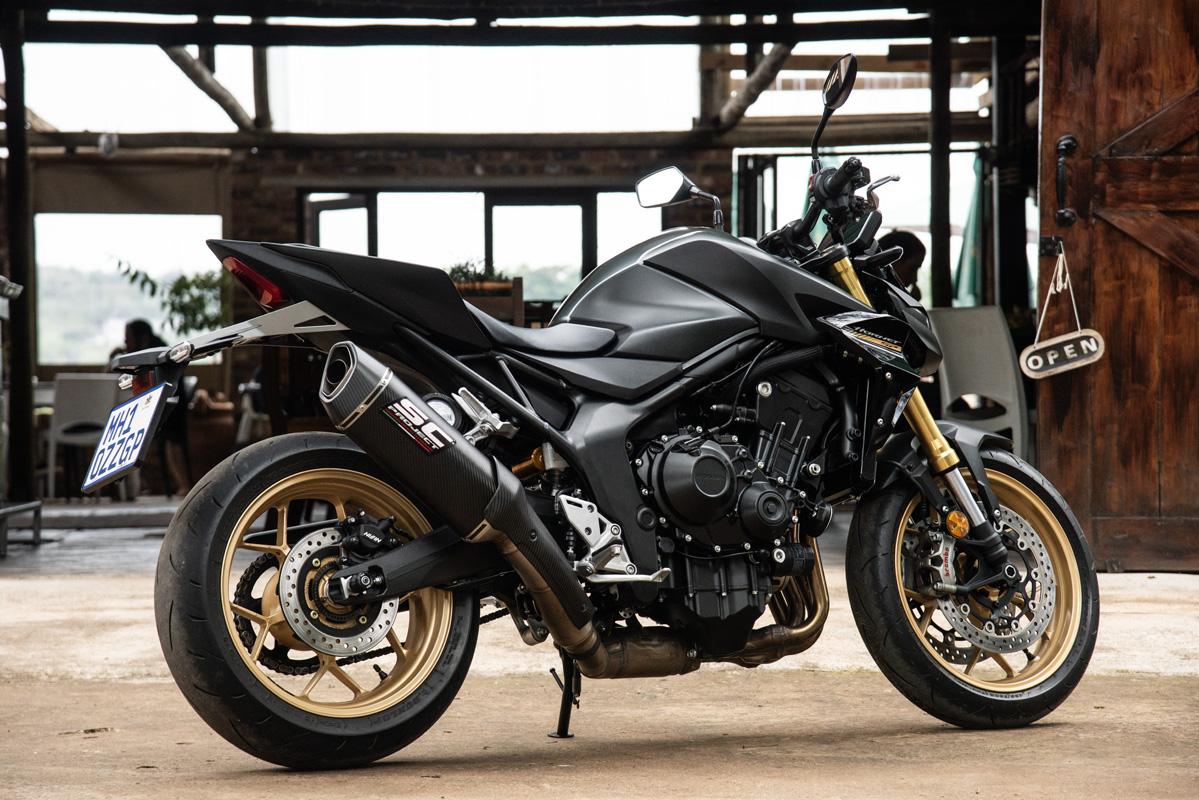
Honda Hornet 1000 SP
For more information on the bike featured in this article, click on the link below…