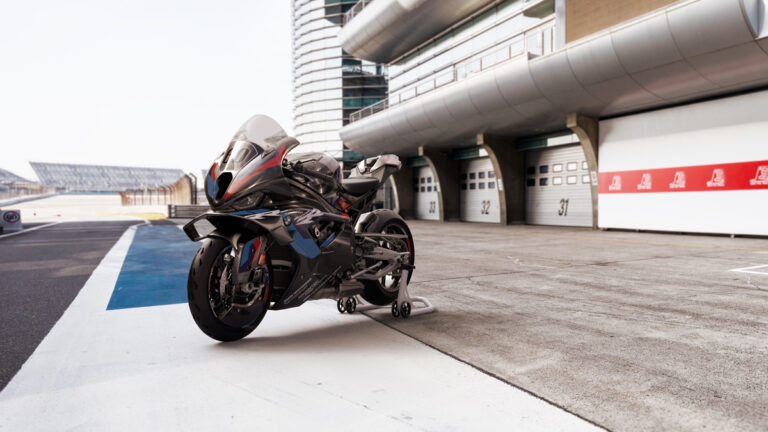
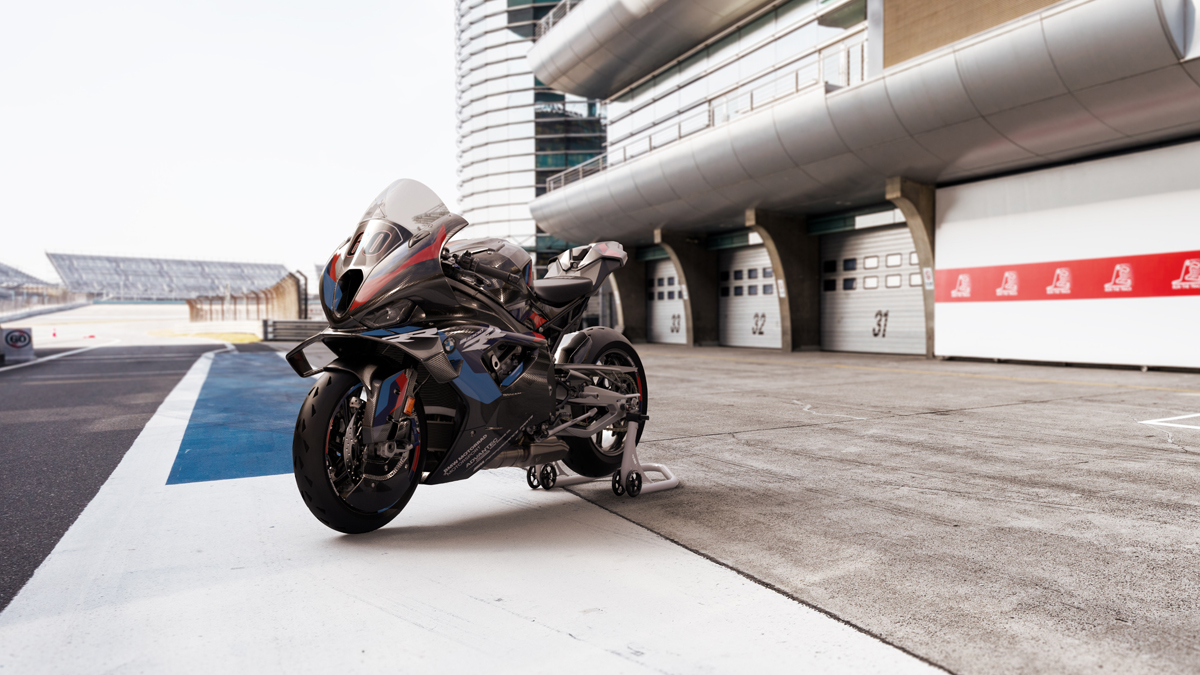
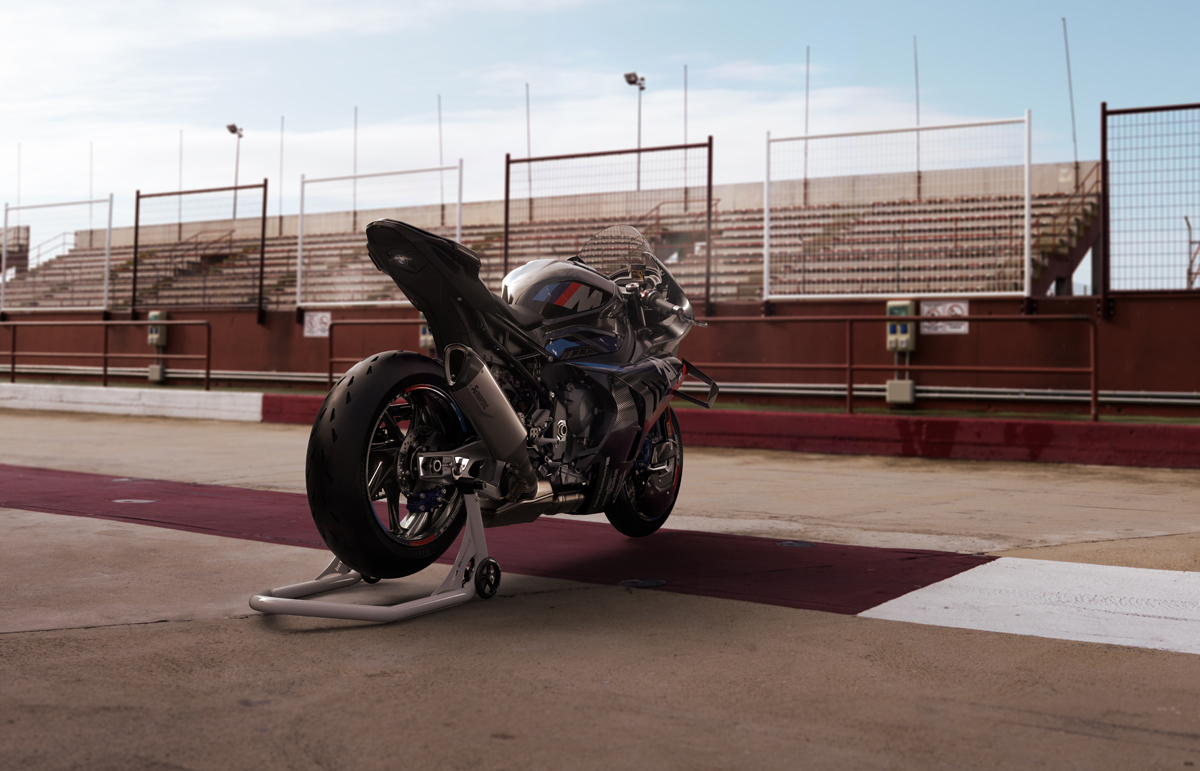
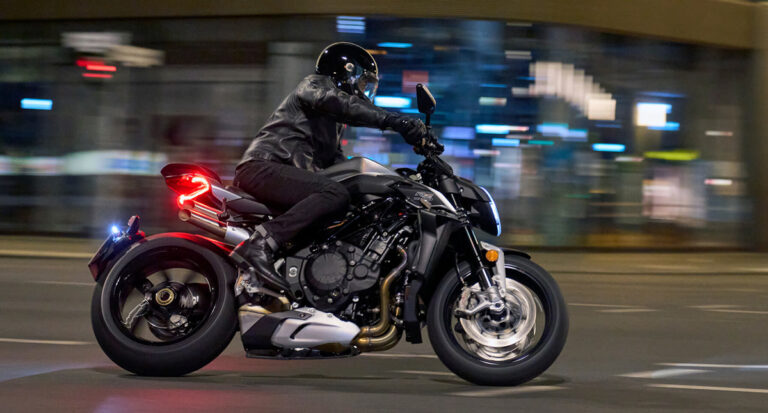
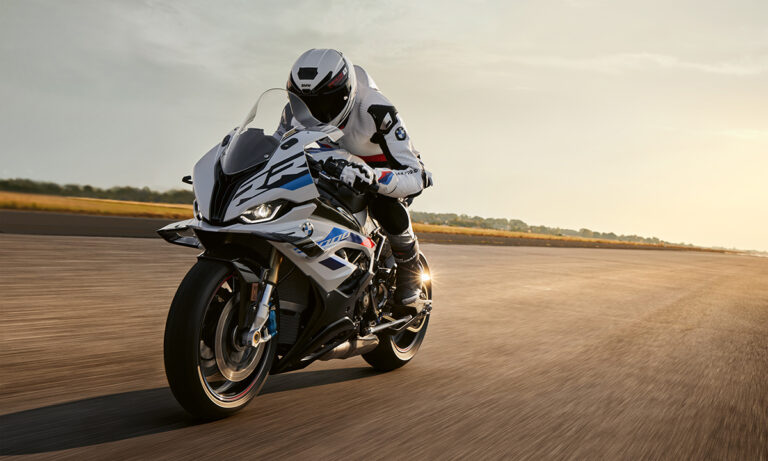
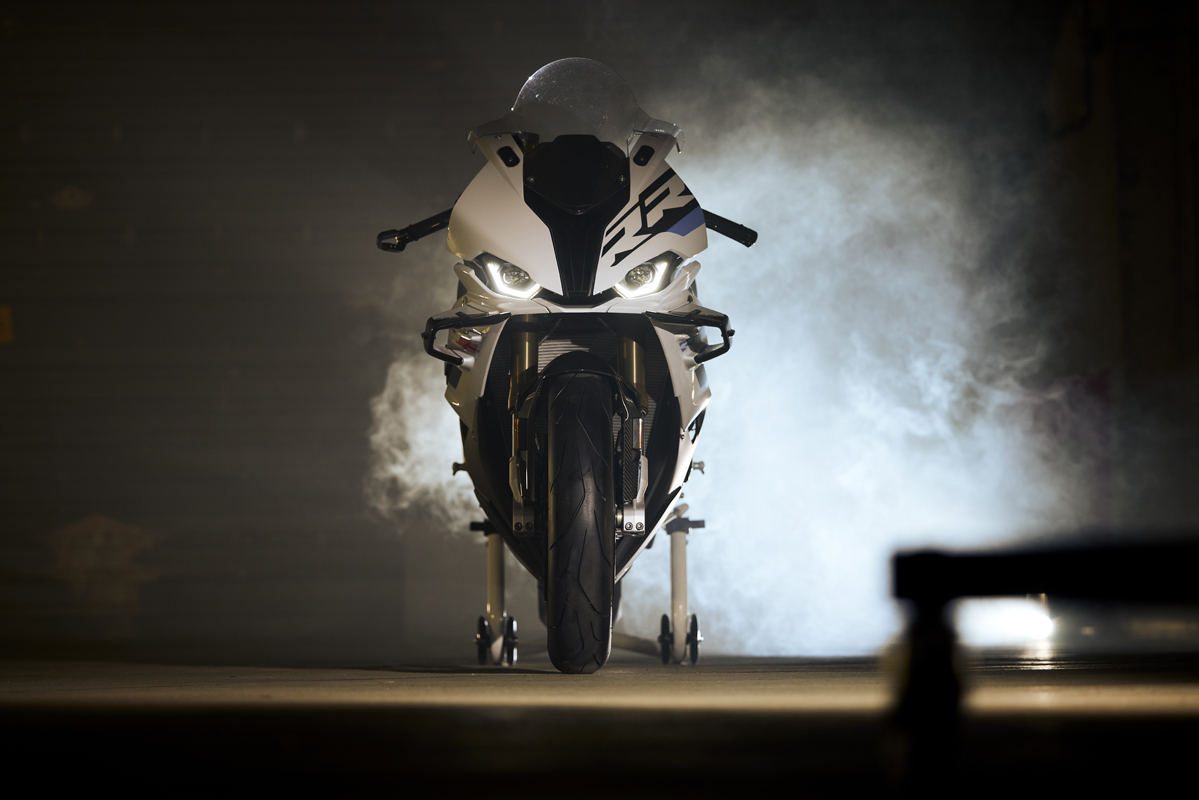
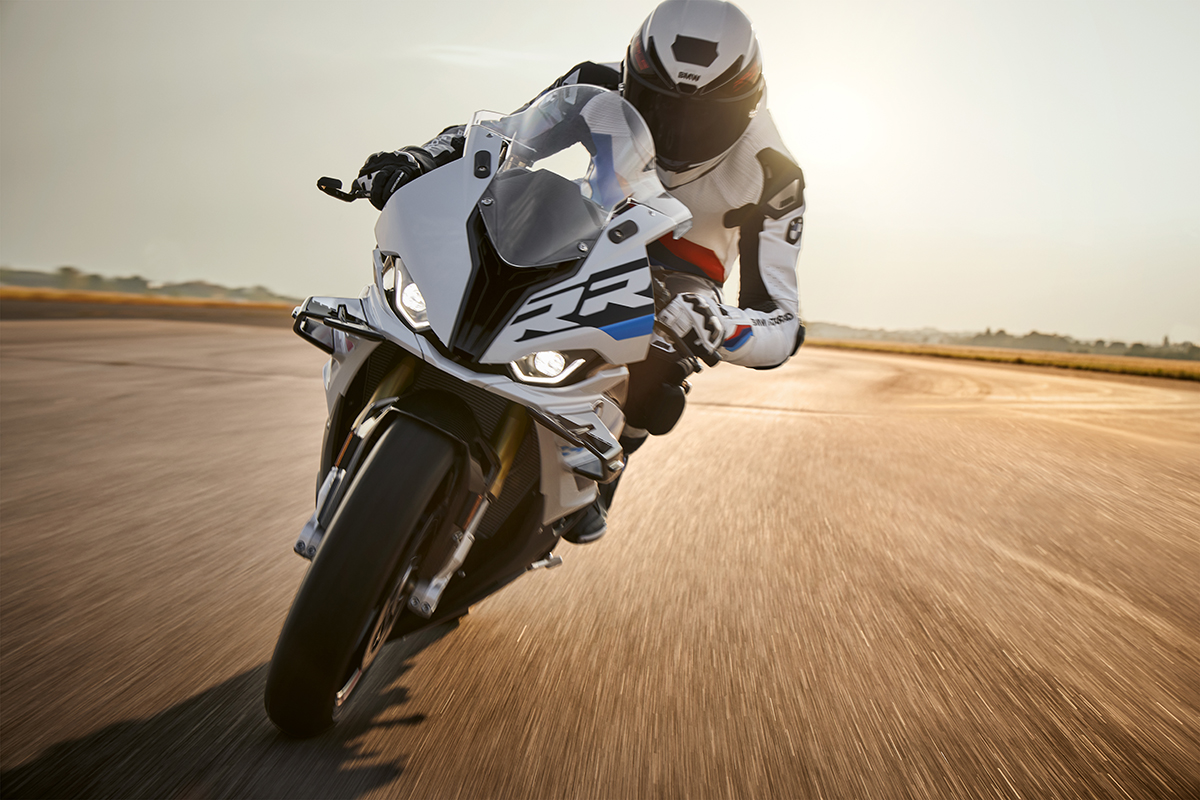
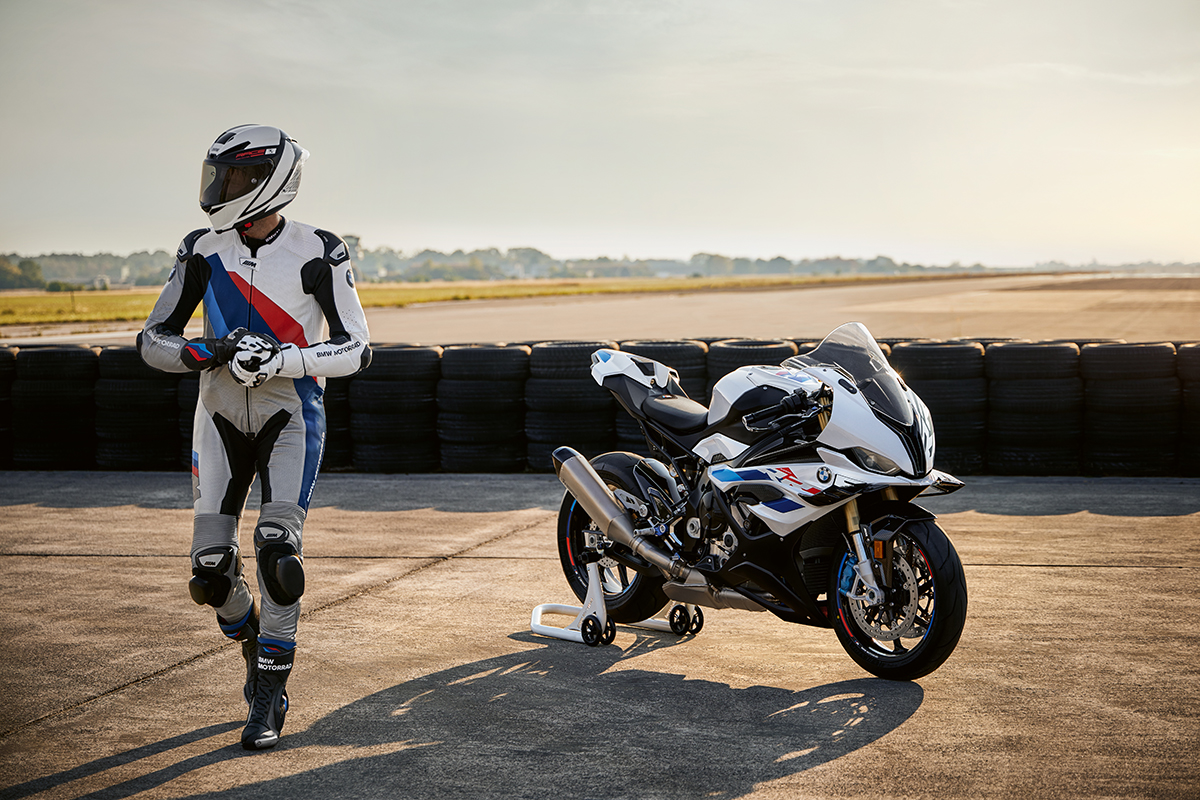
Just how much faster can litre superbikes get? Well, if the new BMW M1000RR is anything to go by, we are looking at an increase of 8km/h, bringing the top speed to 314km/h, up from 306km/h. The amazing thing is that this speed increase has been brought about not by stressing the engine further, but by improvements to the aerodynamic efficiency of the fairing.
The newly designed fairing is made of exposed visible carbon fibre and a higher windscreen offers optimised airflow around the rider. For the first time, this fairing also comes with a particularly light yet very rigid front fairing support made of carbon fibre.
Image source: BMW Motorrad
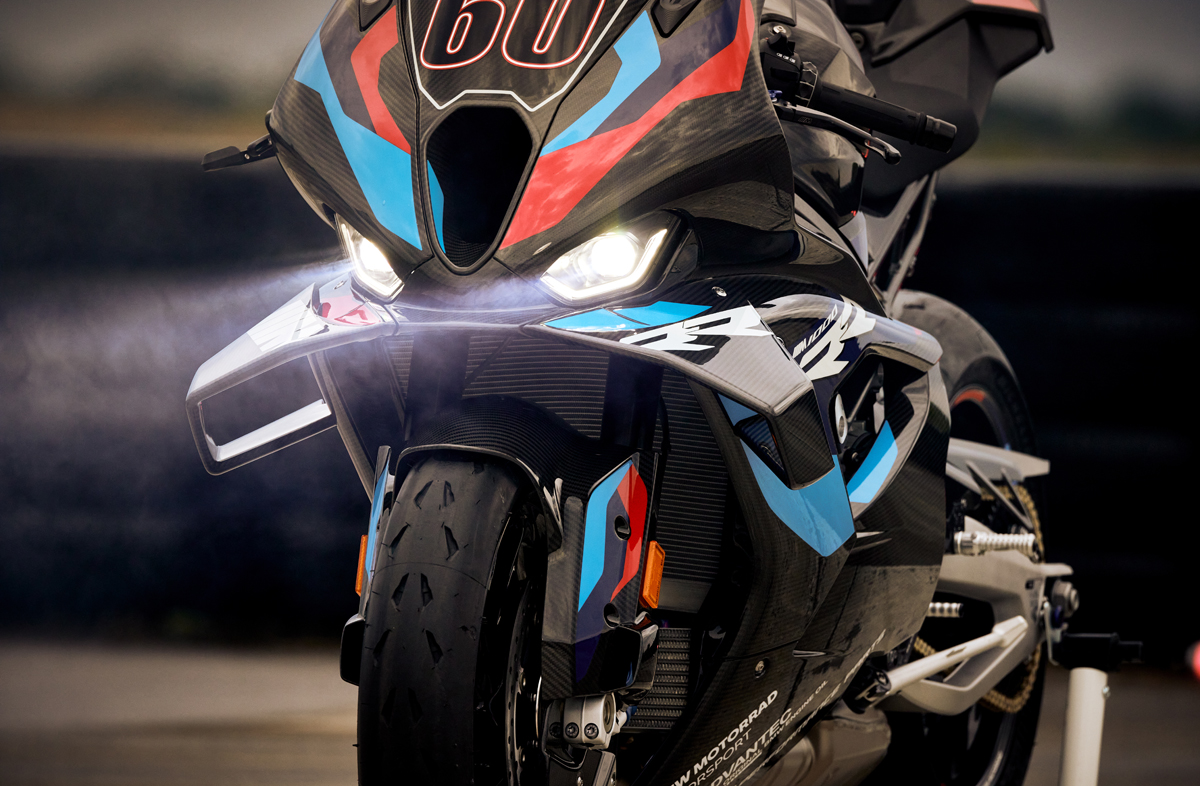
It’s not just the fairing that has received attention. Winglets are now a feature of any self-respecting sports bike and those on the M RR have been revised. They now generate significantly more aerodynamic downforce – both in an upright riding position and when banking.
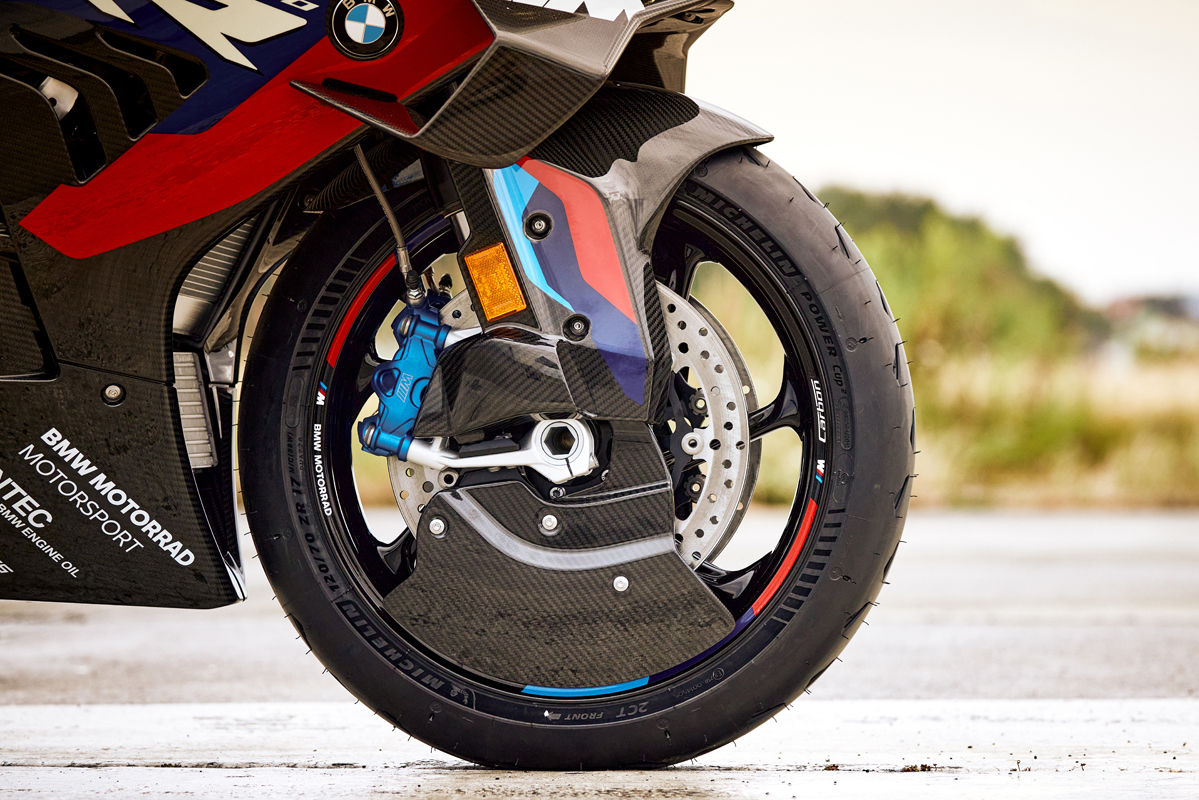
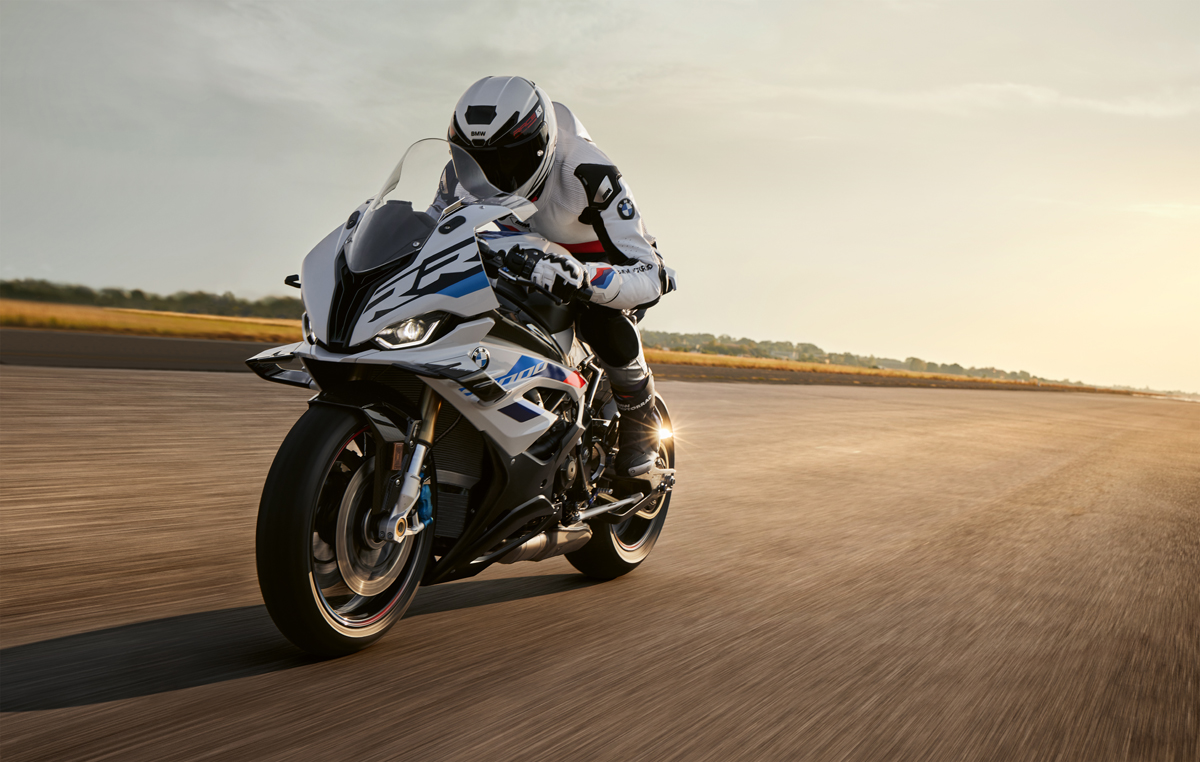
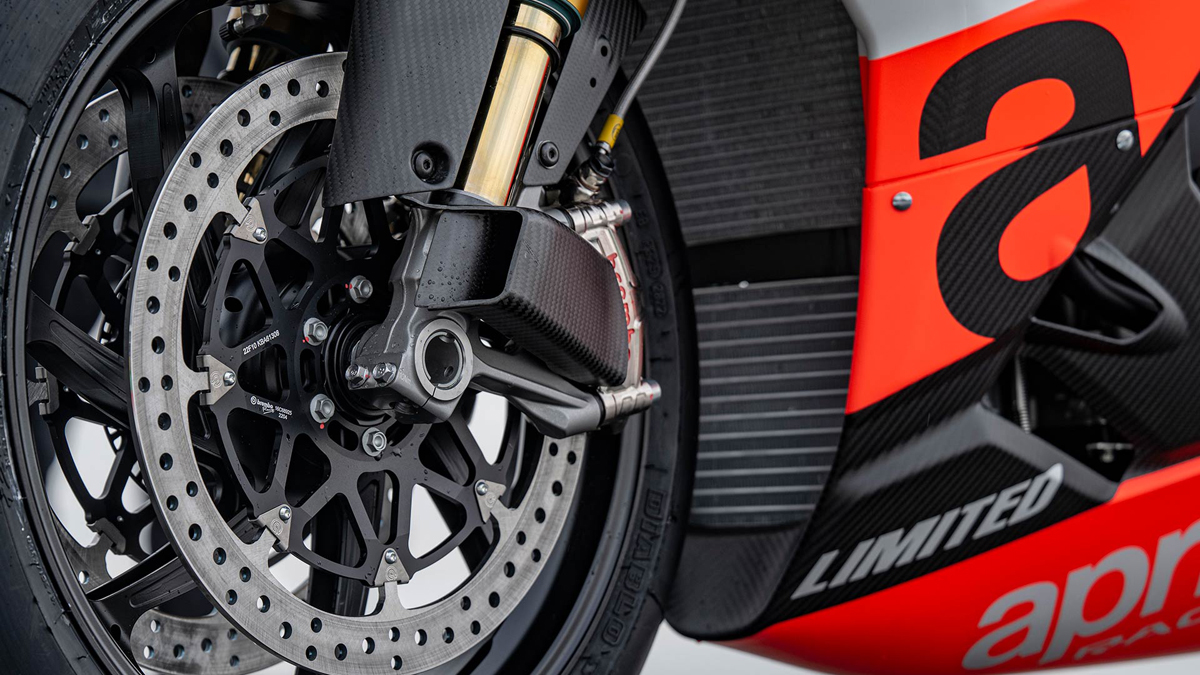
Another central point in optimising the entire aerodynamics was the area of the front wheel: carbon fibre brake cooling air ducts are fitted. They are integrated into the new front mudguard, which has been optimised for improved airflow around the fork legs and brake callipers.
Image source: BMW Motorrad
The M Aero Wheel Covers, which are also made of visible carbon fibre lower air resistance even further – especially at speeds above 250 km/h.
The engine retains its 212bhp at 14,500rpm output and torque figure of 113Nm (83.3 foot pounds) at 11,000rpm.
Image source: BMW Motorrad
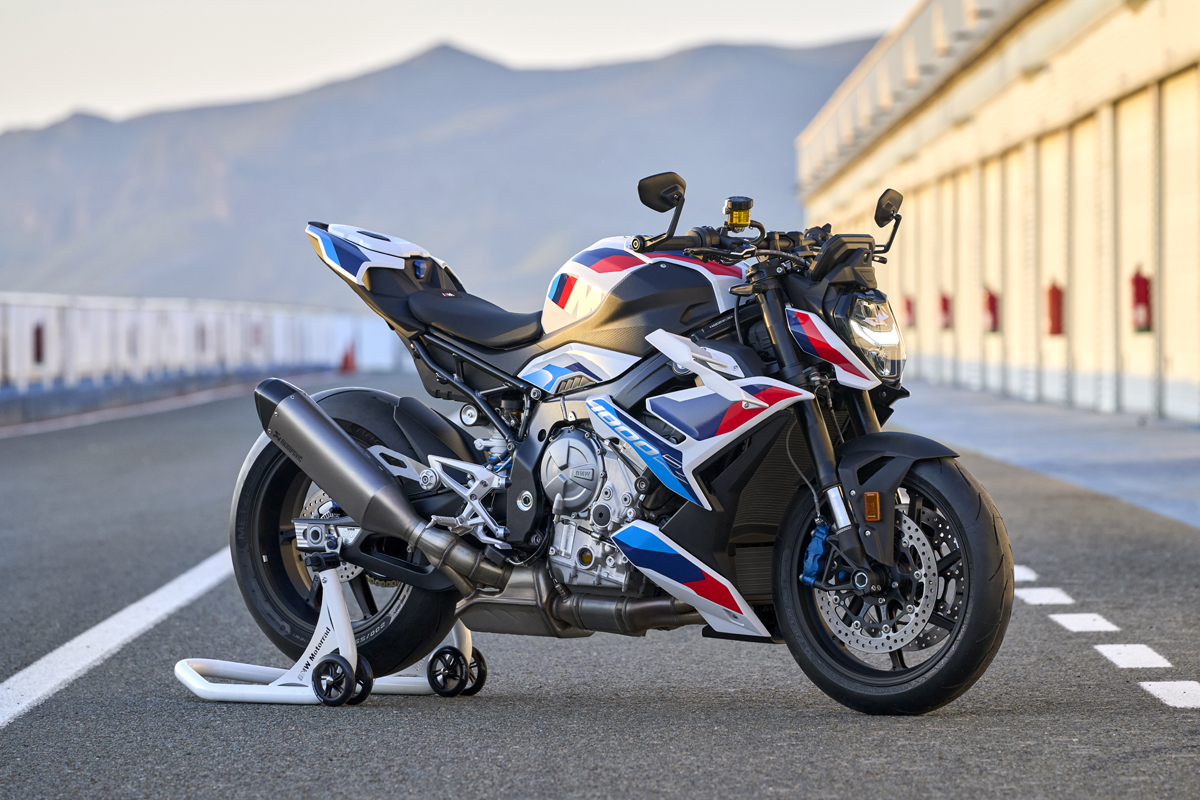
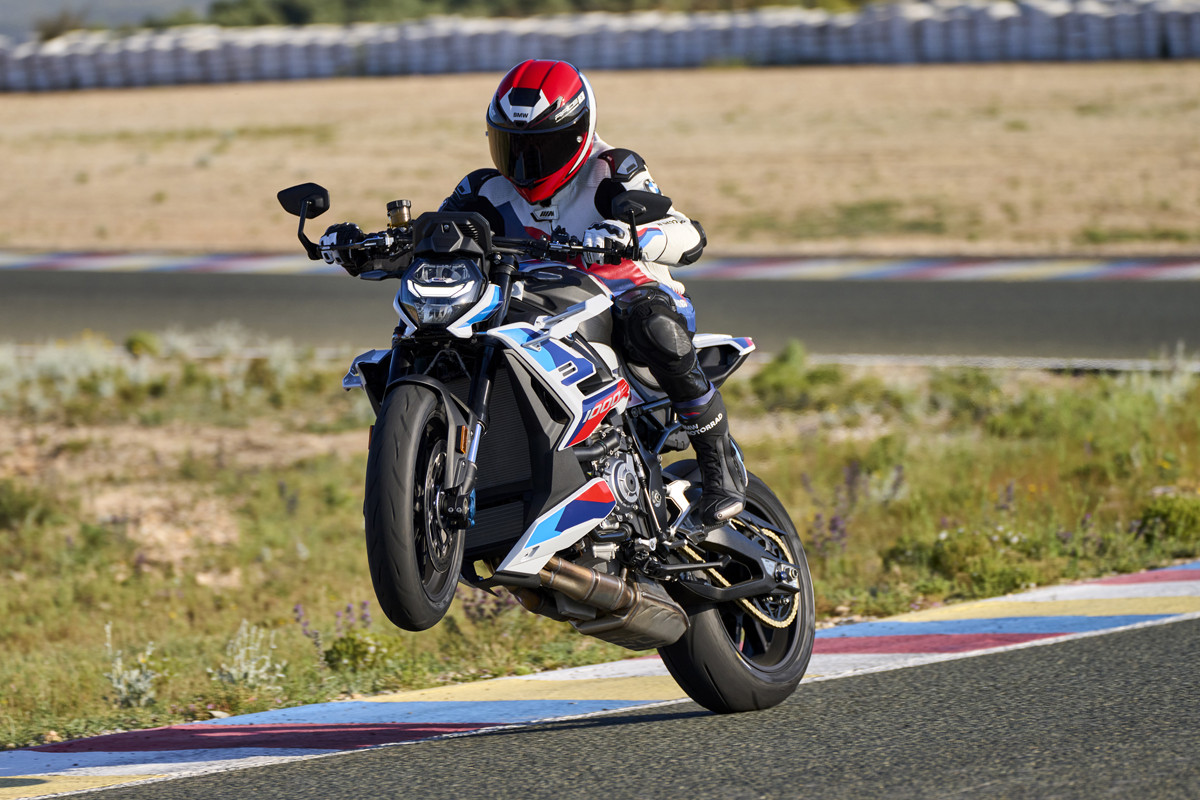
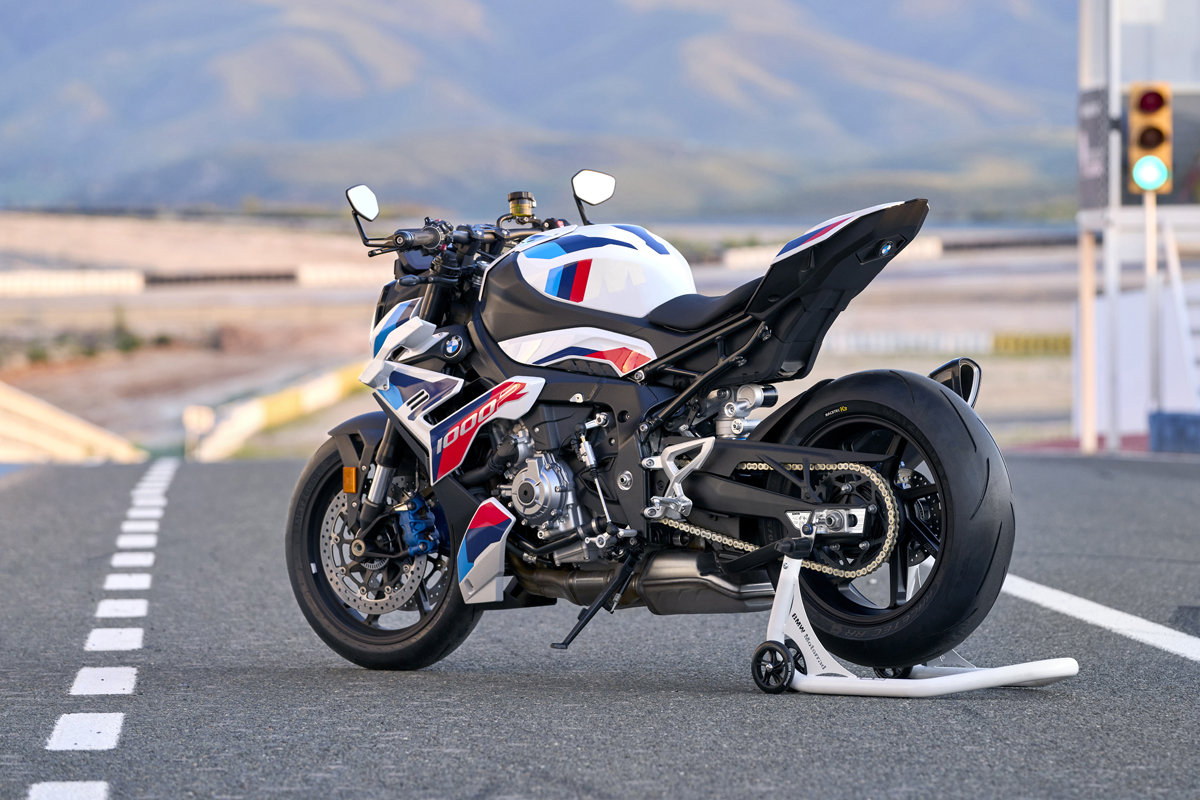
The naked M1000R has also received upgrades, again mainly involving aerodynamics. The new M R was given winglets in the area of the front side panels with the aim of achieving the best possible riding stability at high speeds.
The winglets provide an increase in front wheel load of 11 kg at 220 km/h due to aerodynamic downforce. The BMW Motorrad developers’ countered the slightly increased aerodynamic resistance caused by the small additional frontal area and shape of the M winglets with a correspondingly designed wind deflector in front of the instrument cluster.
Image source: BMW Motorrad
The engine is based on that in the M1000RR and has a peak power output of 210bhp at 13,750rpm. This is a frankly incredible increase of 45bhp over the engine in the S1000R. Torque output remains the same as the M RR at 113Nm (against 114Nm at 9,250rpm for the S1000R). The gearing has been shortened for every gear between second and sixth for ridiculously explosive acceleration.
In both the M1000RR and M1000R, the engine features BMW’s Shiftcam variable valve timing technology.
Image source: BMW Motorrad
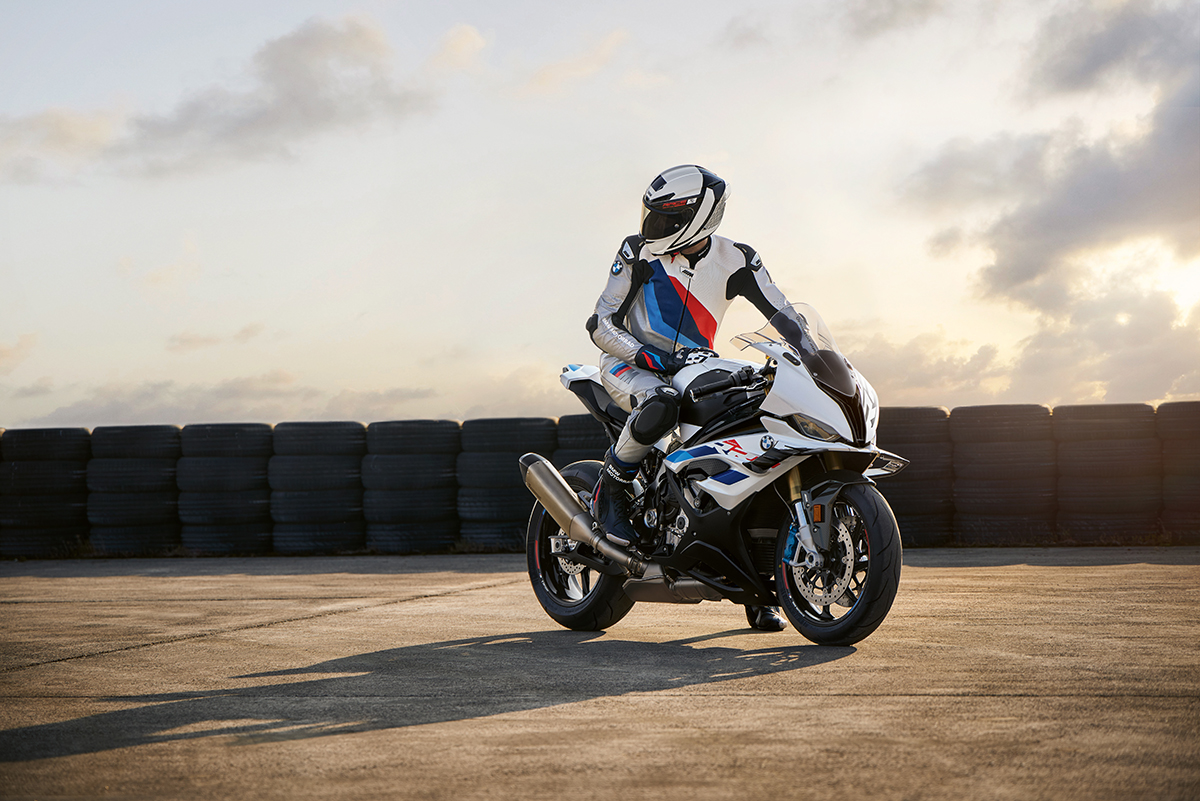
If the new M R in standard trim is still not enough for you, the M Competition Package offers a mix of refined components. In addition to the Blackstorm metallic / M Motorsport colour scheme, the M Competition package includes M Carbon wheels, M rider footrest system, M Carbon parts such as rear wheel cover and chain guard, front wheel cover, tank covers, airbox cover with tapes, wind deflector, sprocket cover, the M pillion package as well as the M pillion cover and a milled, fully adjustable M rider footrest system.
Despite having entered the superbike class over 20 years later than rivals from Japan and Italy, BMW has consistently sat at the head of the table and, with the latest revisions, it looks likely that its position is secure.
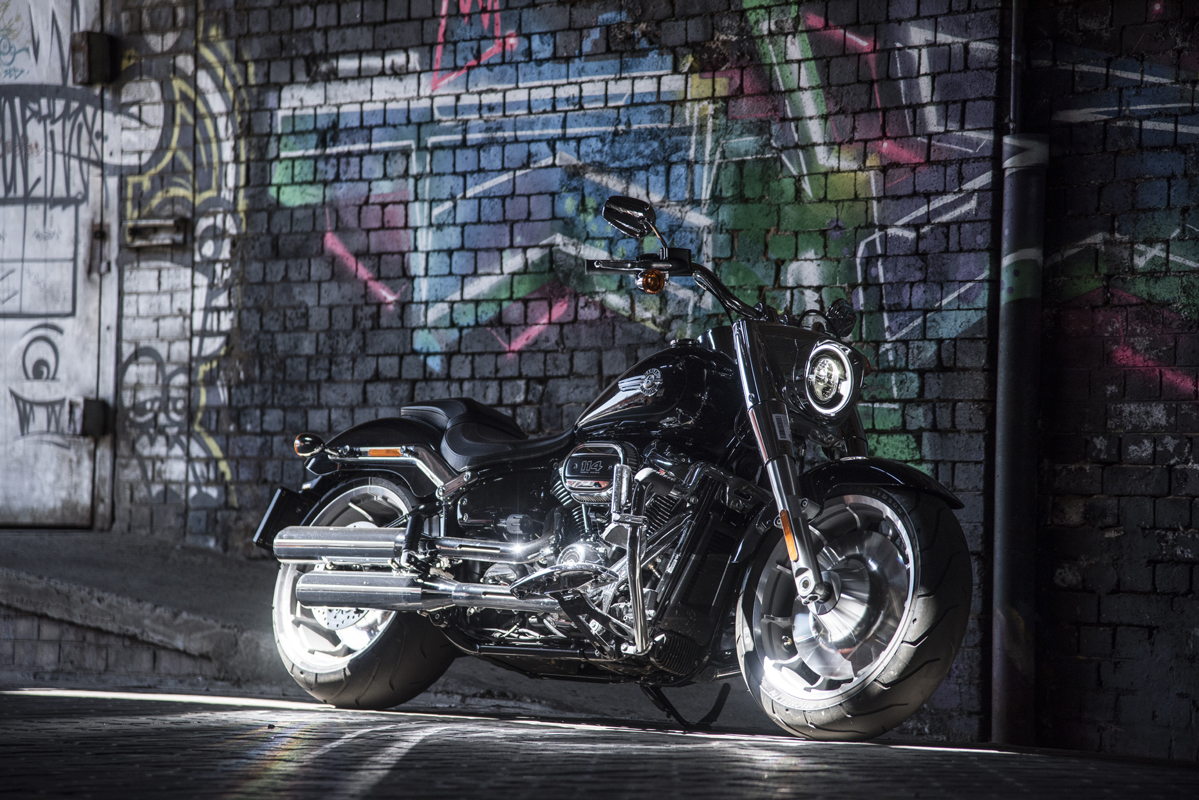
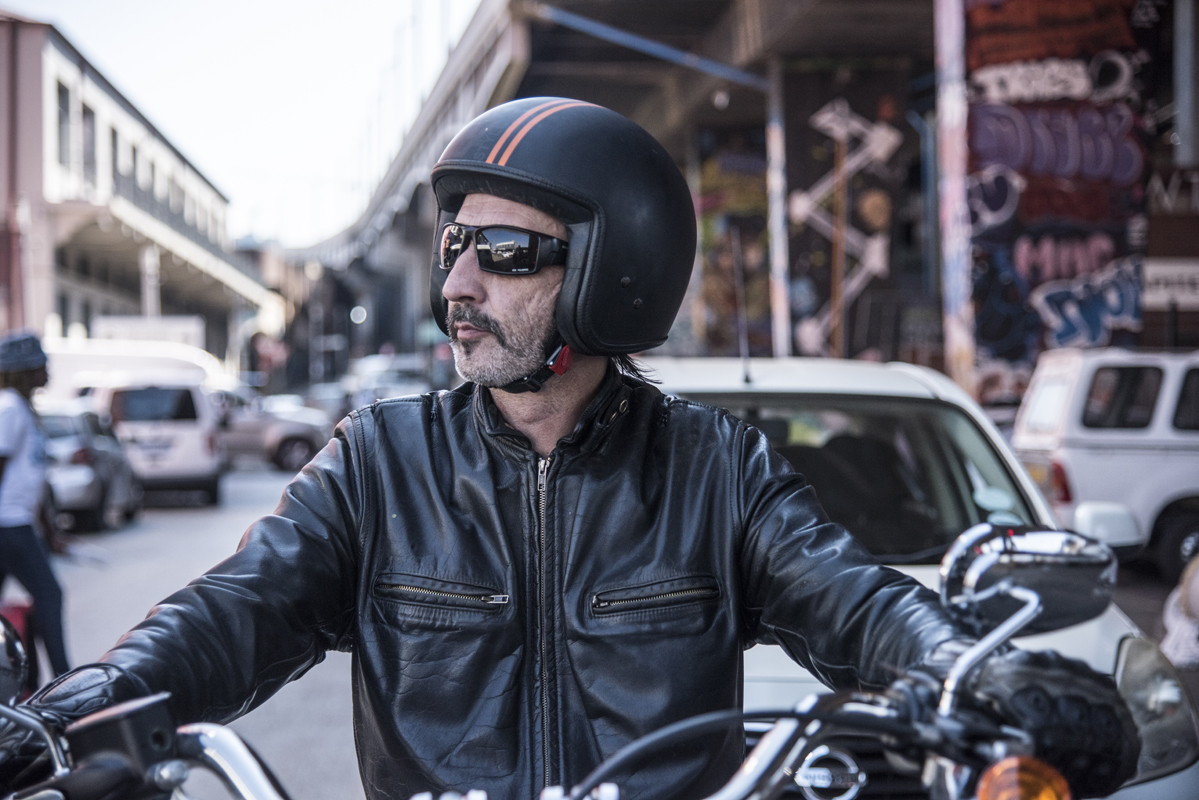
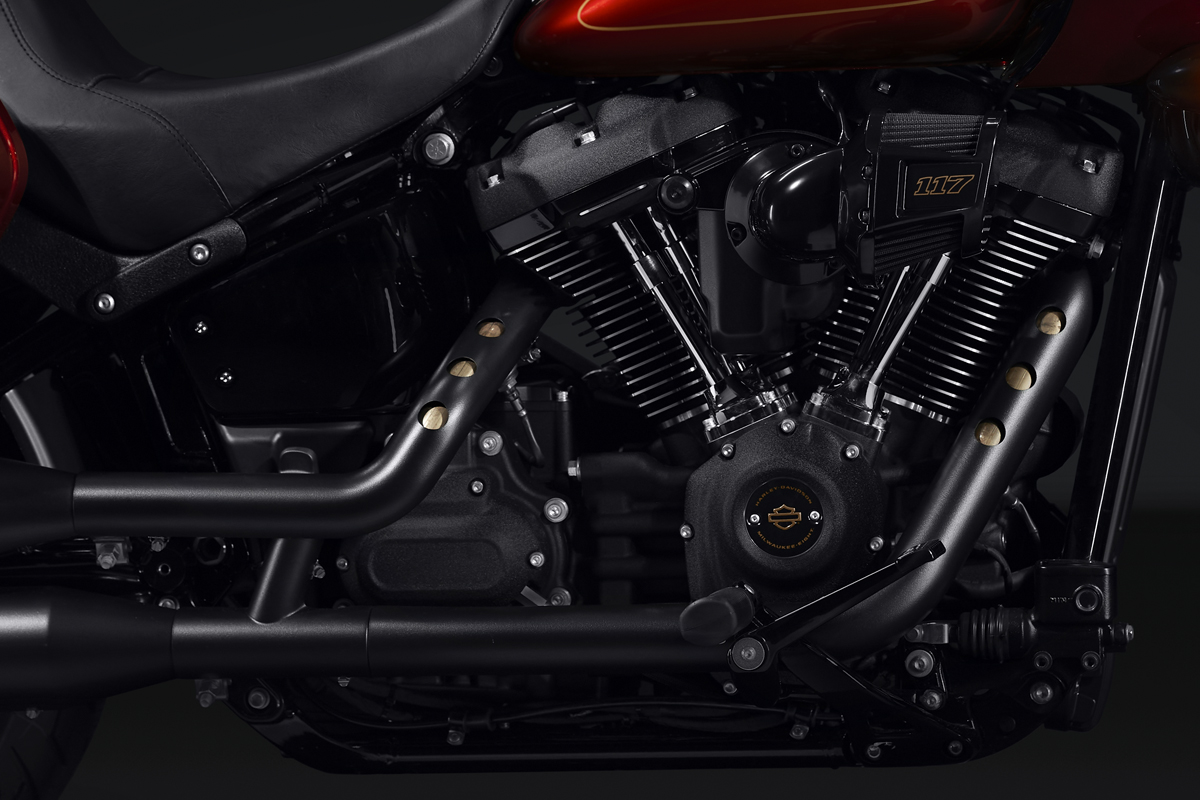
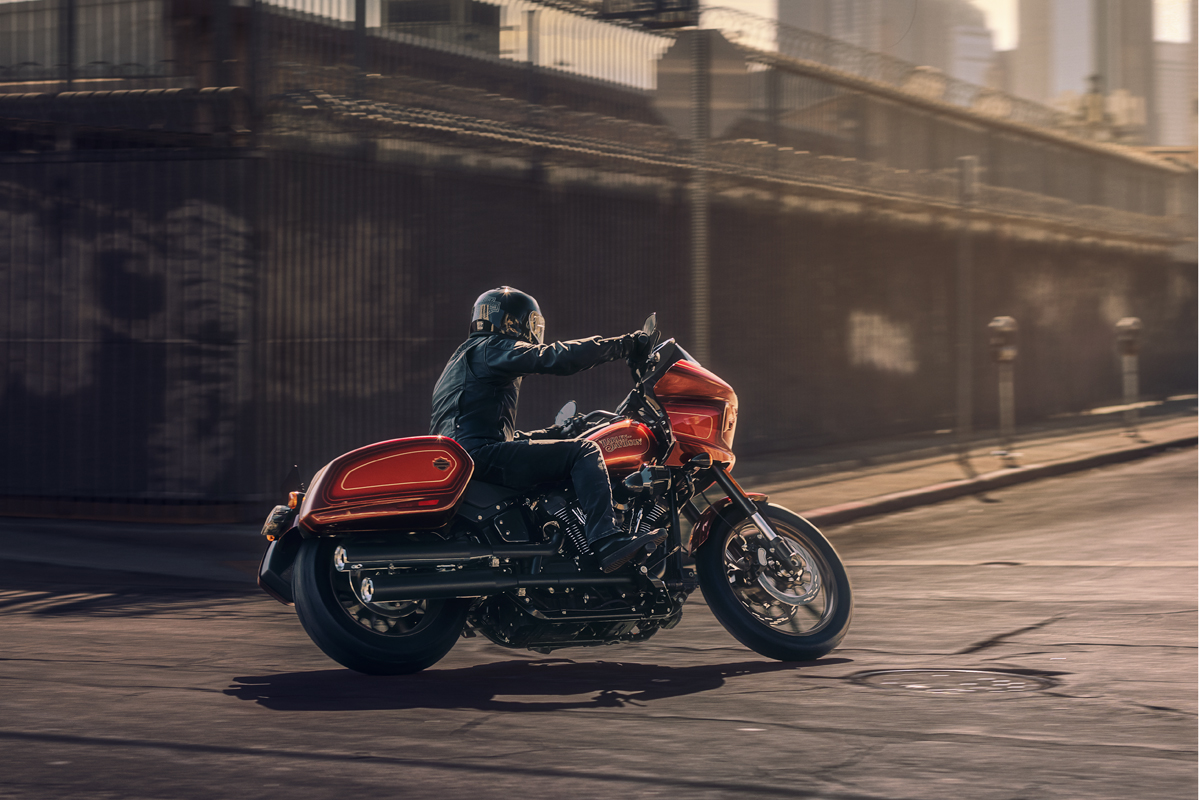
It seems daft to talk about a particular Harley-Davidson model as being iconic: Harley-Davidson itself is iconic and therefore, by extension, so are all the models.
Interestingly, it is not so much individual models that are iconic, but H-D engines: flat head, knucklehead, pan head, shovel head, and Evo are all names that are attached to different generations of Harleys. The individual model names never seem to gain any traction, or not nearly as much.
Photo credit: Bjorn Moreira / ZA Bikers
Of course, having written that last paragraph and sat thinking about it for a moment, I realise that I am (almost) completely wrong. Sportster, Road Glide, Electra Glide, and XR750 are all well-known model names so I’m kind of right and also kind of wrong. Oh, what the hell, it seems like a good way to start an article, so I’m going to stick with it.
If we are going to talk about individual iconic Harley models, then there is one that stands out head and shoulders above the rest, certainly from the last 30 years.
Photo credit: Bjorn Moreira / ZA Bikers
The model was shown in prototype form at the 1988 and 1989 Daytona Bike Weeks, went into production in 1990 and is still with us today. It is, of course, the Fat Boy.
You might think that Harley would be anxious to draw as little attention as possible to the size and weight of their motorcycles, but the Fat Boy name was a stroke of marketing genius: a sort of self-deprecating title that struck a chord with customers.
Photo credit: Bjorn Moreira / ZA Bikers
It has often been claimed that the name comes from the contraction of Fat Man and Little Boy – the names given to the two atomic bombs that were dropped on Japan by the U.S. at the end of the Second World War – as a sort of two-fingered salute to the Japanese motorcycle industry. It’s an interesting, if not a little xenophobic, idea but, thankfully, far from the truth.
“Fat Boy” actually comes from the observation that the motorcycle is rather wider than other bikes when viewed head-on. In a 2015 interview, Scott Miller, Harley-Davidson’s vice president of styling and product development, confirmed that the name was simply descriptive and had nothing to do with Harley’s Japanese competitors.
Photo credit: Bjorn Moreira / ZA Bikers
The Fat Boy was designed with a Softail frame. For those who might be in the dark as to what that means, it means a frame that looks as if it has a rigid rear end but, in fact, has a sprung swing arm with concealed springs.
Despite it being a Harley trademark, the Softail concept was originally designed in a garage in the 1970s by a mechanical engineer named Bill Davis and patented by him in 1976. Willie G. Davidson, the grandson of Harley-Davidson co-founder William A. Davidson originally turned down Bill Davis’ Softail concept, but the company later relented, buying the rights and designing its own Softail frame in-house.
Photo credit: Bjorn Moreira / ZA Bikers
The Fat Boy certainly looked like no other motorcycle on the market and would, in all likelihood, have been a success on its own. However, in 1991, in a marketing coup whose reverberations are still being felt today, it had a starring role in the biggest movie of the year, Terminator 2: Judgement Day.
No need to rehash what happened in the movie – you’ve all seen it – but it was unbelievably successful as a marketing boost for a new model. Overnight, the Fat Boy went from being yet another overblown Harley-Davidson model to a design icon in its own right.
Photo credit: Bjorn Moreira / ZA Bikers
Fast forward to 2018 and, as is the way with all motorcycle models, the Fat Boy was in line for a make-over and refresh. That’s not as easy as you might think: how do you improve your best-selling model without losing the essence of what made it sell so well in the first place and alienating your customer base?
Well, somehow, Harley managed it and, if I may offer my ten cents worth of personal opinion: it looks better than ever. In fact, I’d go so far as to say it is my favourite Harley-Davidson model of them all.
Photo credit: Bjorn Moreira / ZA Bikers
As ever, Harley-Davidson Mzansi was only too eager to lend us their demo Fat Boy for a few days and the only problem I could see was just that: it was only for a few days! The pressures of commerce come first, I know, but, oh boy, did I wish I wasn’t giving it back so soon!
It’s hard to explain if you’ve never ridden a Harley, the sense of occasion you feel when you are riding one. Riding any Harley is something completely different and special in motorcycling, but when it’s one that you really want to be on and to be seen on, it takes things to a whole new level.
Photo credit: Bjorn Moreira / ZA Bikers
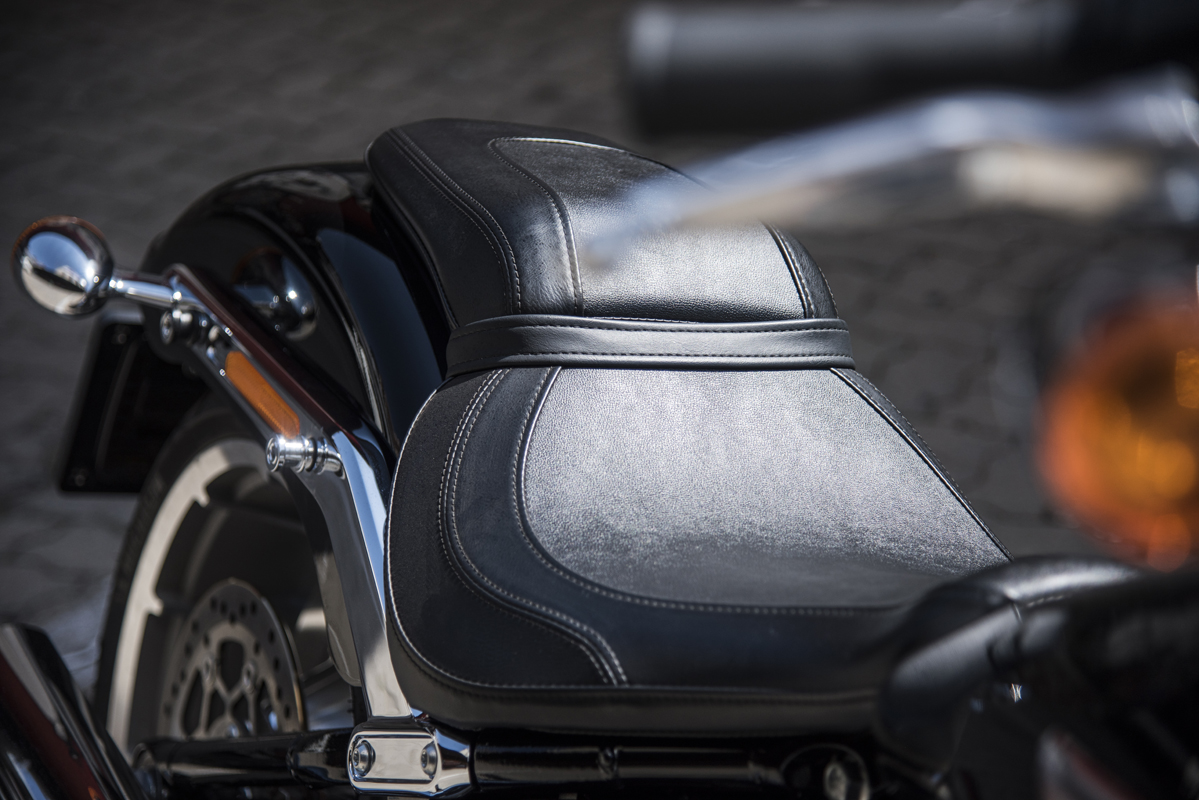
It’s not as if the Fat Boy rides better than any other Harley: it’s not as if it is faster or handles better than any other Harley. It’s certainly not because it makes you feel like you are Schwarzenegger (well, not all the time…) but there’s just something about it. Maybe it’s the riding position – sitting low, arms stretched out wide, pulling your shoulders and torso slightly forward, legs splayed and feet on the footboards – that just makes you feel as if you look badass!
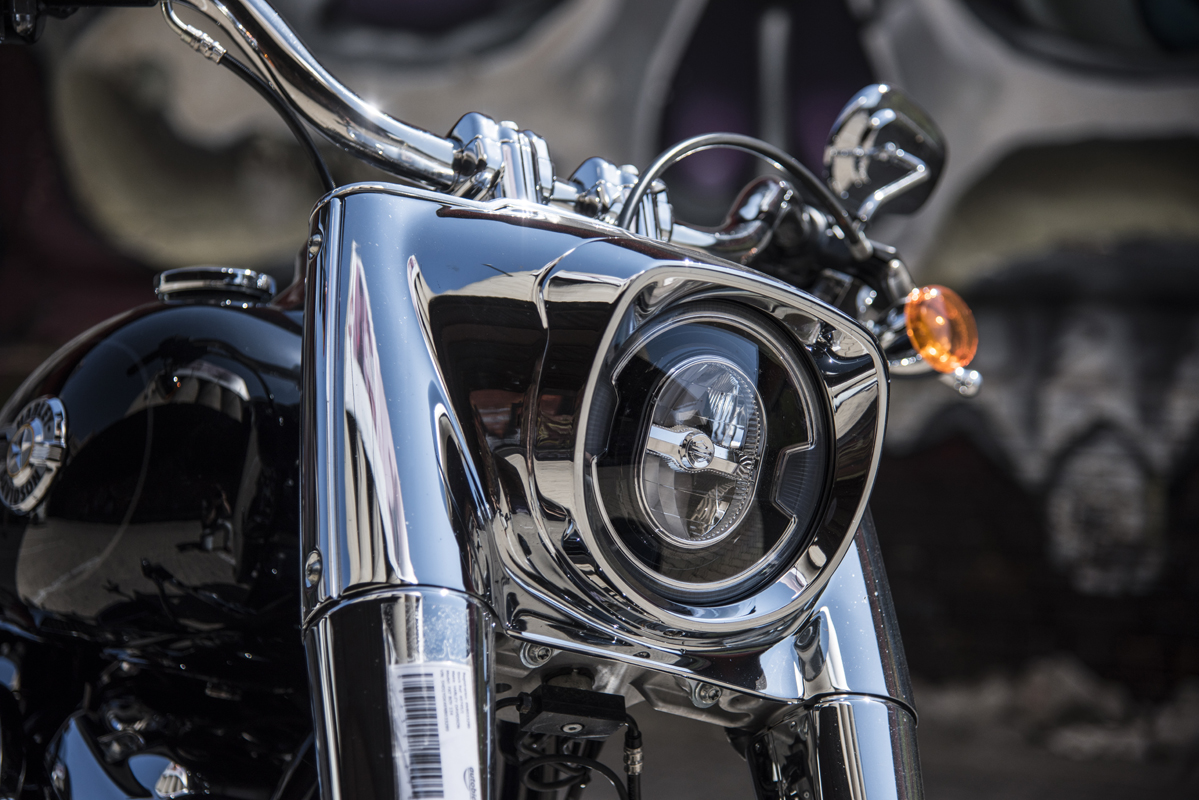
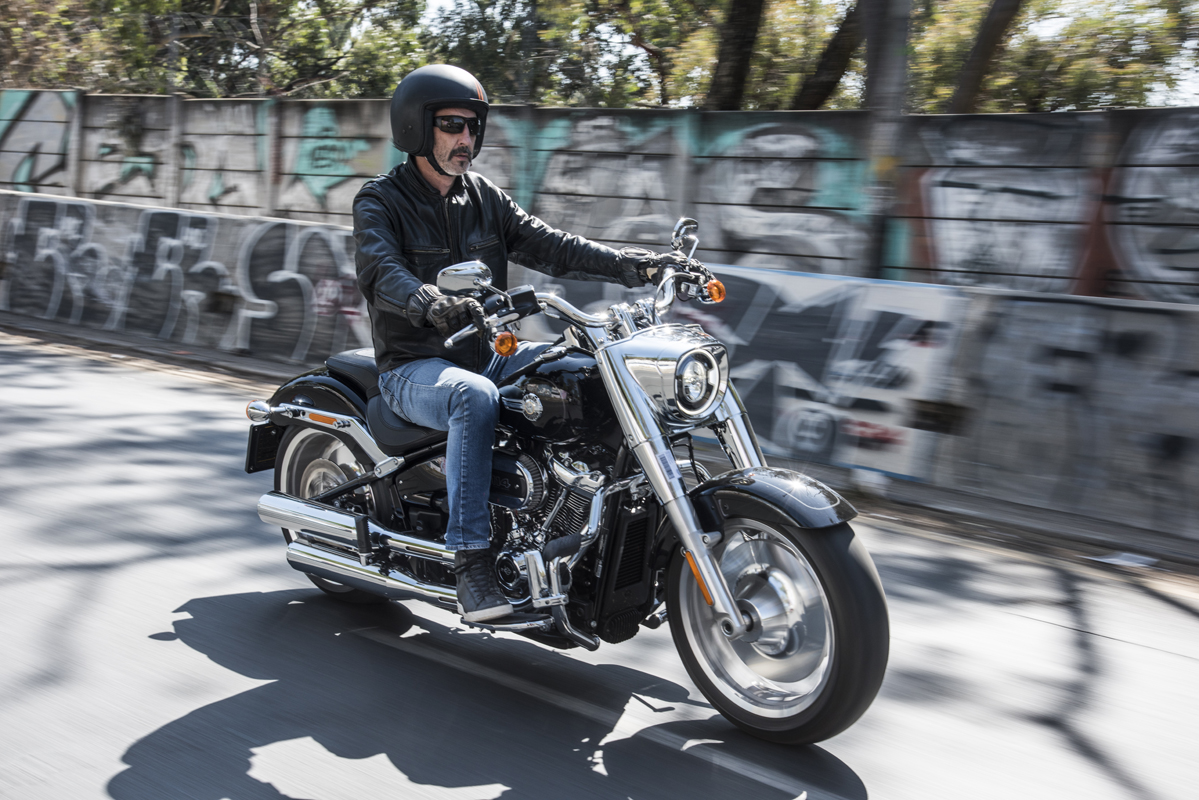
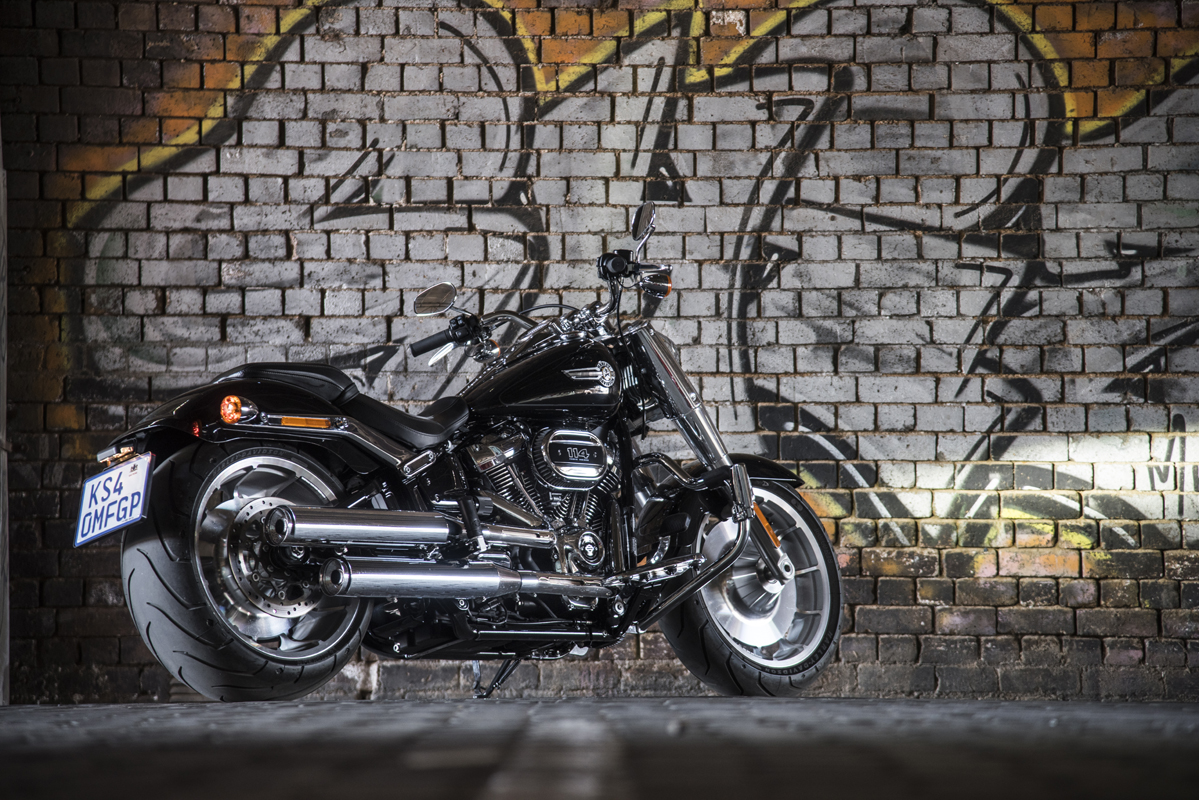
The 2022 Fat Boy is at once long, low and imposing but, somehow, has a delicacy of a line which keeps drawing the eye to it and, crucially, your eyes are never beaten into submission. It should, by all rights, be a brute of a bike but Harley has managed to make a big bike look like a big bike but not look ridiculous. Maybe it’s just all those years of practice?
Photo credit: Bjorn Moreira / ZA Bikers
As it comes off the showroom floor, the sound coming from the exhaust is, at first, a little disappointing: it is exceedingly muffled and low-key. After a while, however, I start to appreciate this unusual reticence for the Fat Boy to shout about itself. It does enough of that with its looks without having to resort to party tricks. Of course, I know I am in the minority and I will admit that there are many levels of decibels between stock and open-piped but I kind of like flying under the radar.
Also – and call me old if you wish – I rather like not being deafened after a long ride!
Photo credit: Bjorn Moreira / ZA Bikers
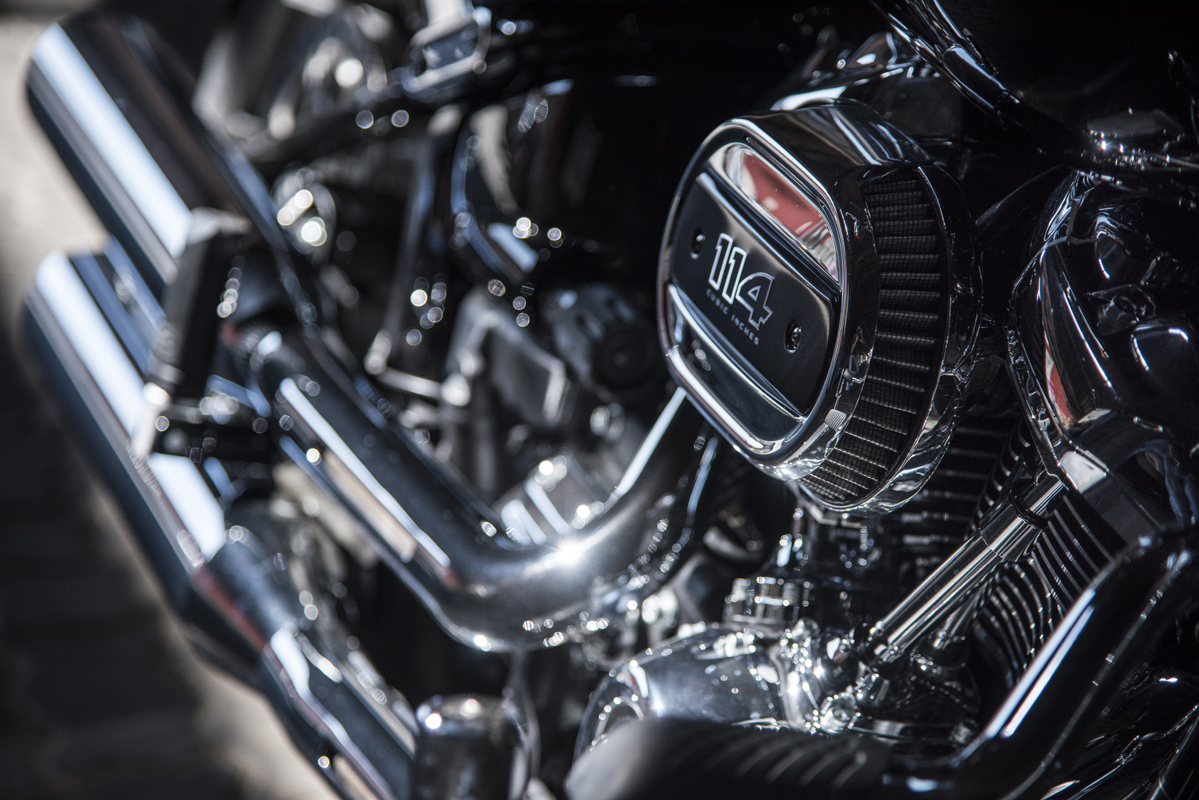
But that one mild and easily remedied criticism is all I have! I can’t think of anything that would prevent me from laying down a wad of cash and buying a Fat Boy. With the uncannily smooth 114 ci. Milwaukee Eight engine (the only option for the Fat Boy), goes like stink and, while the extremely wide rear tyre takes a while to get used to in low-speed cornering, it handles reassuringly well at any speed, the wide bars needing strong input which helps the bike feel all the more solid and planted for it.
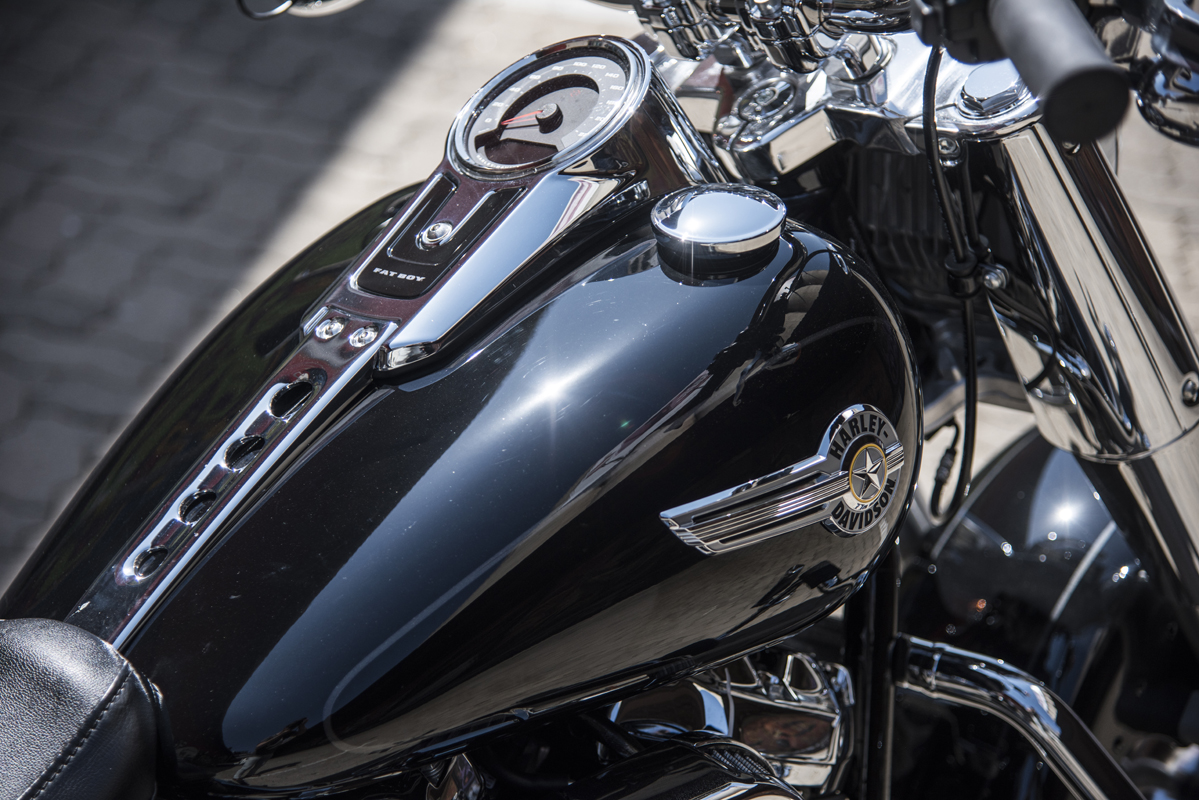
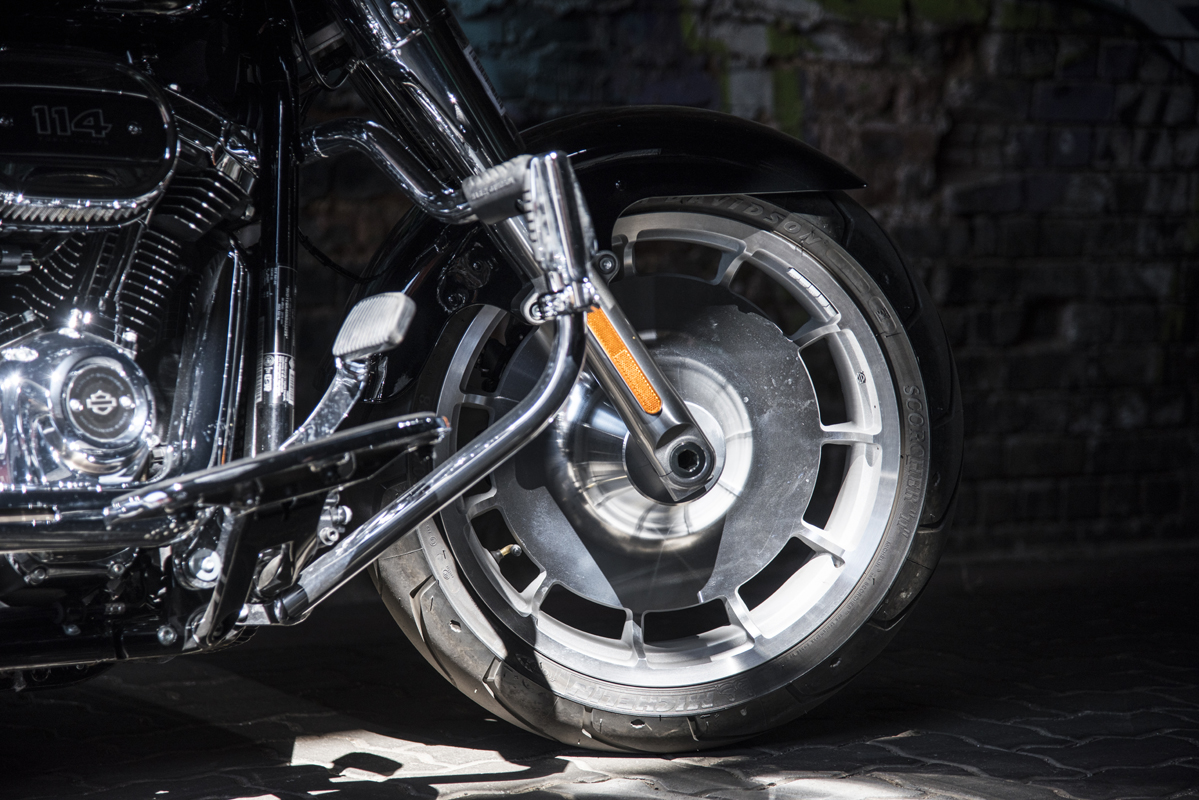
All Harleys are viewed as blank canvasses for customising and the Fat Boy is no exception but there is not a single thing I would change about the 2022 version: to me, it’s just about perfect as it stands. The wheels are no longer solid but have perforations around the edge of the central disc, to help in cross winds, but they are still those iconic (that word again!) solid, heavy-looking wheels, just beautifully updated, like the rest of the bike.
Photo credit: Bjorn Moreira / ZA Bikers
The paint and chrome are both deep and lustrous and it all just feels so right: even the agricultural and clunky gearbox is perfect for the nature of the riding experience.
For that, to return to a theme I touched on earlier, what riding the Fat Boy is; an experience, an occasion. Yes, it’s just a frame with an engine and a pair of wheels, as is every motorcycle but, just like a song which uses the same seven notes as every other song, it’s the way all the elements have been put together that has created something unique and special. I would even go so far as to say the Fat Boy is the best Harley-Davidson you can buy today.
Our thanks to Harley-Davidson Mzansi for the loan of the Fat Boy. Being their demo model, it is available for anyone with a full motorcycle license to try.
I recommend that you do!
Photo credit: Bjorn Moreira / ZA Bikers
Harley-Davidson Fat Boy
For more information on the bike featured in this article, click on the links below…
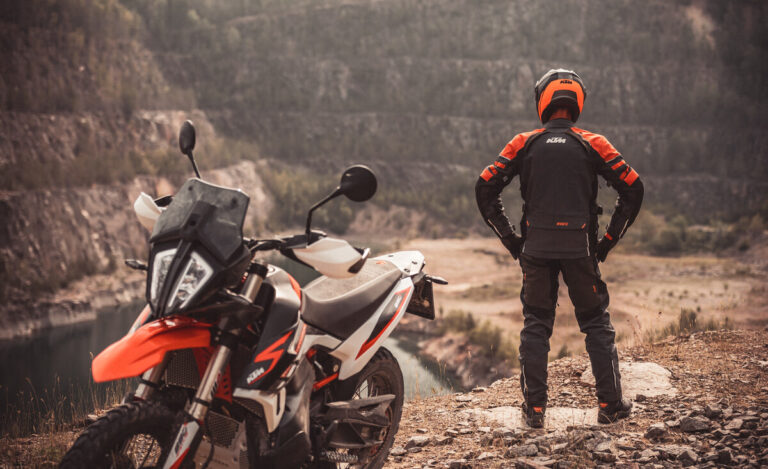
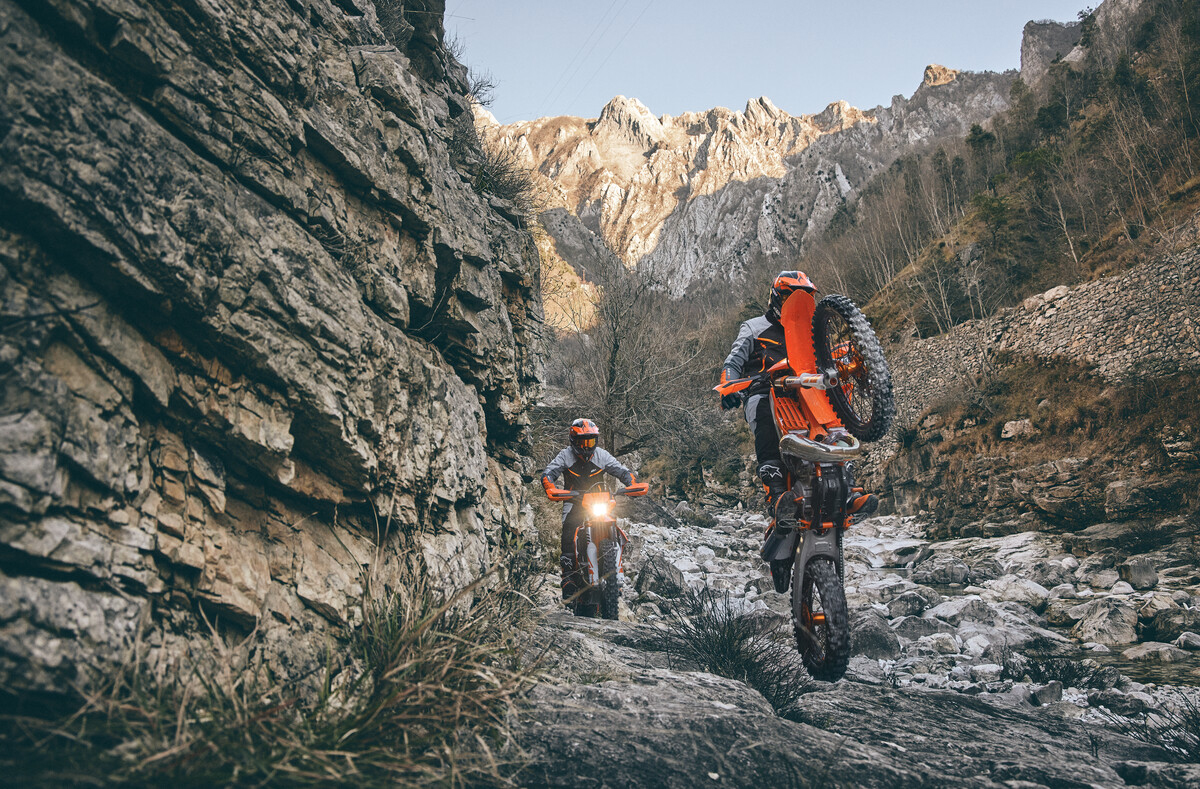
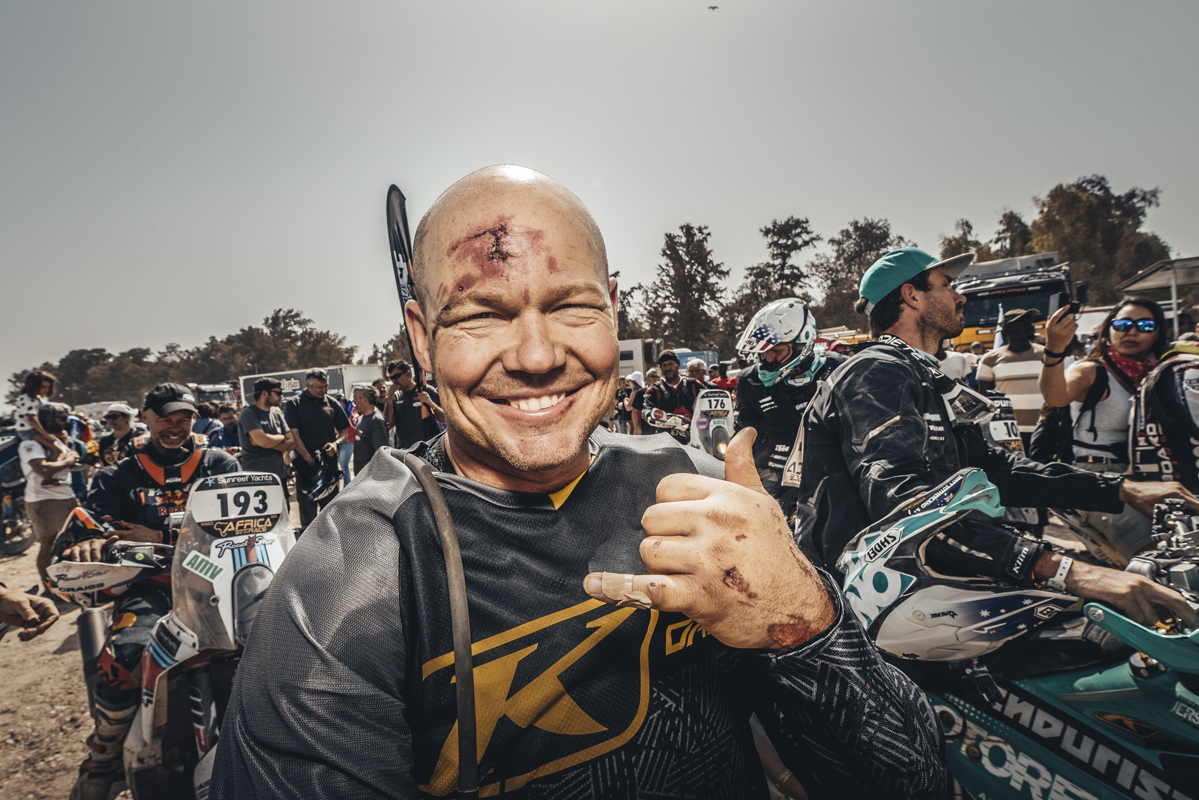
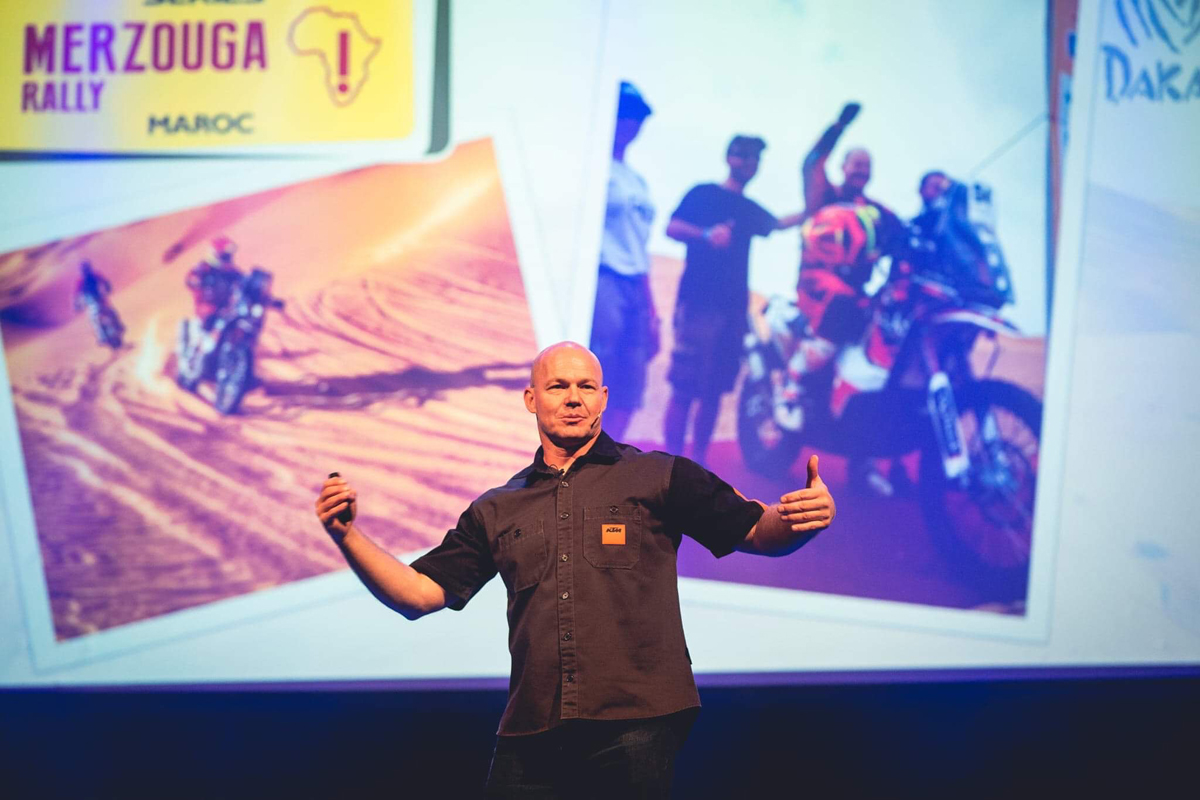
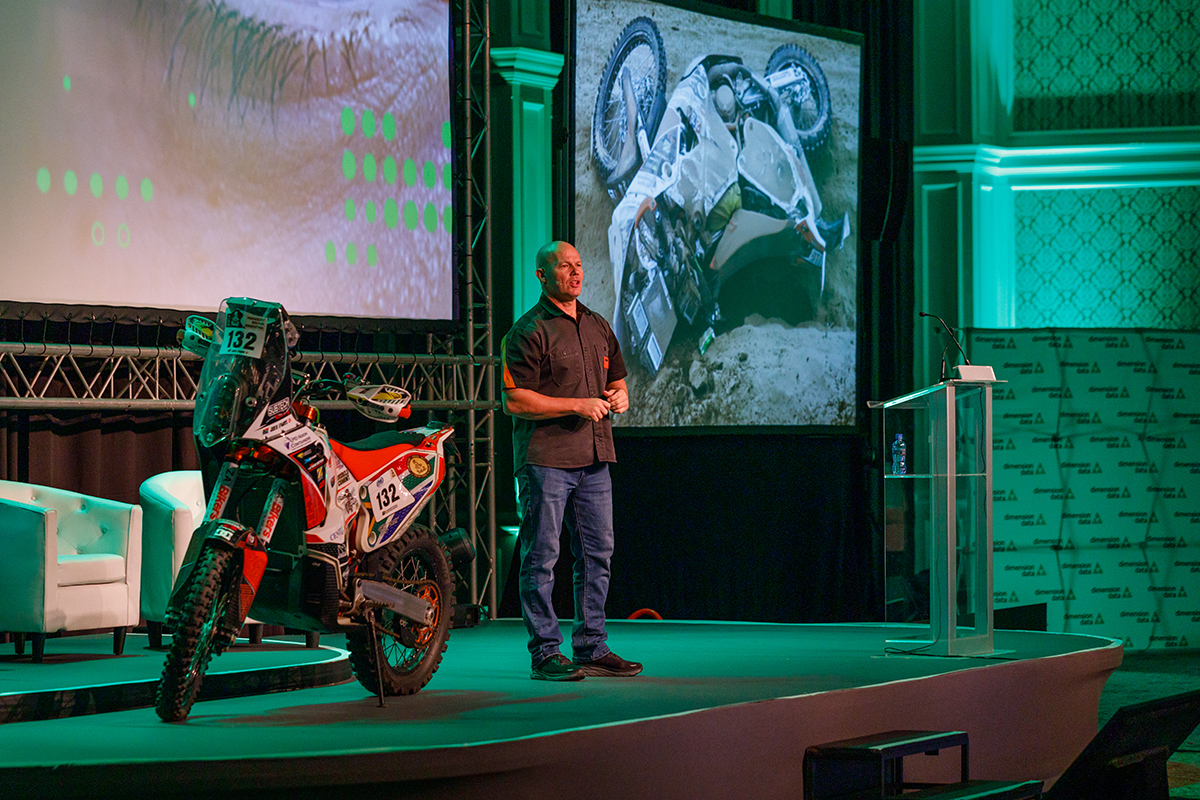
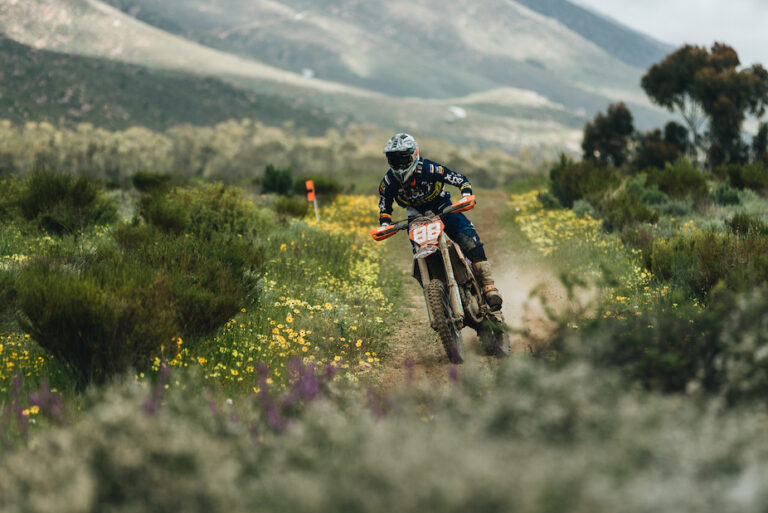
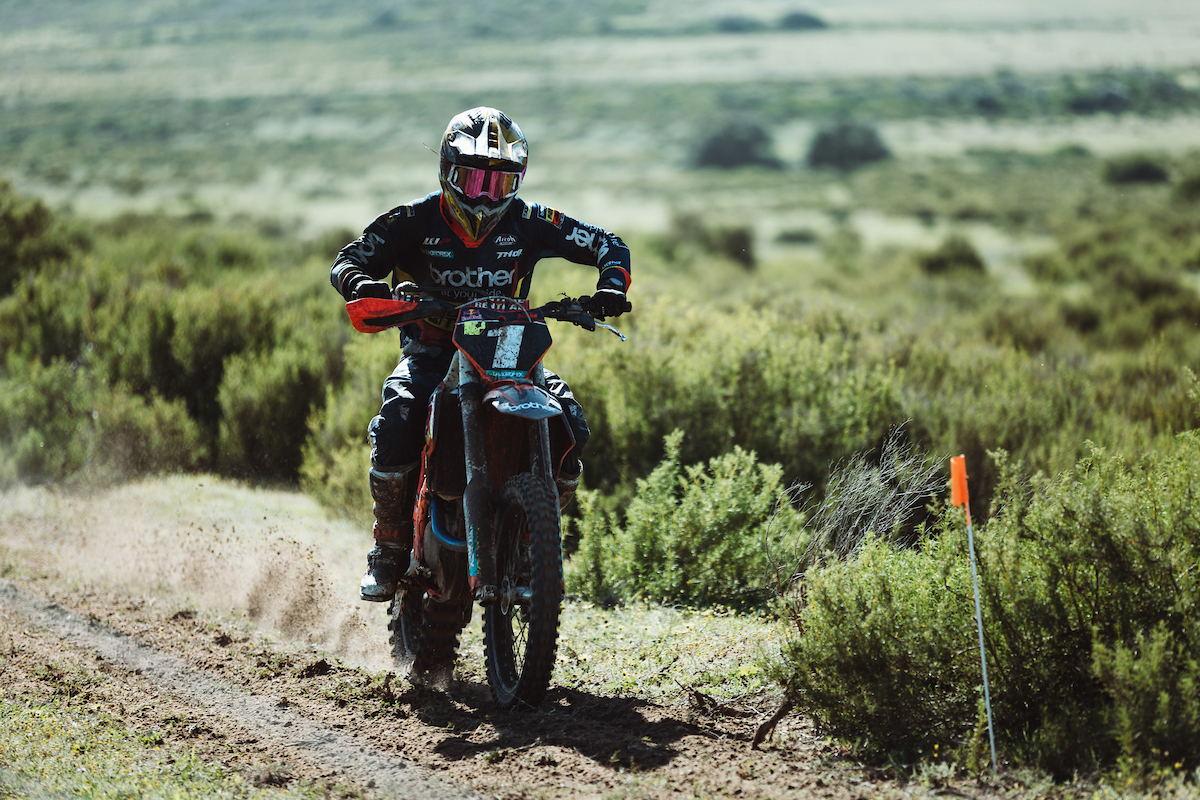
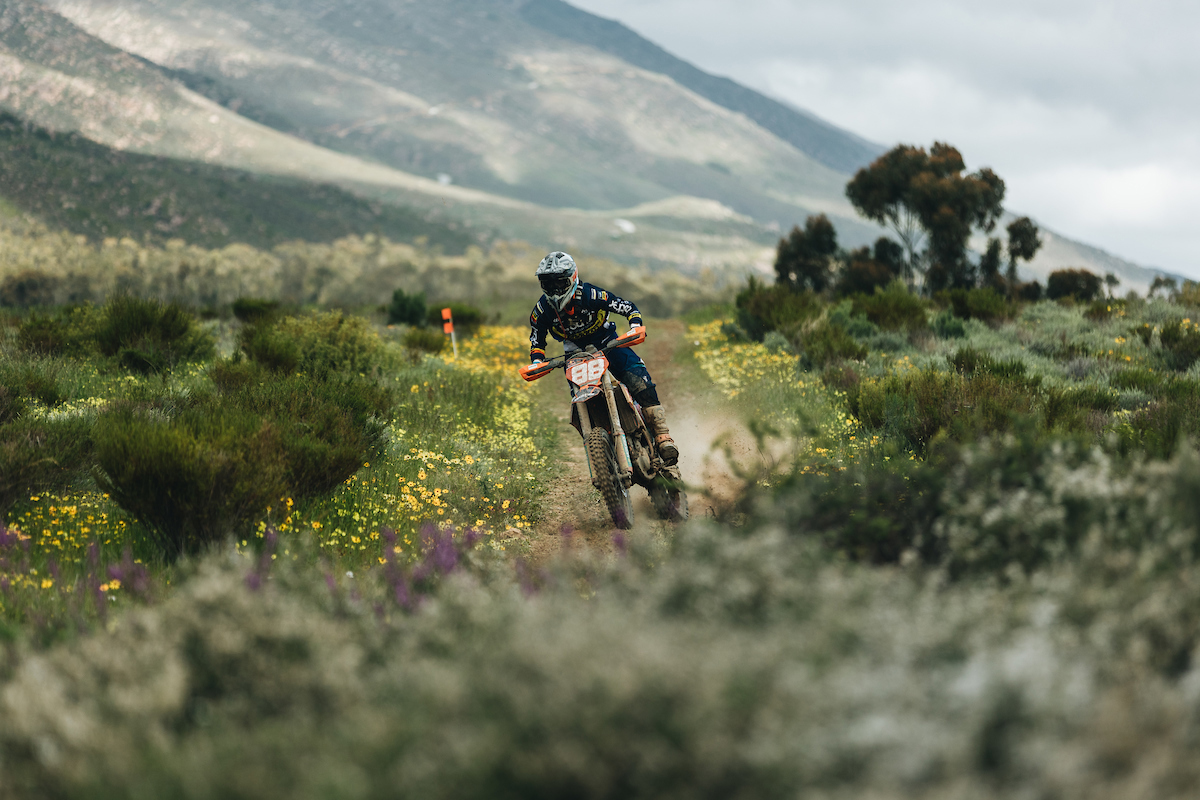
The Kingdom is calling! If you’ve ever dreamed of competing in the Roof Of Africa but have had to come to the conclusion that it’s probably never going to happen, how about the next best thing – following the race on your own KTM adventure bike, through the stunning scenery of Lesotho?
This year’s Roof takes place at the beginning of November and KTM South Africa is offering 50 KTM adventure bike owners the opportunity to be a part of this incredible event.
Image source: KTM
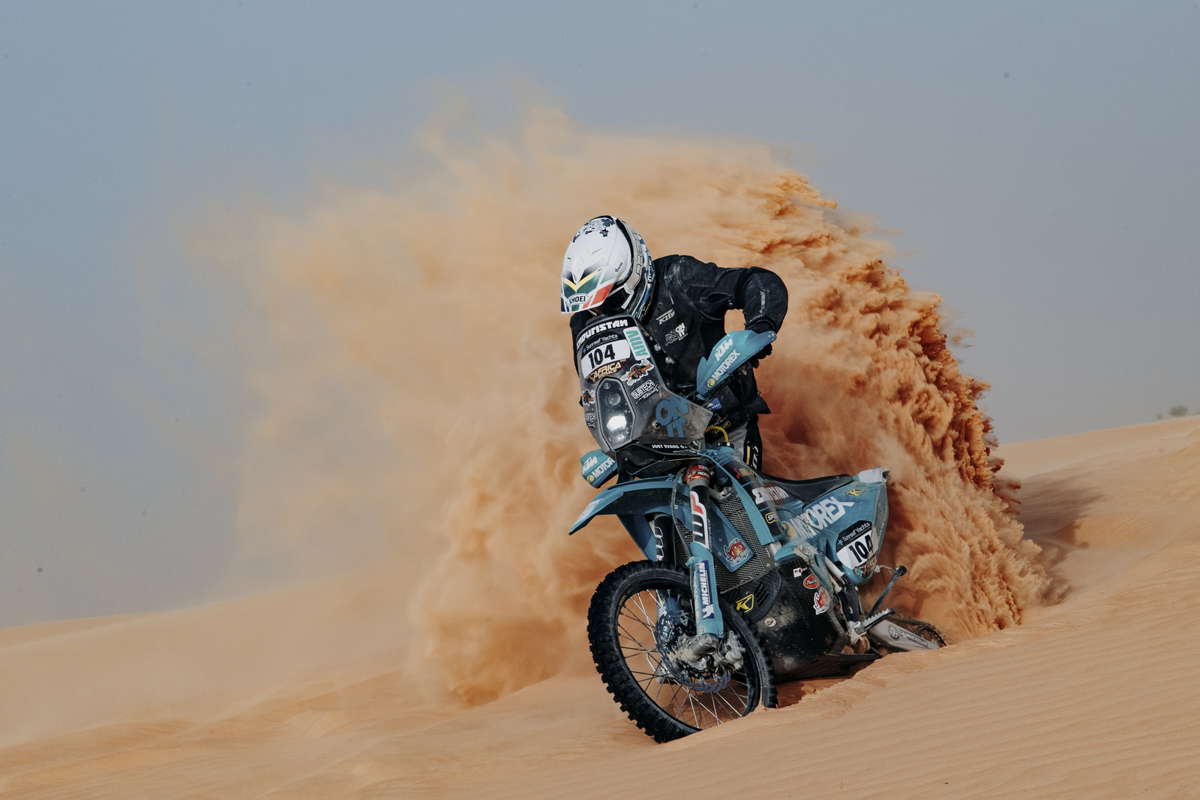
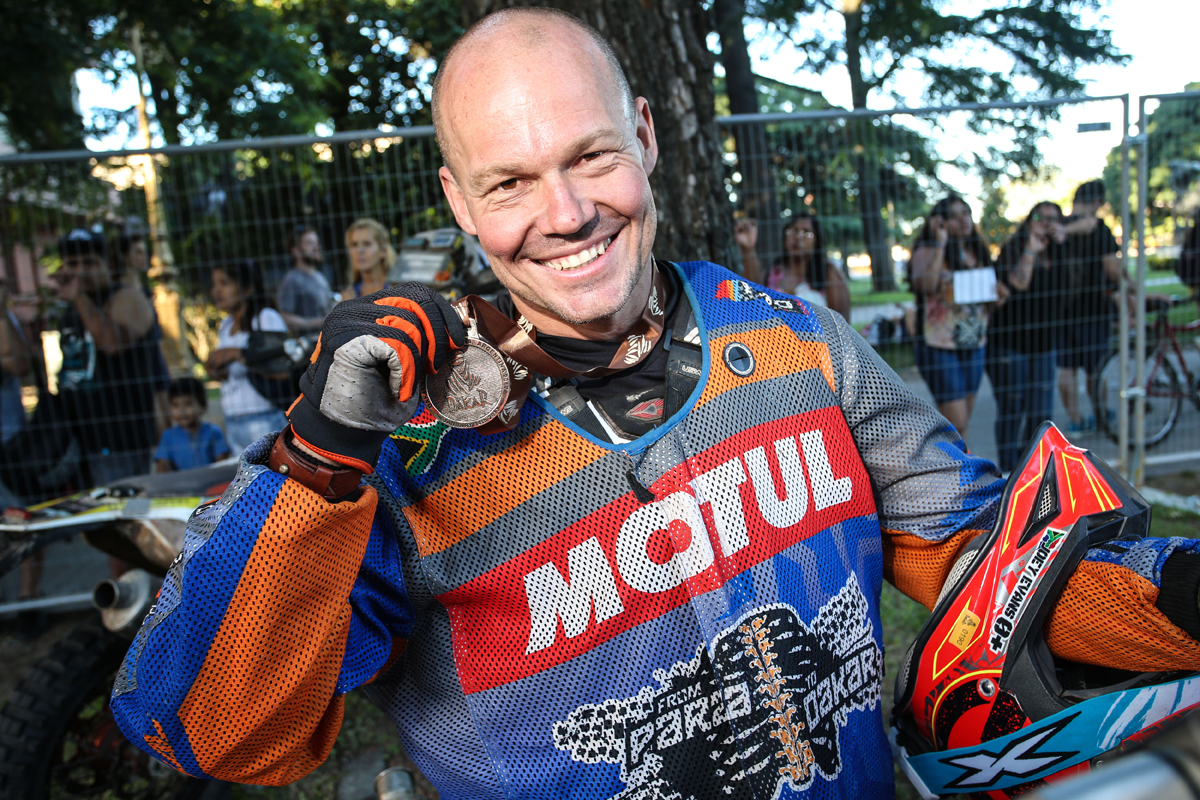
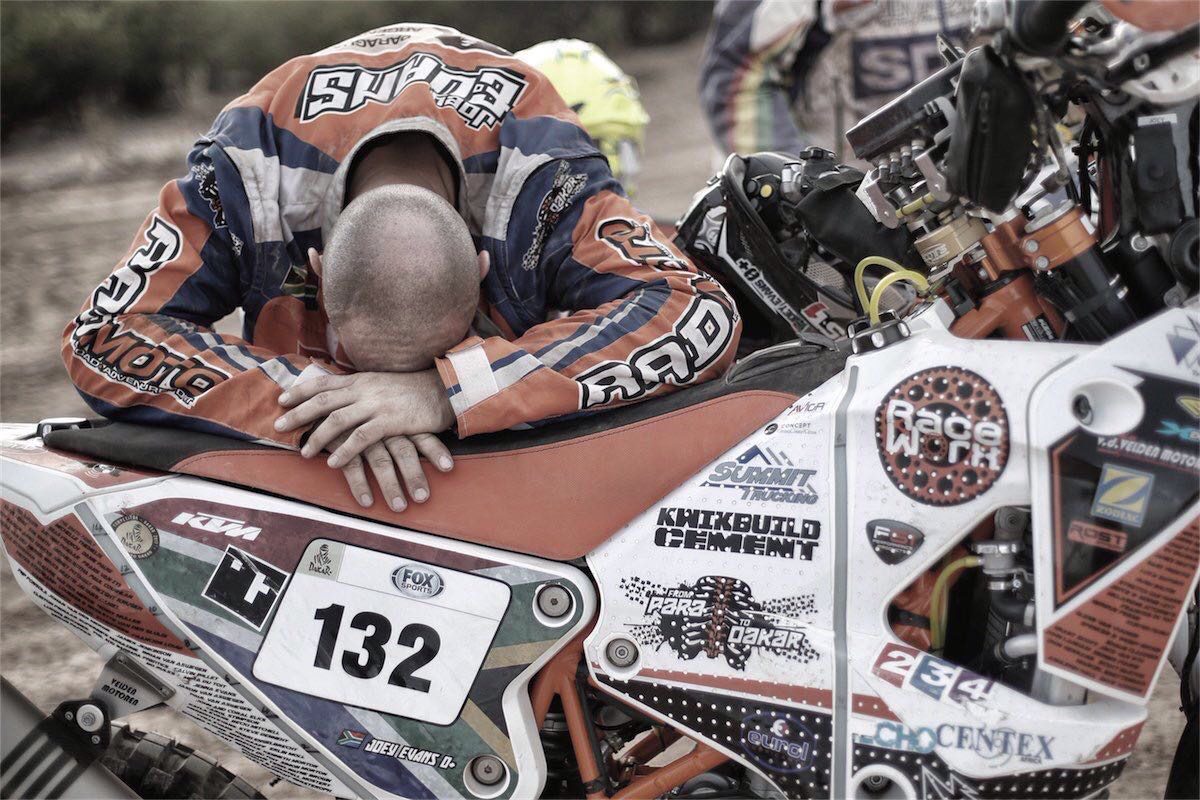
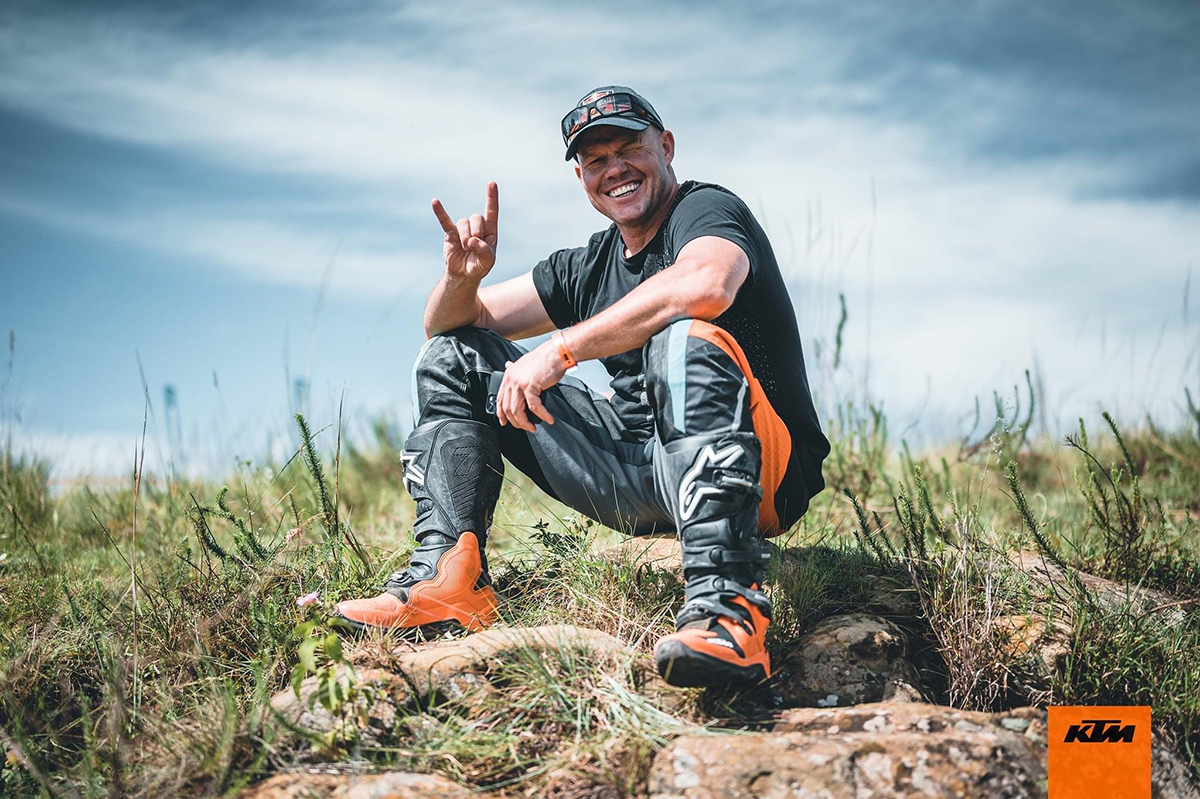
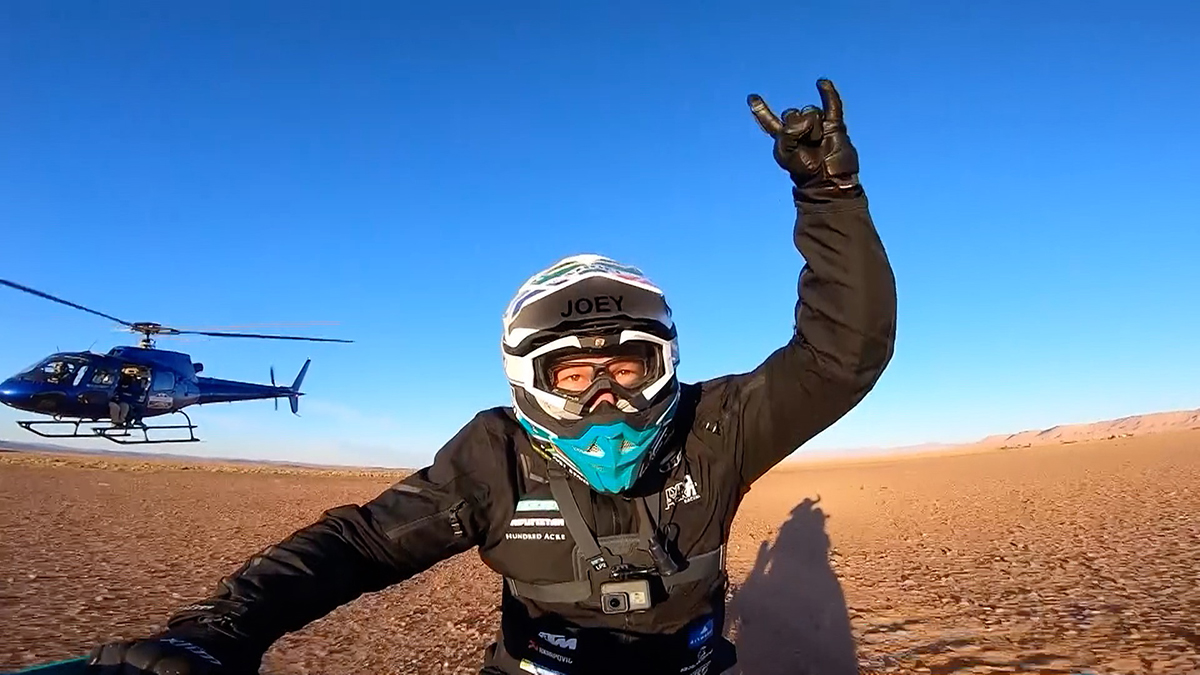
Those who wish to take part will have the opportunity to follow The Roof of Africa on their KTM Adventure bike, led by Joey Evans, hero of the Dakar Rally. Riders will each receive exclusive GPS coordinates to follow the race on routes which take in all the beauty that Lesotho has to offer. Hydration will be supplied en route at specific hydration points each day. Each rider will receive a small KTM gift pack, including a t-shirt etc, at registration. KTM will supply shade and seating at the “official” hydration points as well as start/finish.
The ride is open to those who consider themselves to be of an intermediate skill level and it is not suitable for pillions.
Image source: KTM
The schedule is as follows:
Wednesday 10th November:
Sign-up for The KTM Adventure ride will take place at the Avani Hotel alongside the registration for the Roof of Africa. Please ensure to bring your GPS along so the routes for all 3 days can be loaded. If you don’t have a GPS, please link up with a rider who does.
Thursday 11th November:
After watching around the house in the morning, there will be a short route for the riders to partake in starting and finishing at Bushmans. The route will take you past a few viewing opportunities of the time trial route. Stay at Bushamans to watch the Gold and Silver EnduroX race.
Friday 12th November:
The ride will start at Bushmans, half an hour after the first Gold rider sets off on the route and will be approximately 220 km in distance, following the race. There will be spectator points along the route including 2 official hydration stops. There will be a small snack supplied at the second stop. The ride will end at Bushmans giving the participants the opportunity to watch the finish of day 1.
Saturday 12th November:
The ride will start and end at Bushmans again, giving the riders an opportunity to follow the last day of the race and watch the spectacular finish of The Roof of Africa 2022. The ride on Saturday will be approximately 150KM and include 2 official stopping points where you can watch some of the more remote racing points. Hydration and a snack will be supplied along the route.
Image source: KTM
This is the opportunity of a lifetime to not only watch the world’s best riders in action but to also push yourself and your KTM to new limits.
For more information, contact your nearest KTM Dealer.
If you’ve ever dreamt of owning a brand new MV Agusta but don’t have a spare couple of hundred thousand Rand burning a hole in your pocket, a solution is now at hand.
MV Agusta South Africa has partnered with Wesbank to create affordable access to this exclusive brand. Every model of petrol and electric motorcycles and E-bicycles in the range is included and every finance agreement includes the following benefits:
No deposit
A service plan
Guaranteed future value
Attractive insurance offers
Image source: MV Agusta
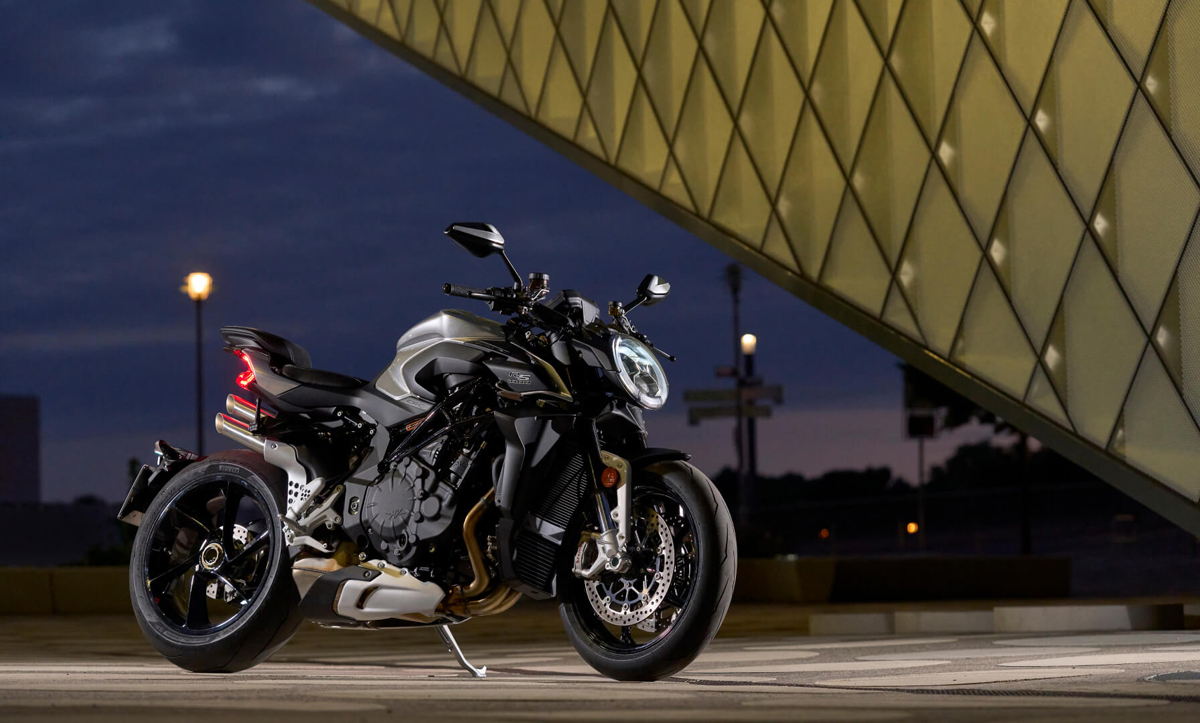
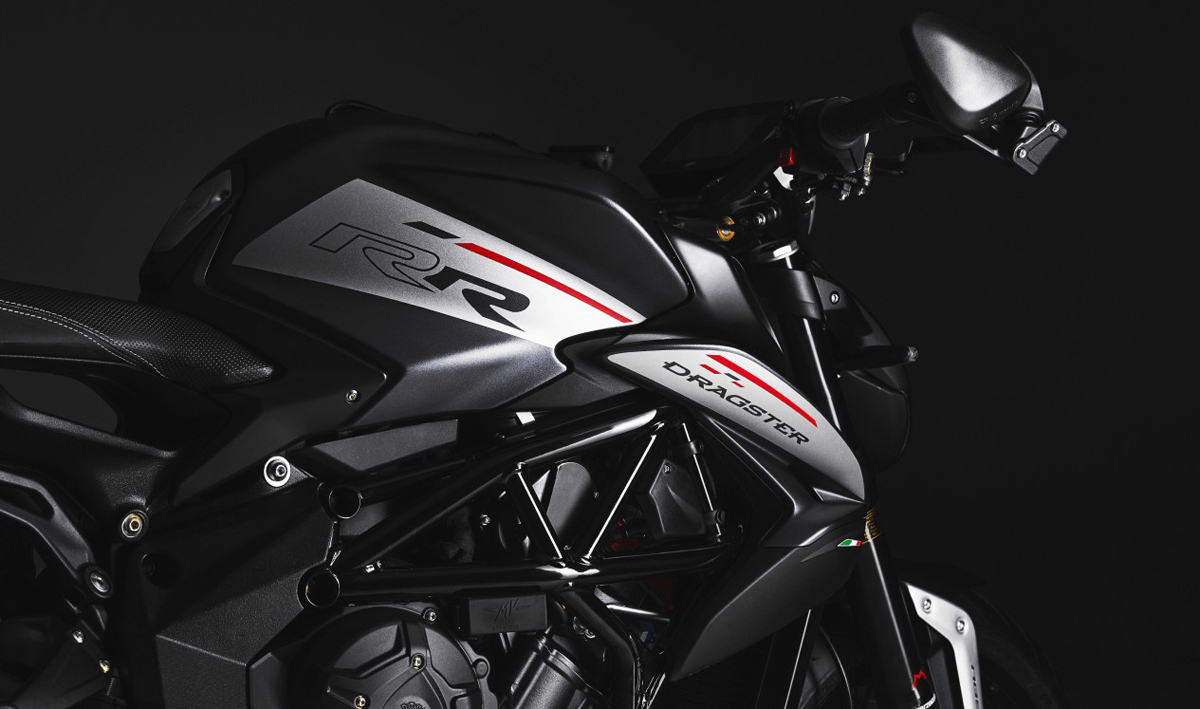
As an example, the beautiful 2022 Dragster 800 Rosso, 2022 F3 800 Rosso and 2022 Turismo Veloce Rosso can be yours from only R4300 pm, including no deposit, guaranteed future value and service plan! The new 2022 Dragster 800 RR SCS, F3 800 RR Carbon and the Turismo Veloce Lusso SCS only R5900 pm, also with no deposit.
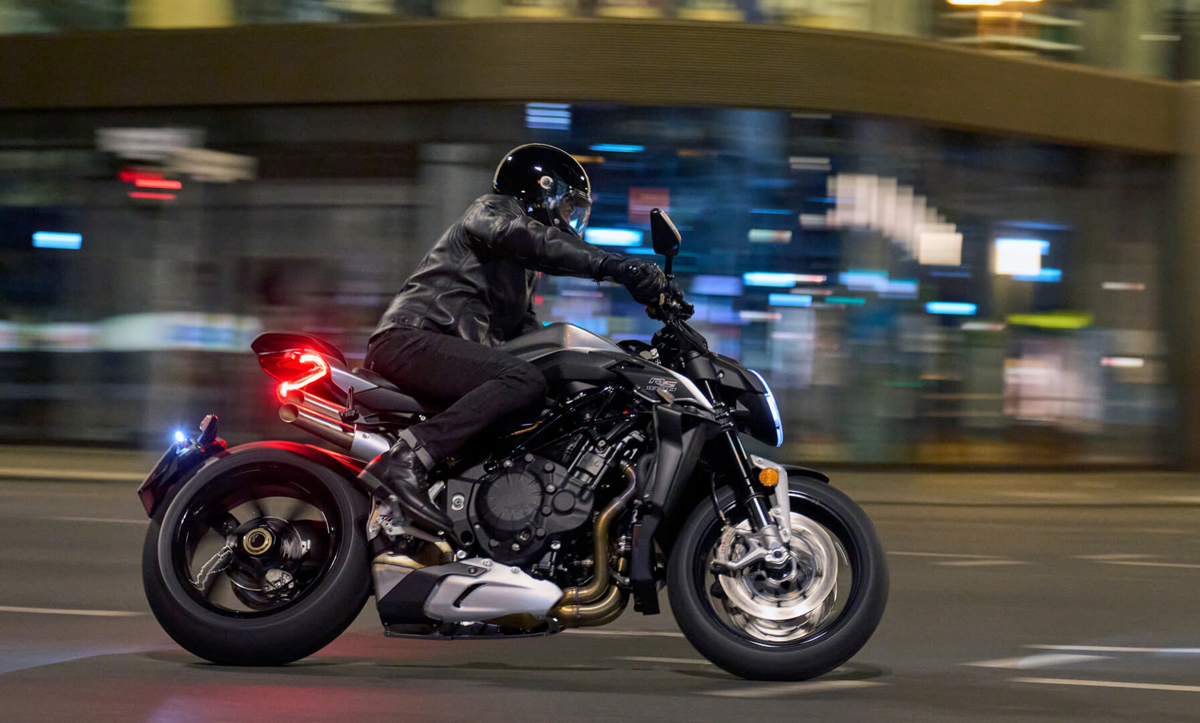
For the brutal Hyper Nakeds such as the Brutale 1000RS and 1000RR, both capable of over 310 km/h, are available from only R6999 pm with no deposit.
Image source: MV Agusta
For the E-Bike fans, the AMO RC and RR are available from only R2399 pm over 36 months with no deposit!
Now now, guys and girls, this is not that kind of website! I’m talking about something totally different. With the onset of the recent bout of unseasonably warm weather, it got me thinking.
Faired bikes are not that pleasant to ride in the heat of the day. All the engine heat seeps from under the fairing and conspires to slow-cook your nether regions. Similarly, the screen, such a boon in cold weather, becomes an obstacle to keeping you comfortable on the bike. Enter the naked bike.
Image source: Ducati
Strangely enough, the Europeans caught on to this ages ago. Perhaps it is because only in recent years have we experienced traffic volumes that are not conducive to riding fast most of the time, where a screen and fairing are a boon.
These days, especially if like me, you use your bike daily, you spend most of your time on the bike at low speeds negotiating traffic. It is in this situation that your bike becomes an unpleasant sauna. Something to be endured rather than enjoyed. Enter the naked bike.
Image source: Ducati
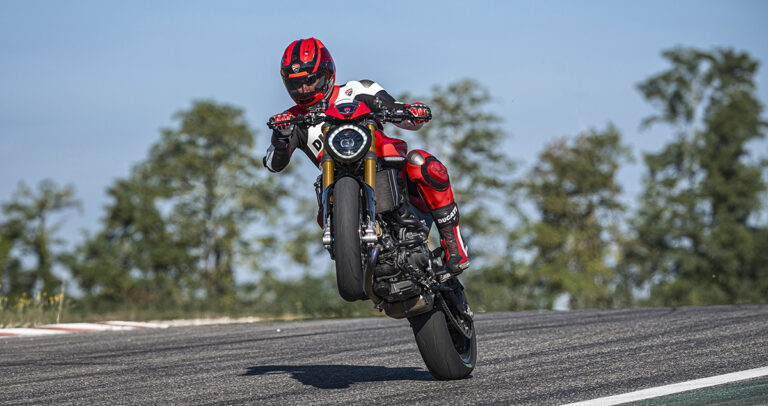
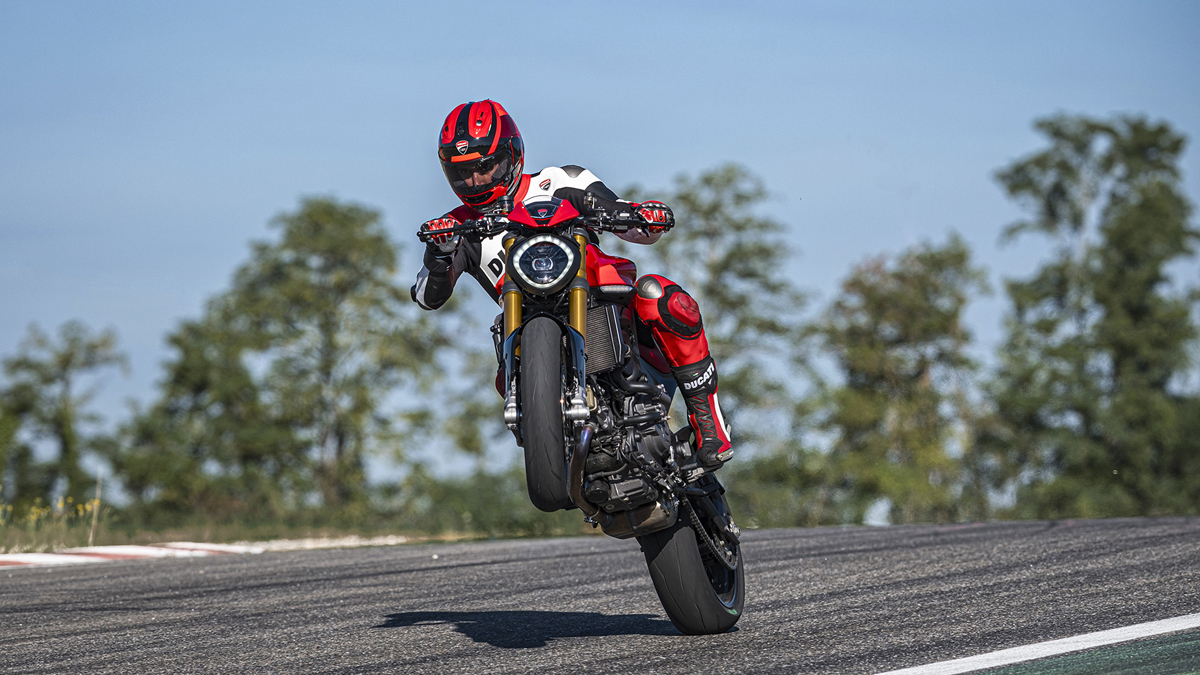
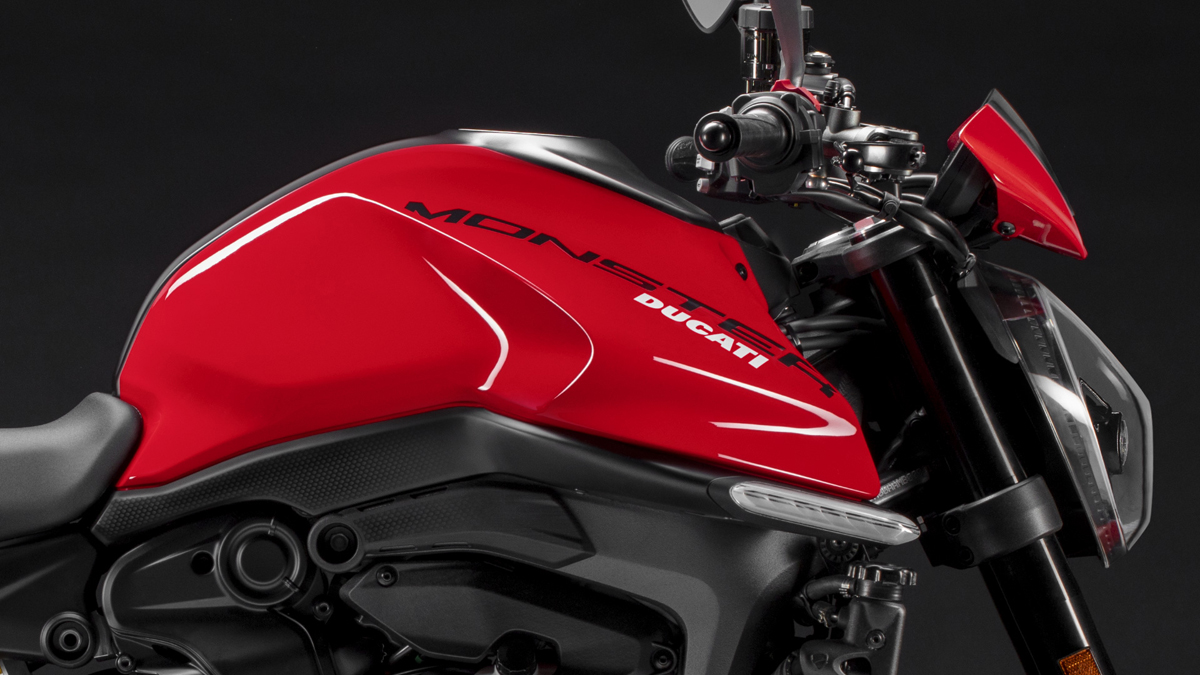
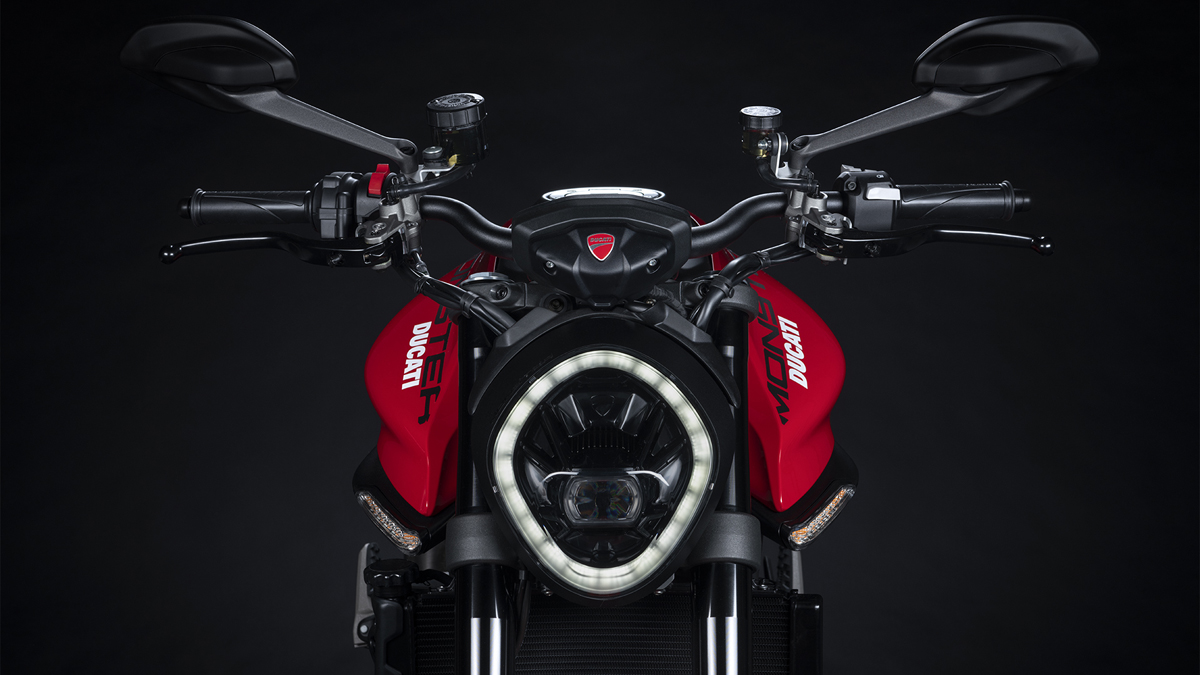
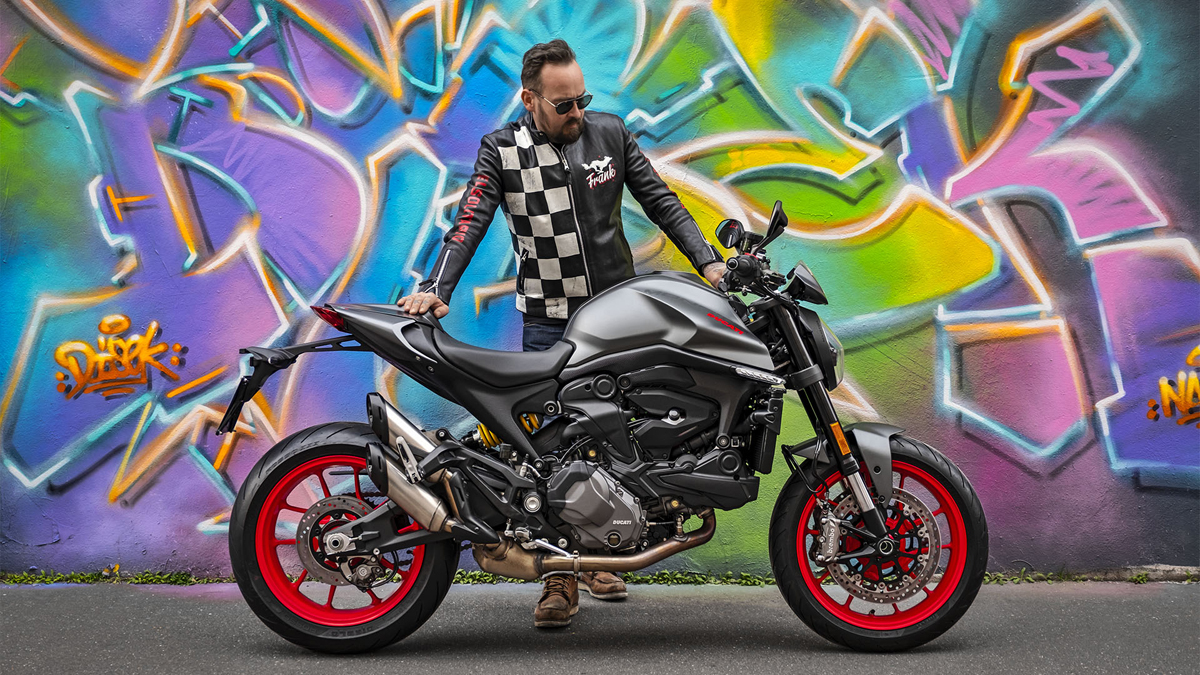
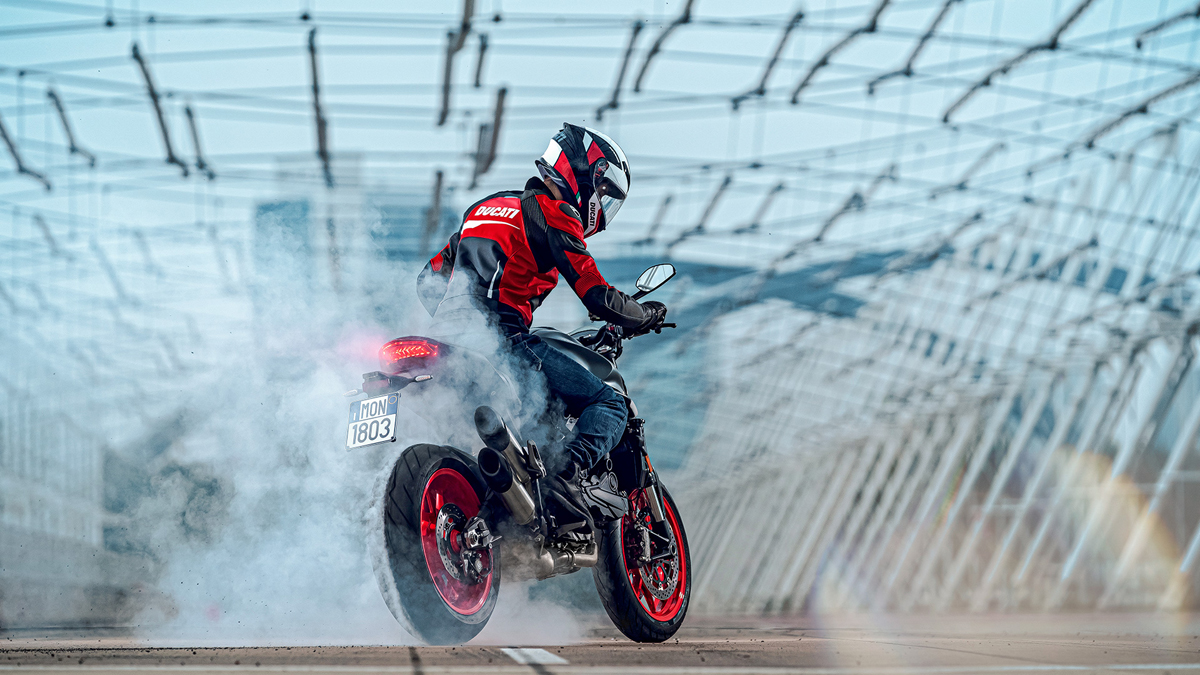
Ducati’s Monster is about as iconic as naked bikes can be. The Monster, introduced in 1993, has built up a cult following all over the world, and for good reason. Firstly, there is the Italian styling and flair that comes standard with every Ducati. Secondly, the Monster is an absolute fun-filled blast to ride! None more so than the latest version.
At its heart is the dependable 937cc, 84 Kw L-Twin Testastretta desmodromic motor (Desmodromic valve actuation is to Ducati what flat sixes are to Porsche). It is a fantastic motor for a naked with oodles of torque (more than 80%) available from as low as 3,000rpm. Rev it out and it rewards with a typical Desmodromic top-end hit. Bolt on a twin tailpipe Termignoni slip-on and get a symphony of sound going that only a V-Twin can offer. It makes the most beautiful music through a mountain pass…only Andrea Bocelli could come close!
Image source: Ducati
Ducati have managed to pare significant weight off the latest Monster by utilising an aluminium frame and high-tech composite sub-frame. Whilst retaining the required rigidity of the old trellis frame, it has reduced the frame weight by a whopping 6,4 kg. The whole bike is a feathery 167 kg. You feel this as soon as you lift it off the side stand and especially when you are winding it through the twisties.
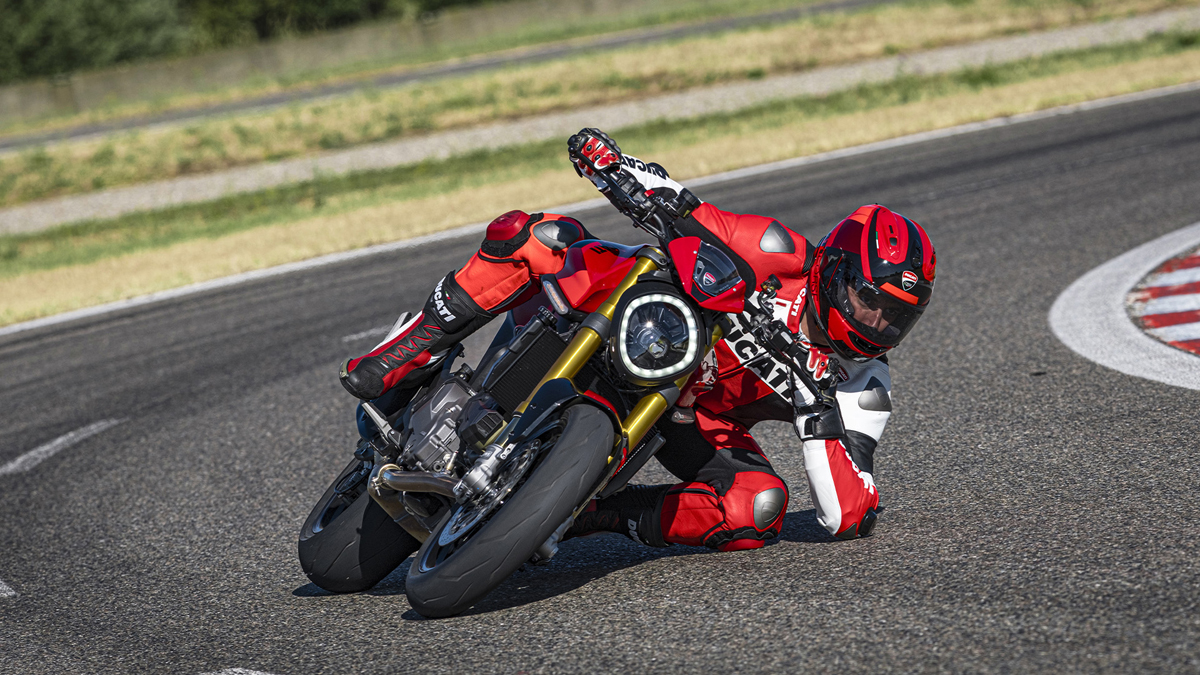
All variants of the Monster handle superbly, with their 43mm upside-down forks and mono-shocks. You even have the option, if you are a well-heeled connoisseur, of shelling for the top-of-the-range SP model, which is Ohlins equipped.
Taller bars and lower pegs have made the rider even more comfortable without compromising ground clearance. The wheels are also almost 2 kg lighter, making the lean-sensitive ABS Brembo brakes even more effective. The seat height is modest at around 820 mm and 840 mm on the SP. A lowering kit can be purchased to drop the seat height to 795 mm, making the Monster accessible to damn near everybody. A bi-directional quick-shifter mated to a six-speed box, enhances the riding fun even more.
In summary, there is an almost undefinable something that is built into a Ducati that makes these bikes special. A kind of unique Italian exotica which looks so undeniably cool outside your favourite coffee shop or eatery.
Image source: Ducati
Stick on your open face and Carrera’s and go for a cruise. Alternatively, pull on your leathers and go and bait sportbikes on your favourite stretch of twisty road. The Monster will always be a willing companion. So, if you are getting a bit hot under the collar, (or a bit further south) on your crotch rocket, maybe you should add an Italian hottie of the Monster variety to your stable.
Image source: Ducati
Ducati Monster Range
For more information on the bikes featured in this article, click on the links below…
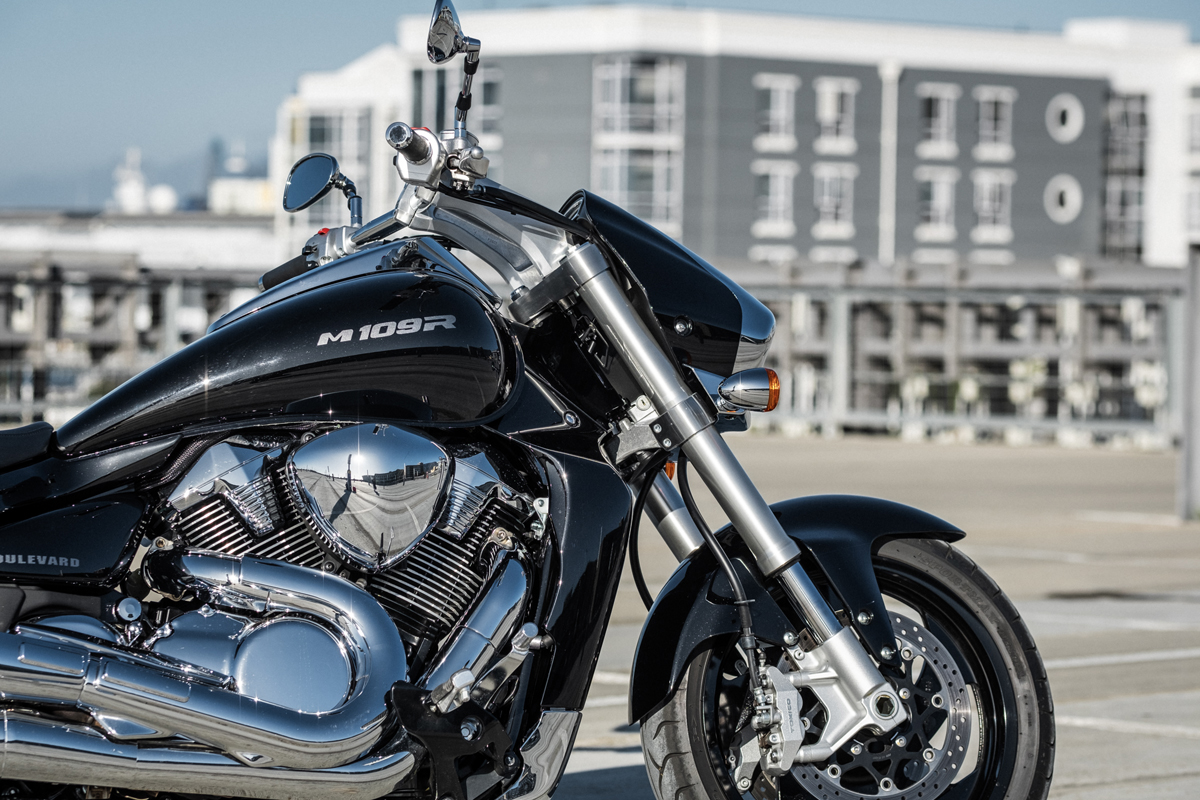
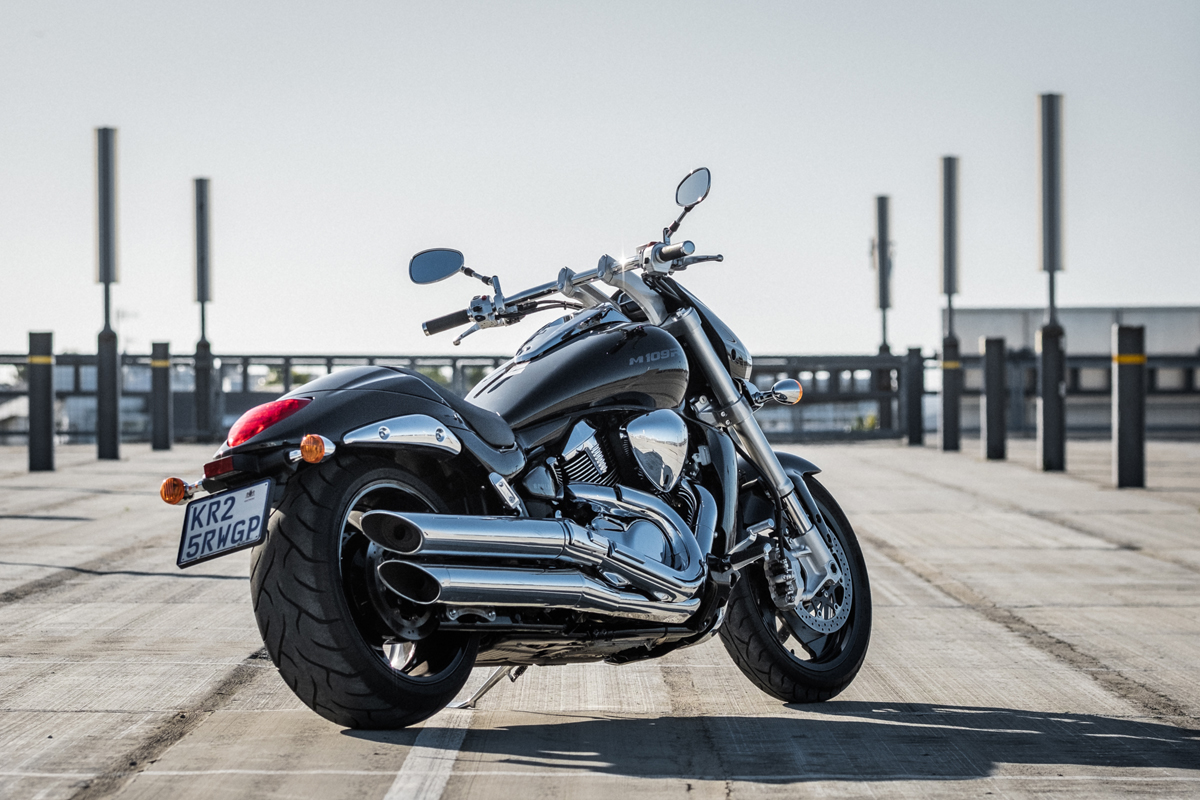
Within ten minutes of riding the Suzuki Boulevard M109R, I have it all figured out. At least I think I do. Another ten minutes in, and I’m scratching my head, furiously drawing up a mental pros and cons list without the vaguest idea of where it’s going to land.
It must be a Boulevard thing. At least, that’s what I suspect lifelong fans of Suzuki’s monster cruiser will probably tell me; you either get it, or you don’t.
Photo credit: Wes Reyneke
Because when you think about it, the Boulevard really is to cruisers what the Hayabusa is to sportbikes. You either had a poster of it on your wall as a kid, or you think it’s butt-ugly and goofy. There’s a rare middle ground where maybe you don’t quite get it, but you get why some people love it so much.
Spend enough time with the Boulevard and its cult status, as niche as it is, starts to make sense.
Photo credit: Wes Reyneke
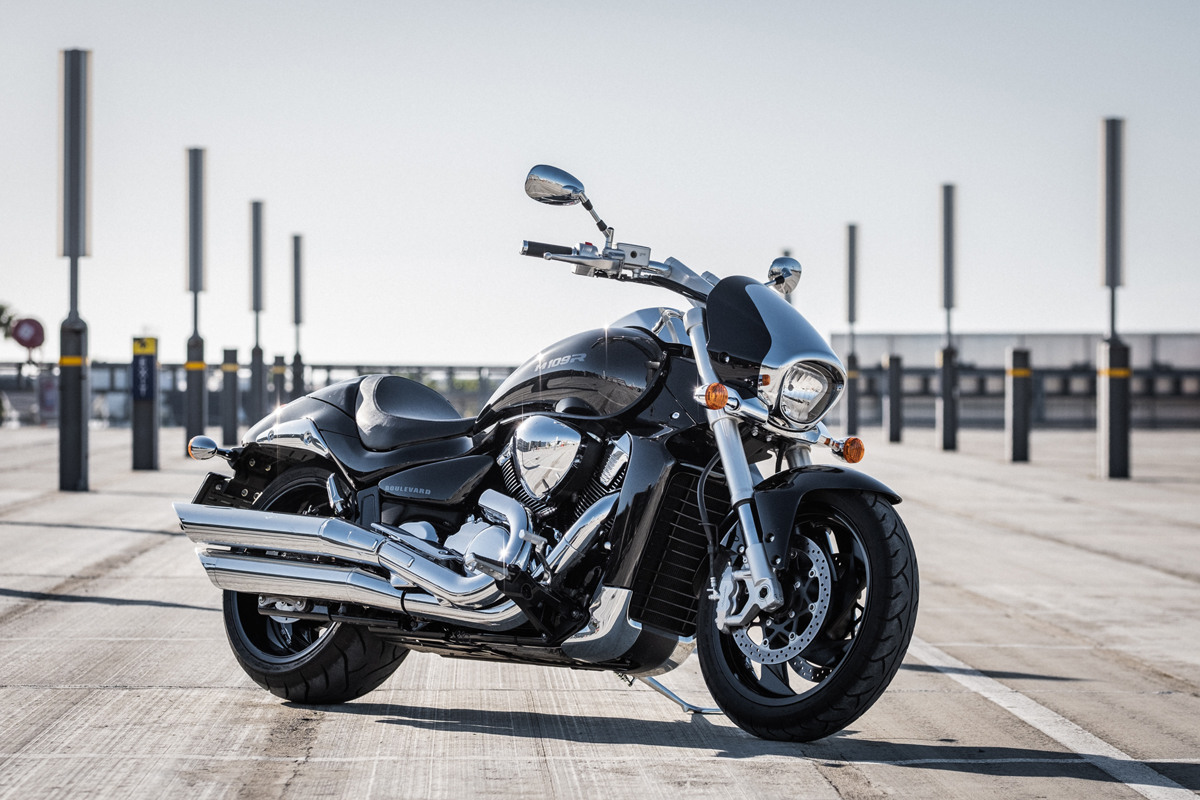
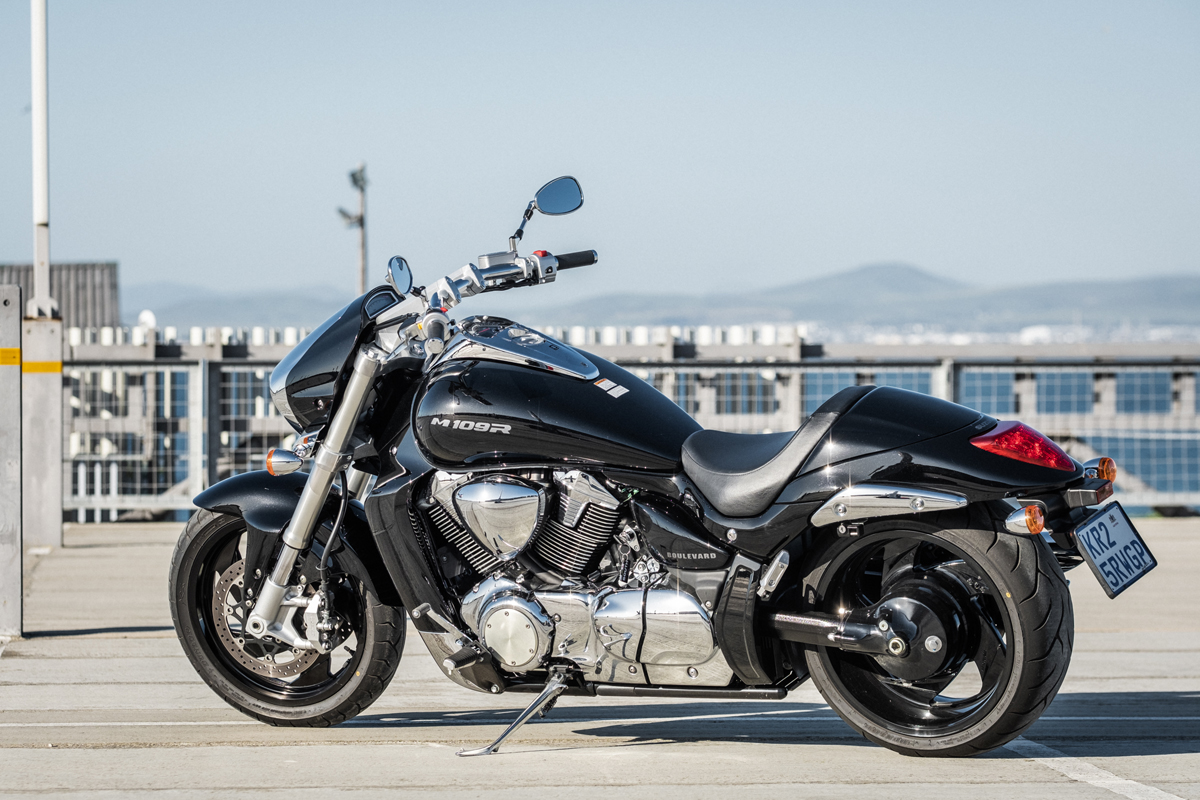
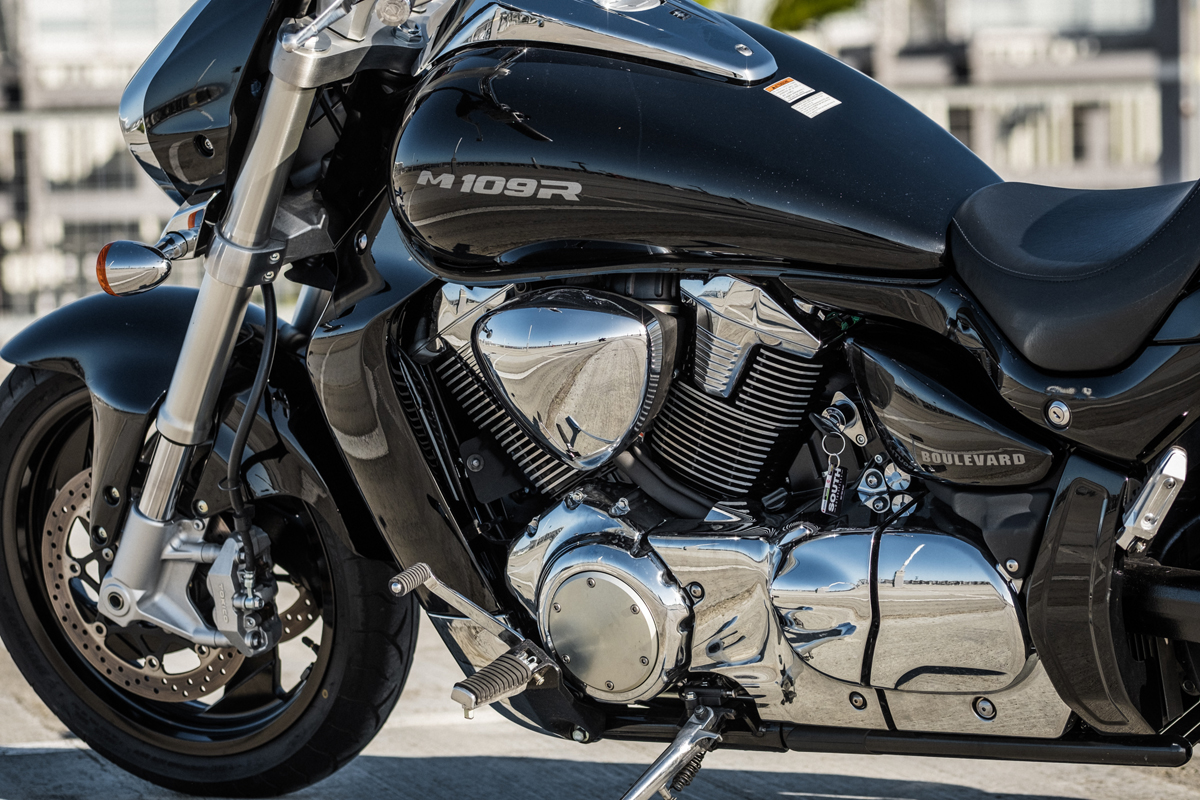
For starters, it looks like nothing else out there. The closest thing to it is probably the now-defunct Harley V-Rod—but visually, the Boulevard stands apart. It’s a little classic, a little futuristic, very fluid, and unapologetically muscular.
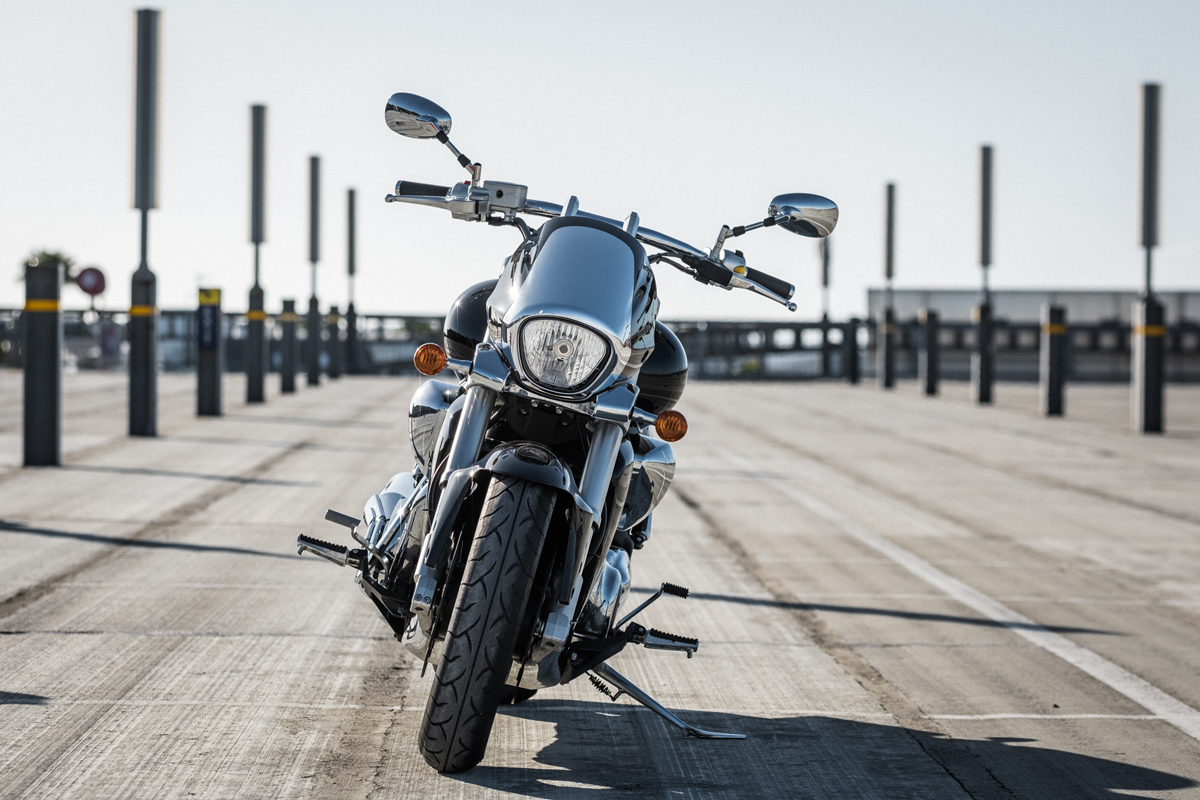
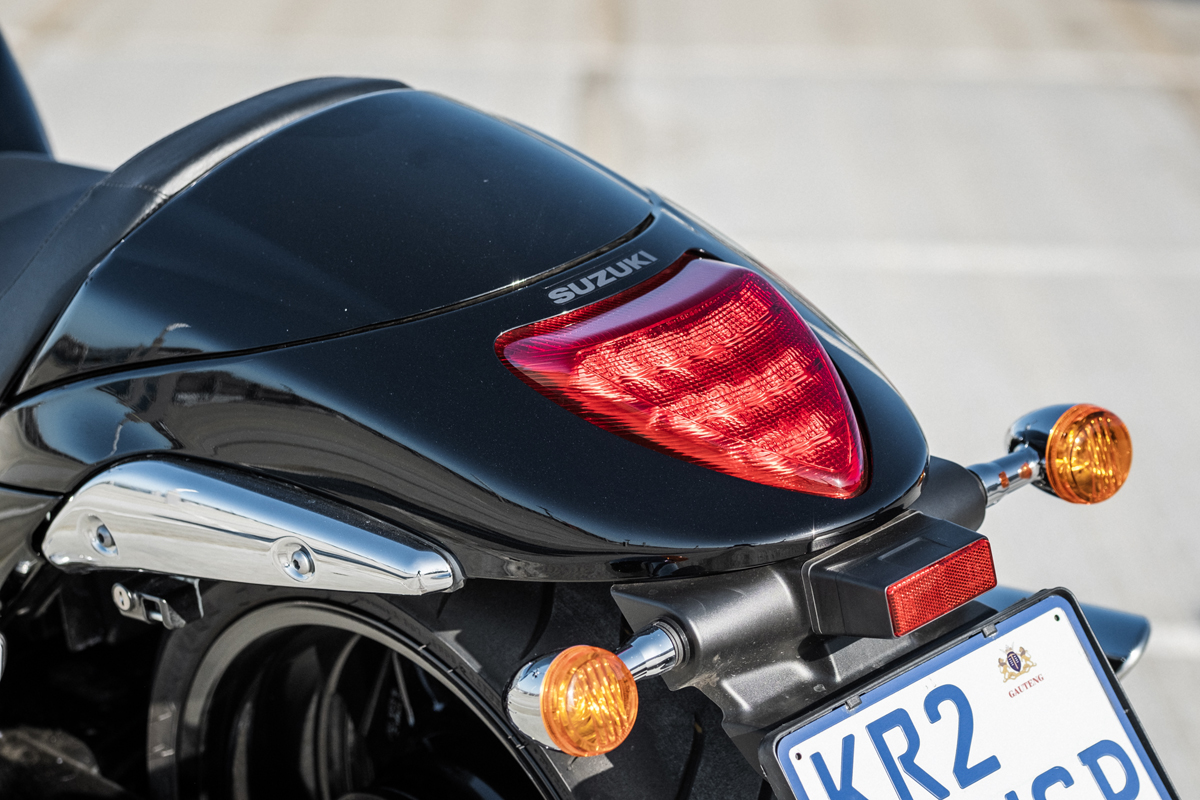
No doubt, the Boulevard’s design is polarising. But, for better or worse, it’s also undeniably cohesive. From the distinctive headlight cowl to the swooping tank and tapered tail section, everything feels like it belongs.
Photo credit: Wes Reyneke
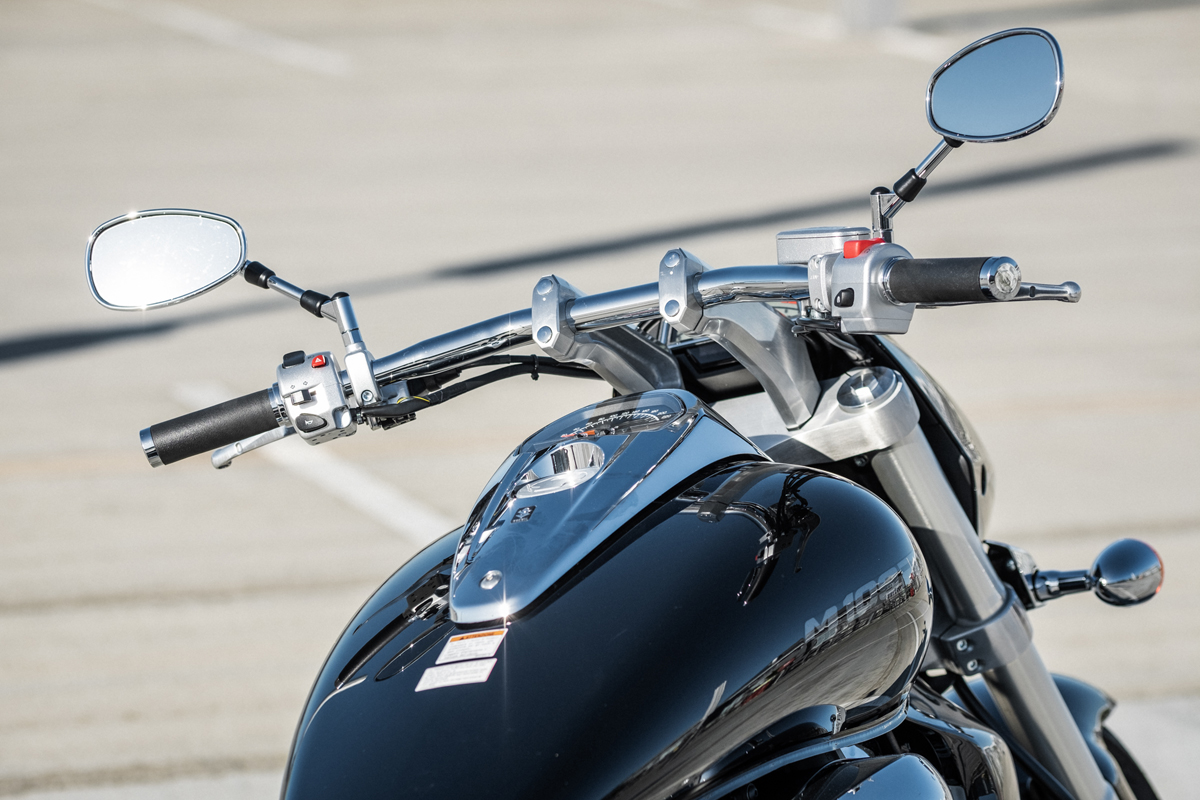
The 18” wheels and upside-down forks add a hint of sportbike style, while the chunky swept-back risers and thick drag bars scream performance cruiser. A rear cowl keeps things streamlined, though it can be swapped for a passenger seat (which comes with the bike). And even the multitude of chromed surfaces complements each other perfectly; although there is a blacked-out option too if chrome ain’t your thing.
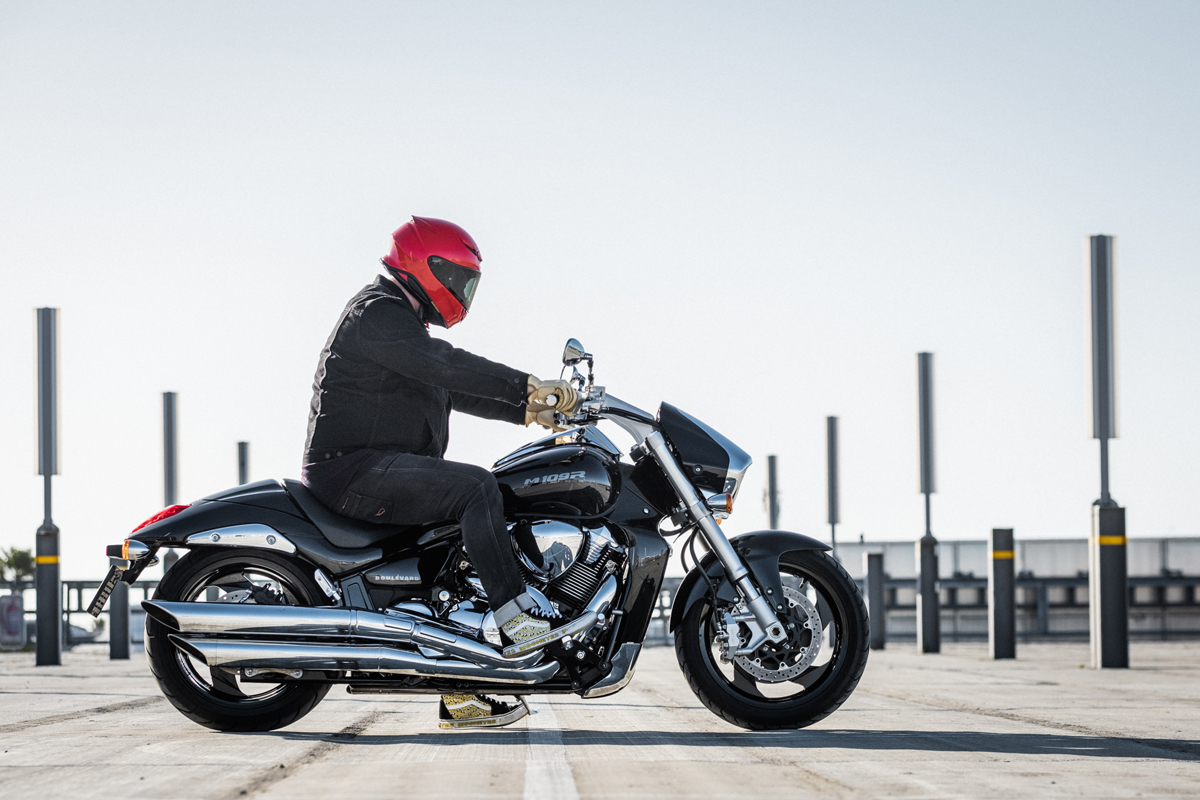
If nothing else, it has a presence—which is unsurprising, given its 347-kilo curb weight and 1,710 mm wheelbase. For reference, that’s almost as long as a BMW R18, but almost 20 kilos lighter.
Photo credit: Wes Reyneke
From the cockpit, the 19.5 l fuel tank splays your legs apart, as your feet reach for the forward pegs, and your arms stretch out to find those drag bars. The seat itself is super comfy; the rider triangle, not so much. Strong shoulder and inner thigh muscles are a must if you plan to ride the Boulevard over distance, at speed.
But while Suzuki’s flagship cruiser is best known for its looks, its biggest asset is actually its 1,783 cc V-twin motor. Suzuki doesn’t list its output—which is bizarre, because it makes good numbers. A quick jaunt around the internet’s myriad motorcycle spec websites reveals around 123 hp and 160 Nm, which, again, puts it a hair ahead of the R18, and Harley-Davidson’s Fat Bob 114.
Photo credit: Wes Reyneke
It’s not just good on paper though. In the real world, that motor is an absolute peach. Thanks to a smooth throttle response, and snappy power delivery from the Boulevard’s shaft drive, it pulls like a freight train.
I’m not sure if it’s baked into the motor’s architecture (it has forged aluminium pistons, liquid cooling, twin air intakes, a two-stage cam and up-to-date fuel injection), but the Boulevard somehow manages to be vibey and smooth at the same time. There’s enough vibration there to add character, but not so much that you feel it through the grips or pegs. And even at highway speeds, the picture in the rearview mirrors is still crystal clear.
Photo credit: Wes Reyneke
The cable-actuated clutch is lighter than it has any business being. Shifting through the Boulevard’s gearbox is easy enough, and although it only has five gears, their ratios are spot on. The engine’s happiest at around 3,000 rpm—that’s where it makes most of its torque, and that’s where it’ll sit at highway speeds in fifth, hardly breaking a sweat.
As for corners… you do the math. Given its heft, wheelbase, whopping 240-wide rear tyre and goofy riding position, the Boulevard is no GSX-R. But if you lean into the bars with boxy elbows and muscle it into turns, it’ll stick, and it’ll even surprise you with its lean angles. Plan your approach speed and angle of attack just right, and it might even be fun to corner with—albeit exhausting.
Photo credit: Wes Reyneke
Given how contemporary the engine feels, the rest of the Boulevard’s accoutrements (or lack of) feels almost agricultural. The brakes and suspension are mostly up to the task—but it lacks switchable rider modes or cruise control.
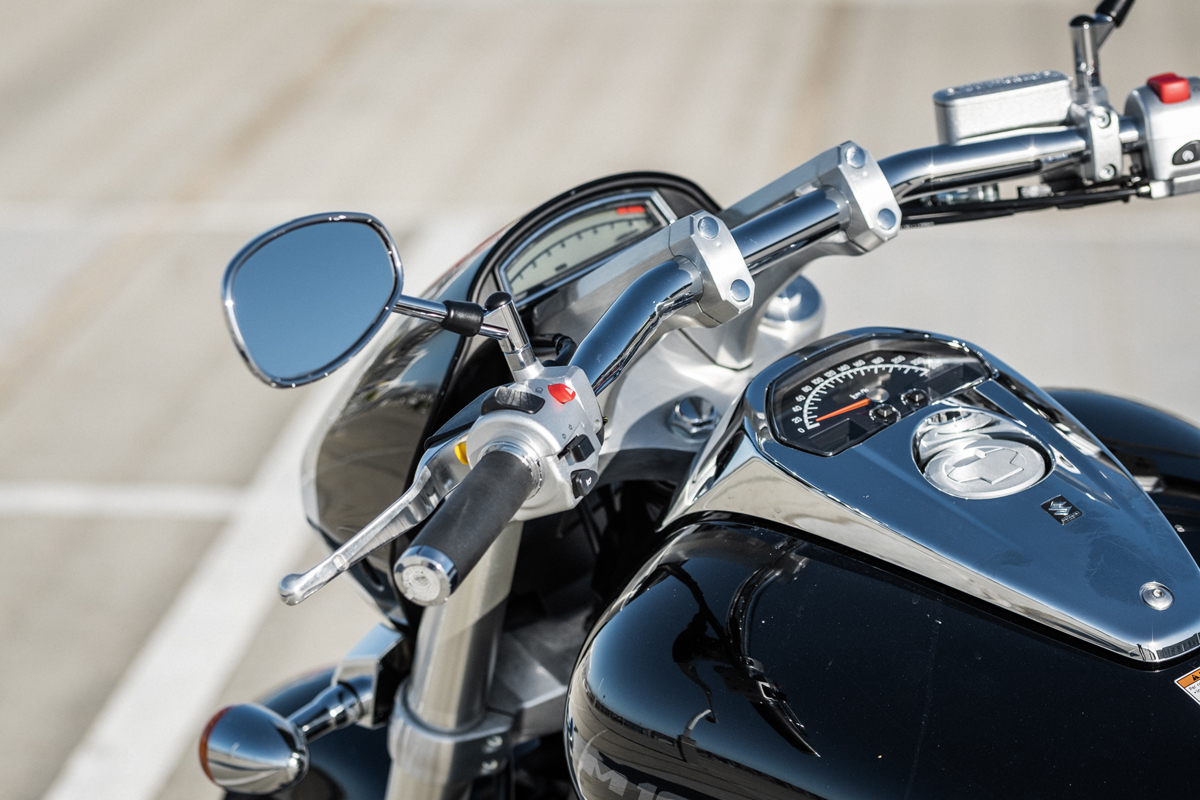
The dashboard is a highlight; a rev counter, gear position indicator and warning lights sit behind the headlight’s shroud, with a speedo that looks like it was lifted from a muscle car mounted atop the tank. But while you get an odo, trip meter, fuel gauge and clock, bonus features like your projected fuel range are omitted.
Photo credit: Wes Reyneke
Granted, most Boulevard customers are likely to dismiss these details as froufrou. But a part of me wonders if adding them, along with a set of cases and a fairing, wouldn’t turn this muscle cruiser into a capable and comfortable long-distance bagger.
But that’s just me, and my opinion is largely irrelevant. Ultimately the Boulevard is what it is: an unapologetic cruiser with love-or-hate looks, that does exactly what it says on the tin. There might be a ton of chrome, but there’s no pretence—and I can respect that.
Photo credit: Wes Reyneke
Suzuki Boulevard M109R
For more information on the bike featured in this article, click on the links below…
If anyone at Yamaha had a script to which they were working to this season, they obviously forgot to tell their rival teams. Or maybe the rival teams had a script but forgot to tell Yamaha about the last-minute changes.
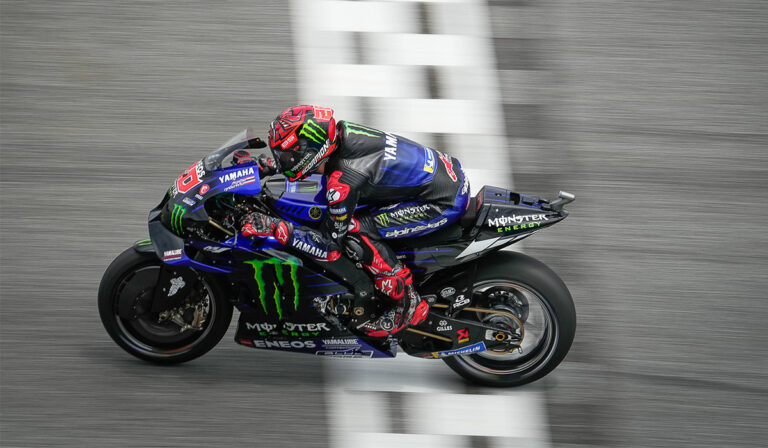
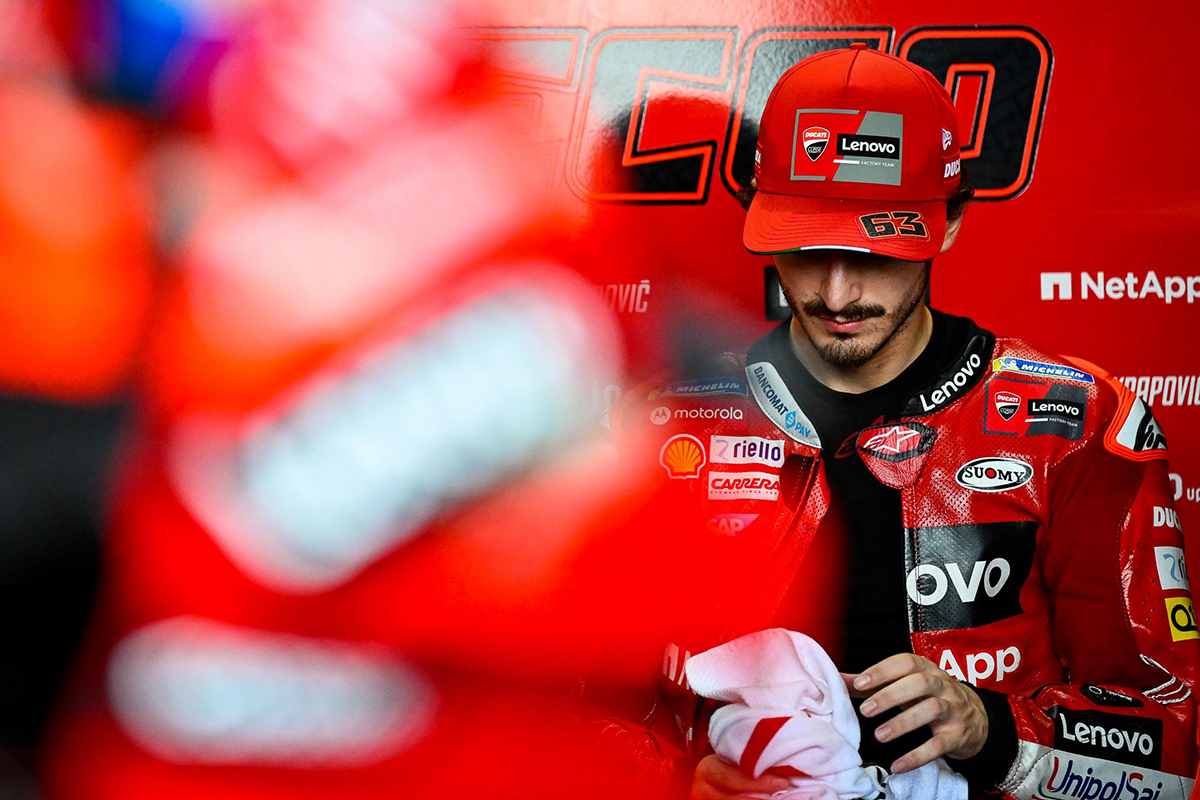
What does Fabio Quartararo have to do to win the championship this year? Well, winning a race might be a good idea. Or finishing in the points? Both are good ideas. But, don’t forget, Bagnaia has crashed out of five races so far this year and yet there he sits, an insignificant two points off the top of the table after being 90 points adrift not that long ago.
Image source: www.motogp.com
Even Jack Miller has catapulted himself into contention with 45 points from the last two races. OK, so it’s a mathematical chance, one that would take huge levels of ill fortune for Bagnaia, Quartararo and Espargaro to come to fruition but, if there’s one thing that this season has taught us, it’s to expect the unexpected and take nothing for granted.
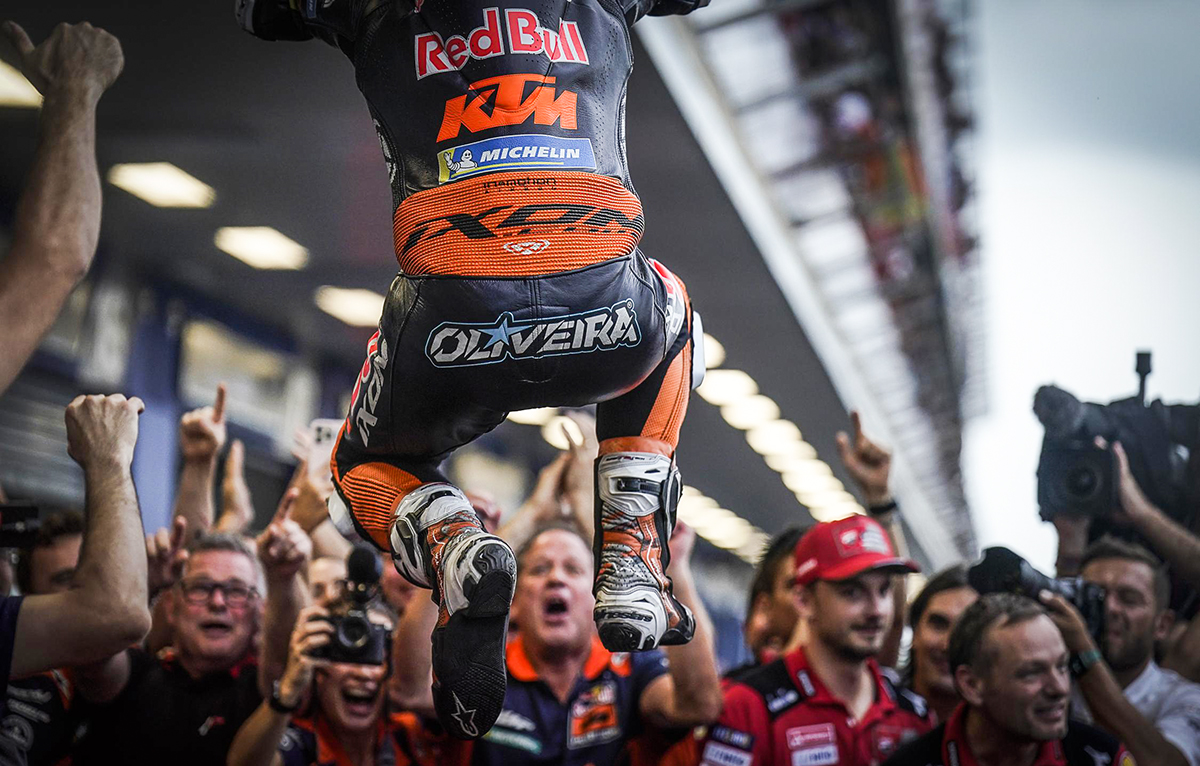
Ducati could still shoot themselves in the foot by not imposing team orders. Jack Miller was fighting for the win against Miguel Oliveira but, once that was over on the last lap, could he not have moved over to let Bagnaia through and gain some more important points? It would have stuck in Miller’s throat, for sure, especially with that mathematical chance, but he’s a team player and would probably have done it if he was asked, his departure from the team at the end of the season notwithstanding.
Image source: www.motogp.com
Instead, we had the sight of a blisteringly fast Zarco closing relentlessly on the leading four – Oliveira, Miller, Bagnaia and Marquez. He despatched Marquez with ease but then noticeably refrained from inflicting the same wounds on Bagnaia. This was just what Pecco needed: a buffer keeping Marquez at bay but one who wasn’t going to take points away from him.
Zarco was clearly playing the team game. Had he been asked by his team to leave Bagnaia alone? We’ll probably never know but what we do know is that Zarco has a debt owing to Ducati for facilitating the ride with the Pramac team when his career looked as if it was on the skids a couple of years ago. His keeping station behind the championship hopefully will have done his future prospects no harm whatsoever which is a good thing: Zarco deserves to win at least one race and, the longer he’s on the grid, the more likely that it will happen.
Image source: www.motogp.com
It is, of course, not just Bagnaia that Quartararo is up against: not just Bagnaia, but all other seven Ducati riders on the grid who will, you have to think, be told to help Bagnaia sooner rather than later.
Naturally, Bagnaia has to be in a position to help himself as well: it’s no use expecting seven Ducatis riding in front of you – if you’re having a bad race – to move over and let you past just so you can get the points: Bagnaia will have to win this on merit.
And it is the merit that got him onto the podium in Thailand. Remember the week before, in Japan? Bagnaia was nowhere and then crashed out. It’s no secret he doesn’t like the rain and who can blame him? If that is the case, then his ride in Thailand was one of the rides of the season and it could be pivotal for both Quartararo and Bagnaia, in terms of points won and not won. Mind you, you could say that about any race throughout this season.
Image source: www.motogp.com
A couple of weeks’ break and then we’re off to that king of tracks, Philip Island. Is it a Ducati track? Is it a Yamaha track? Can Quartararo pull himself out of his emotional slump (if, indeed, he is in one: you’d have to be some sort of superman to not be feeling down about the last two months’ racing and results but, then, that’s exactly what these guys are) and prevail against the Ducati army all on his own?
For that is what he’s been doing all season. Should Quartararo win the title in 2022, he will have done it all by himself. So has Bagnaia, if you want to be precise, but you have to think that he will be getting help from his teammate or the other Ducati riders in the last three rounds if he needs it. With no disrespect to Morbidelli, Quartararo is on his own for this one.
Image source: www.motogp.com
It’s by no means a foregone conclusion and it is likely that the title will go down to the last round in Valencia, which is exactly as it should be.
Philip Island. The MotoGP circus hasn’t been to Australia since 2019 and, in that time, aero add-ons have become ever more important. The wind can be punishingly strong on the island so how will the bikes cope? A track full of balls-out corners and all of them need full commitment from the rider and a bike that works properly. The Yamaha has traditionally been that bike but now, the Ducati GP22 is also that bike: good at any circuit in any conditions.
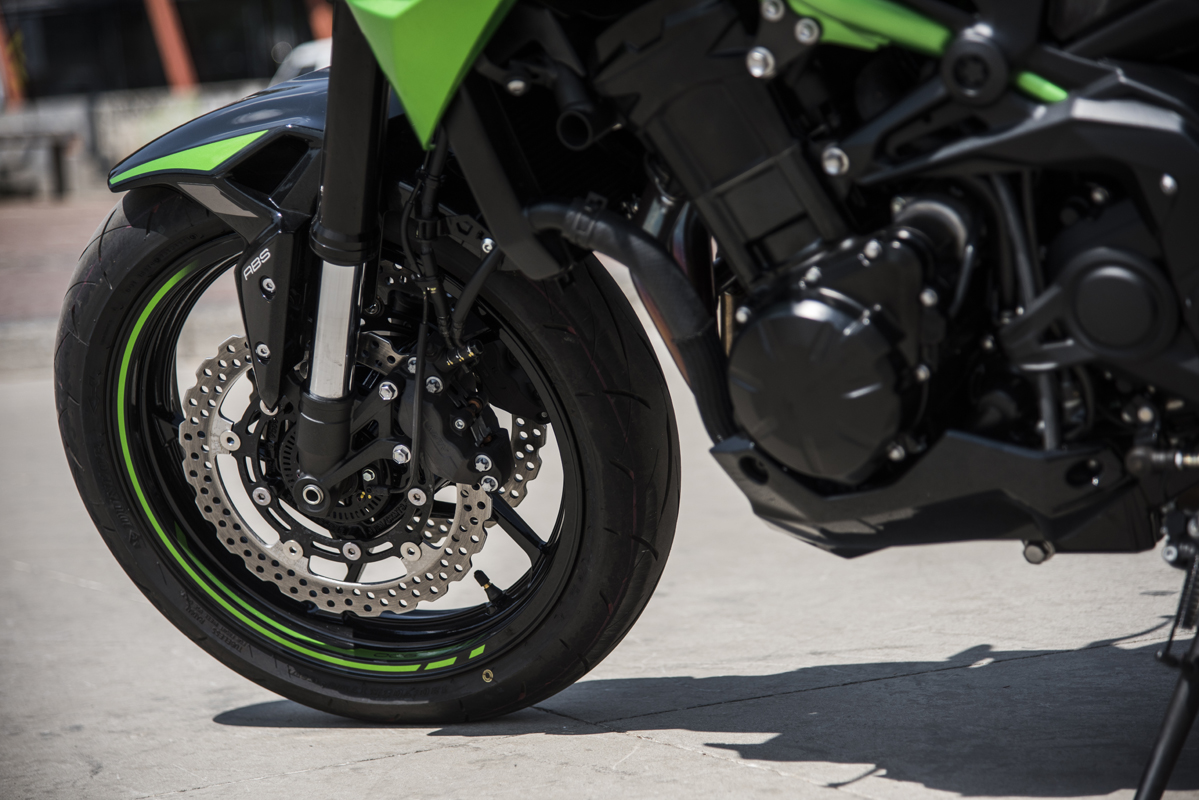
What can you say about Kawasaki’s Z900 that hasn’t already been said? The highly praised king of smooth took over the role of the Z800 back in 2017 and soon thereafter the Z1000, bringing riders a lighter tubular chassis, sharper handling and improved build quality. Five years down the line the Z900 is still around and has gone through design updates along with subtle tech updates to keep up with the times. All in all, the Z900 is still the same creamy smooth ‘Z’ that slipped its way into the exciting and competitive middle-weight naked bike class five years ago.
The question I found myself asking is, how does the Z900 fare with the current crop of nakeds and what makes it stand out from the massive horde of buzzing hoons?
Photo credit: Bjorn Moreira / ZA Bikers
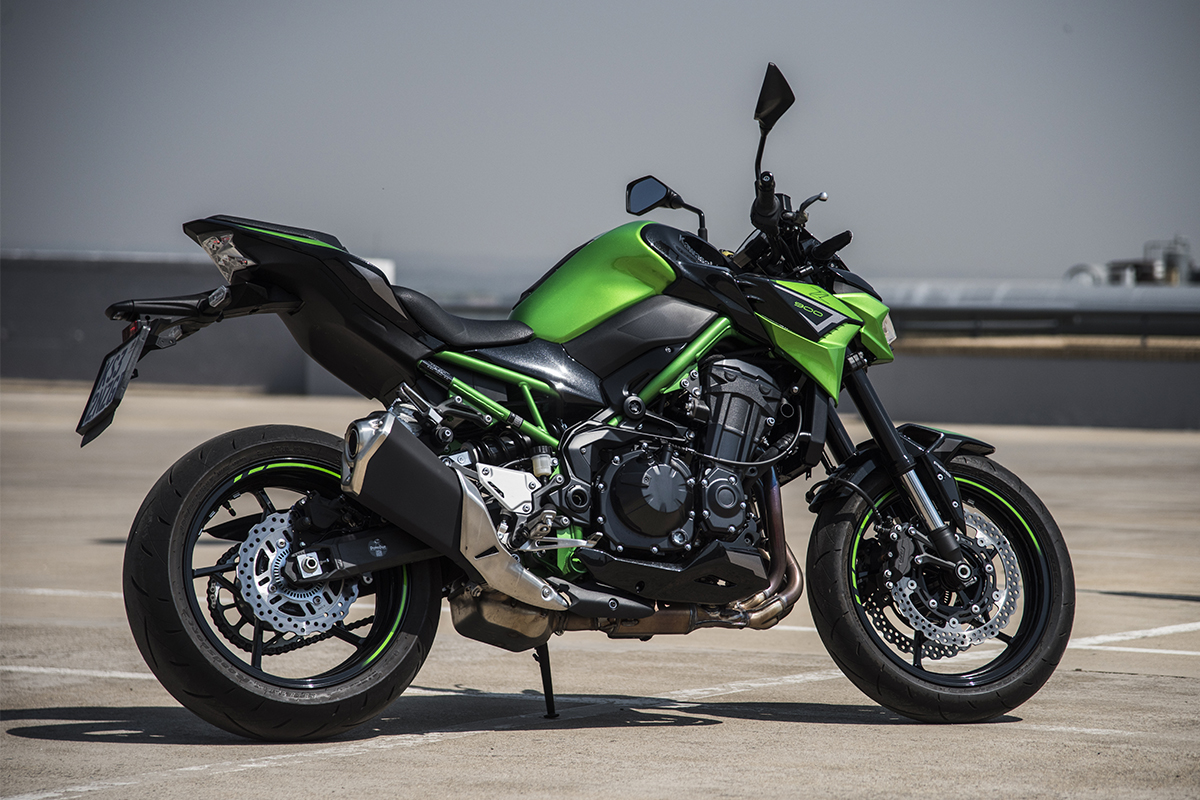
Rolling into 2022 we see a familiar face, almost like bumping into a good old friend that reminds you of the good times. The Z900 greets you with its angular “Sugomi” design language followed by excellent build quality, starting from the wasp-like LED headlight, and broad shoulder fairings, to the sharpened-off tail section. Well the aesthetics of the Z900 can divide opinions, there’s no arguing that it is uniquely Kawasaki.
Kawasaki didn’t stop at the design, they’ve paid special attention to the smaller details too, like the metallic ‘H2-like’ tubular green frame, wavy discs, standard fly screen, Z-shaped LED tail-light and machined bar ends. These smaller details are what many manufacturers tend to just slap on last minute without much thought, but not so with Kawasaki and for me that goes a long way.
Photo credit: Bjorn Moreira / ZA Bikers
Who said inline-fours have no guts? In most cases, this statement stands a truth, but not so with the Z900. This fierce assassin throws its Kunai blades at its opponents with bags of midrange punch and low-down torque, making the Z as versatile as it gets. The Z’s 948 cc powerplant has always been the heart and soul of the Z900’s linear nature—the definition of smooth.
With 123 hp on tap and 99 Nm of torque, the Z pulls strong from as low down as 2,000 rpm, all the way to its 10,500 rpm redline. The low-down torque and light throttle make the Z a capable urban missile, allowing you to carry higher gears which in turn translates to a smooth and more economical ride. Looking down at the TFT display while cruising at 120 km/h on the highway, I saw the evil green purring at just 5,000 rpm with minimal vibration coming from the bars and pegs, but nothing worth stressing about.
Photo credit: Bjorn Moreira / ZA Bikers
On the 4.3” TFT display you’ll see three pre-programmed riding modes: Sport, Road, Rain and then one custom mode for the hooligans that want to turn it all off called Rider. Now pre-programmed explains itself, but here’s the easy science behind it: Sport mode has full power and TC set on 1, Road has full power but TC set on 2 and Rain has low power and TC set on 3. At first, I thought rain mode to be a bit of a gimmick, but after thinking about it Rain mode is really there for two reasons and that’s for rainy conditions and for those who are still finding their “sea legs”.
After finding my way around Kawasaki’s easy-to-understand and neatly laid out riding information on the dash, I stuck the Z in Sport mode. Sport mode in my opinion really suited the Z900’s chassis as the addition of traction and power control helped reel the bike in, or get the most out of the machine without much restriction. In town you can really feel how light and precise the clutch feel is, the movement on the shifter is just so short and quick—it just feels like it was tuned by people who ride.
Photo credit: Bjorn Moreira / ZA Bikers
A downer for me was that the main menu settings couldn’t be engaged on the switchgear but only on the buttons of the screen and secondly, I would have loved to also see a standard quick-shifter on the Z900—the power of the Z and intoxicating exhaust note warrants that extra performance factor.
When it comes to handling, I just have to use the “v” word again, versatile. Whether you’re a daily commuter or corner scratcher, the Z900 can do it all well and a lot of that is thanks to its chassis and suspension. Yes, it’s not shiny gold Öhlins like on the ‘SE’ model, but the chassis is already just so good that it gives you confidence right out of the blocks. In all honesty, it’s one of the only bikes that I’ve ridden and instantly felt at home on.
Photo credit: Bjorn Moreira / ZA Bikers
The suspension is stiff but well damped, which makes longer stints in the saddle doable and heaven on the twisties. My personal handling preference when it comes to a motorcycle is a stable and planted front end and that’s exactly what the Z900 offers, without feeling heavy. The steering is very stable, which makes leaning onto the edge of the tyre on faster sweeps just effortless.
Once out of the bends there’s lots of stopping power at both ends provided by the Nissin callipers. The only drawback for me was the standard Dunlop Roadsport 2 tyres which just felt vague and would brake loose just by looking at them, thankfully a good set of Pirelli Diablo Rosso’s, fitted by Kawasaki’s technicians made the Z stick to the road like jam on toast.
Photo credit: Bjorn Moreira / ZA Bikers
After a long day’s ride or work and back commute, the Kawi should return a reasonable fuel economy of just around 20 km/L. In two hectic days of slow JHB traffic and smooth riding, I actually got 23.3 km/L, but if you going to loft the front wheel you should see a number around the 18 mark.
If you are the kind of rider that likes to ride spiritedly, the Kawasaki will still do so with a few litres of fuel to spare with its surprisingly big 17-litre fuel tank—a good 2 to 3 litres more than most of the bikes in its class. The ergo’s are really good too. The seat is firm yet comfy, the stretch to the bars is just right and the footpeg position is mid-set—definitely a bike I’d smash big distance on.
Photo credit: Bjorn Moreira / ZA Bikers
At the end of the day, Kawasaki’s Z900 offers you real-world versatility in a confidence-inspiring package, which is super easy to live with. Unlike its competitors, the Kawasaki sort of does it all and will always score a 4/5. The best part is, you don’t have to break the bank either!
The Z900 will cost you a lightweight bill of 165k, now that is a bargain with almost all of its serious competitors costing you 200k plus VAT. You could argue that the Z900 is too clinical or boring for your taste buds, but I doubt you’d find a better-naked bike that can do it all.
BMW has announced the next generation of its S 1000 RR superbike and claims that it has raised the performance to a new level. Given the heights to which they have already raised the S 1000 RR with the current generation, that is a bold claim.
This is no cosmetic make-over: BMW has introduced innovations to the engine, suspension, chassis, aerodynamics and electronic assistance systems.
Image source: BMW
The engine gets 2 more kW of power (about 2.6bhp in old money), making the total 154kW (about 210bhp). Torque remains at 113Nm. The torque curve has been flattened to give more usable power delivery through the rev range.
The heart of the chassis of the new S 1000 RR is still the aluminium bridge frame, which is a welded construction of four gravity die-cast elements. The engine is a load-bearing part of the structure. With the aim of optimising flexibility laterally, the main frame of the new RR was given several openings in the side areas. The new chassis geometry is accompanied not only by even better riding precision but also by increased accuracy and clearer feedback from the front wheel.
Image source: BMW
But it is the electronics that, almost inevitably, have had the biggest upgrade, featuring new ideas that you never thought you needed!
The new feature of Dynamic Traction Control DTC is the Slide Control function. It allows the rider to select two preset drift angles for the traction control system when accelerating out of bends. Technically, this is achieved using a steering angle sensor. Up to the respective leaning angle, the traction control system allows slippage at the rear wheel when accelerating out of a bend, thus enabling rear wheel drift. When the preset steering angle value is reached, traction control intervenes, reduces slip and stabilises the motorcycle.
Image source: BMW
The ABS is upgraded to ABS Pro with new Brake Slide Assist and ABS Pro “Slick” setting functions. The new Brake Slide Assist function is an important and very helpful innovation for race track riders. As in the new DTC Slide Control function, this new system is also based on steering angle sensors and allows the rider to set a specific drift angle for so-called braking drifts while sliding into corners at a maintained speed.
The bodywork has been tweaked front and rear, and the inevitable winglets add downforce to the front when accelerating out of corners and stability under braking. You can expect to see the new S 1000 RR in showrooms in South Africa in the second quarter of 2023.
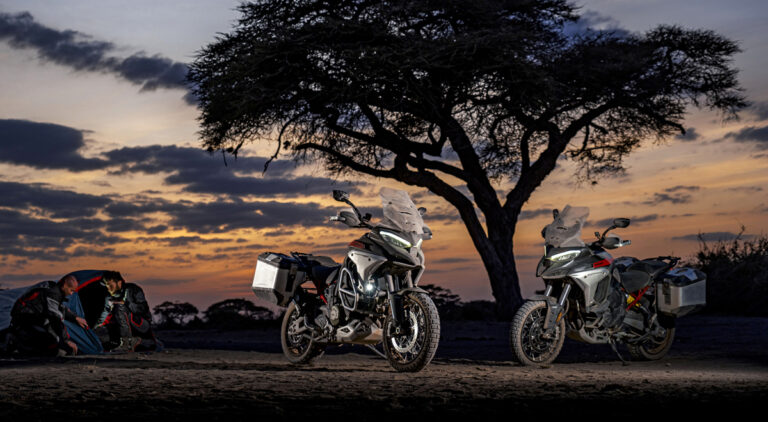
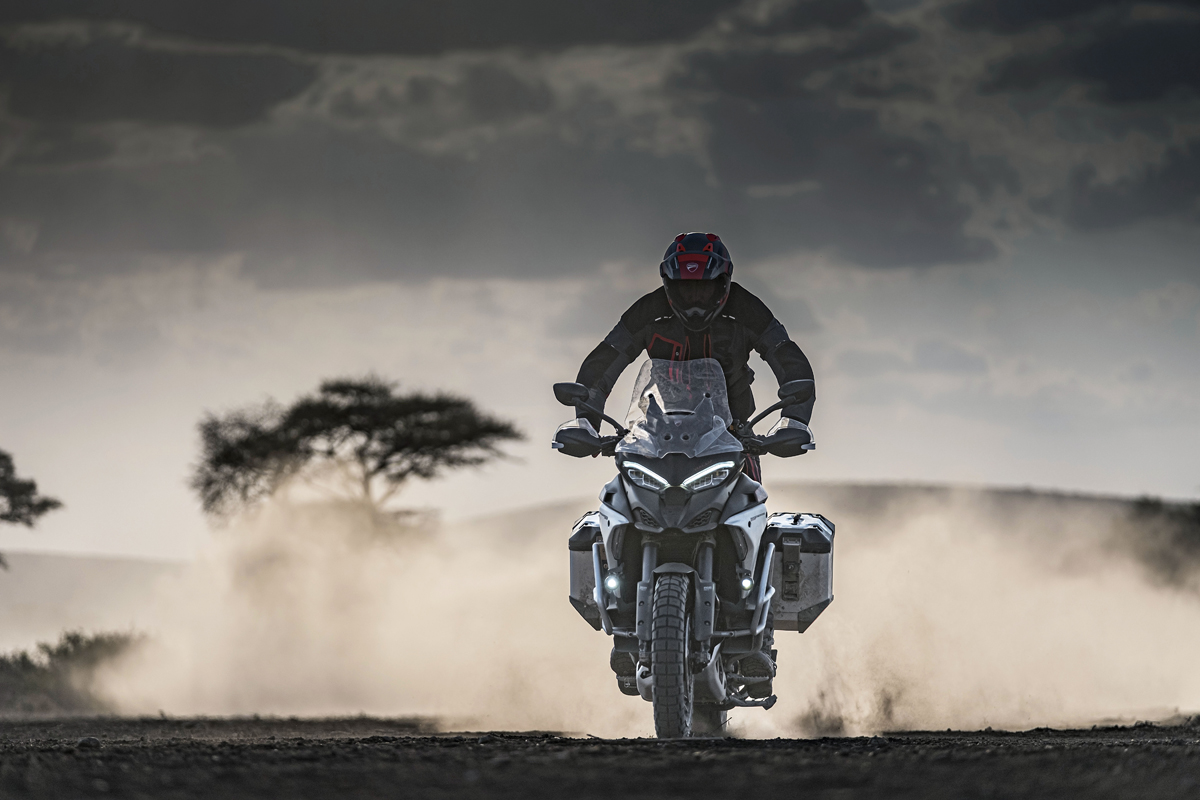
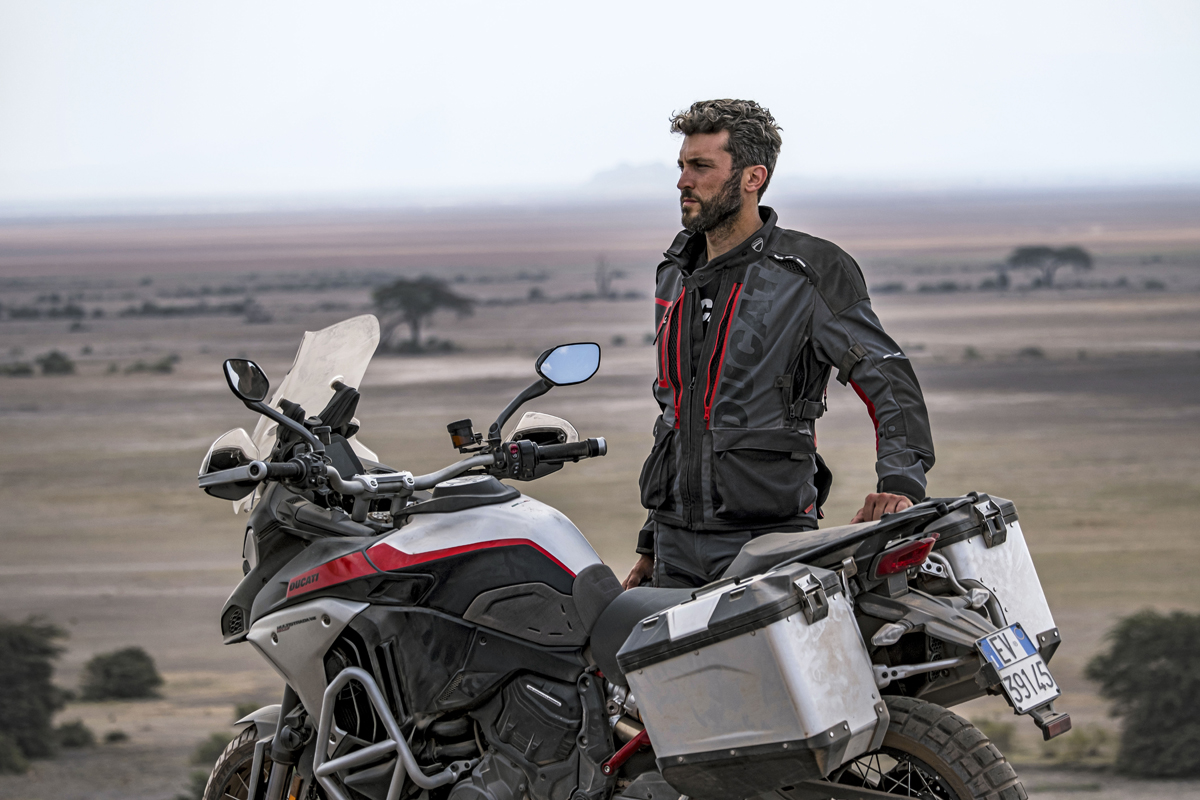
In what is becoming an annual fixture ahead of the EICMA show in Milan, Italy, in November, Ducati used the third of its weekly online World Premiere episodes to showcase the new Ducati Multistrada V4 Rally.
Key features of the new model are improved comfort, a larger fuel tank giving greater range and a whole new dose of off-road aptitude. Ducati is clearly taking a very close look at both KTM and BMW and wanting to improve the real-world ability of the Multistrada V4 while losing nothing of the Ducati DNA.
Image source: Ducati
If you were inclined to think that power outputs for adventure bikes were getting a little out of hand, then maybe turn away now. The V4 engine in the Multistrada produces 170bhp: that’s a lot for any bike, let alone an adventure bike but it’s not at the expense of longevity as Ducati has managed to keep service intervals to 60,000km for the valve train and 15,000km for the oil. The engine is fed by a new 30-litre petrol tank.
Image source: Ducati
The semi-active suspension has increased travel (now 200mm) which also gives a higher ground clearance. Skyhook DSS EVO is fitted as standard, as is auto-levelling to keep the bike on an even keel no matter the load.
The screen is bigger and the pannier mounts have been moved back to give the pillion more room. Talking about dimensions, those vertically challenged riders who might not usually think that an adventure bike is for them will be pleased to note that various seats are available in different thicknesses and there is a suspension lowering kit.
Image source: Ducati
Taking a leaf out of Harley Davidson’s book, the Multistrada V4 Rally is fitted with Minimum Preload Function which allows the rider to lower the bike when coming to a stop or riding at low speed. It does this by minimising the preload of the rear shock absorber. Another neat electronic function is called Easy Lift, which, by opening the suspension hydraulics when turning the bike on, reduces the effort required to lift the motorcycle from the side stand by compressing the forks and shock. A centre stand is also fitted.
On the electronics side of things, the Multi V4 Rally is the first bike in the world to be fitted with front and rear radar, supporting active cruise control and blind-spot detection. Naturally, there is cornering ABS and traction control, wheelie control, and cornering lights.
Image source: Ducati
Four riding modes are present and Enduro mode reduces power to 114bhp and, when idling, the rear bank of two cylinders is shut off. This also occurs at low engine loads in order to increase fuel consumption.
Three different versions are available: Adventure Radar, with Adaptive Cruise Control and Blind Spot Detection, Adventure Travel and Radar, which adds aluminium panniers, heated grips and saddles, and Full Adventure adds an Akrapovic silencer and carbon fibre front mudguard.
For pricing and arrival dates for the new Multistrada V4 Rally, visit Ducati South Africa at www.ducati.co.za
Over the years we have seen a majority of motorcycle manufacturers jump on the small capacity adventure motorcycle bandwagon, not just for the sake of it but because of how important it is to influence new buyers and grow the market. There is no denying it, adventure and off-road motorcycling are two of the most popular markets in the industry today, and that may be because we seek adventure more than ever in this modern society or because we see adventure bikes as the jack of all trades.
The thing is, we have been brainwashed to think we need to throw a leg over the giants in the industry because “I read it’s the best for this or that”, but for getting started you might not need all that bike and later on what that particular bike is suited for is maybe not your cup of tea. The best part of it all is that adventure motorcycles come in all shapes and sizes and bigger isn’t always better—we highly recommend something lightweight and with a smaller engine size in most cases.
Photo credit: Bjorn Moreira / ZA Bikers
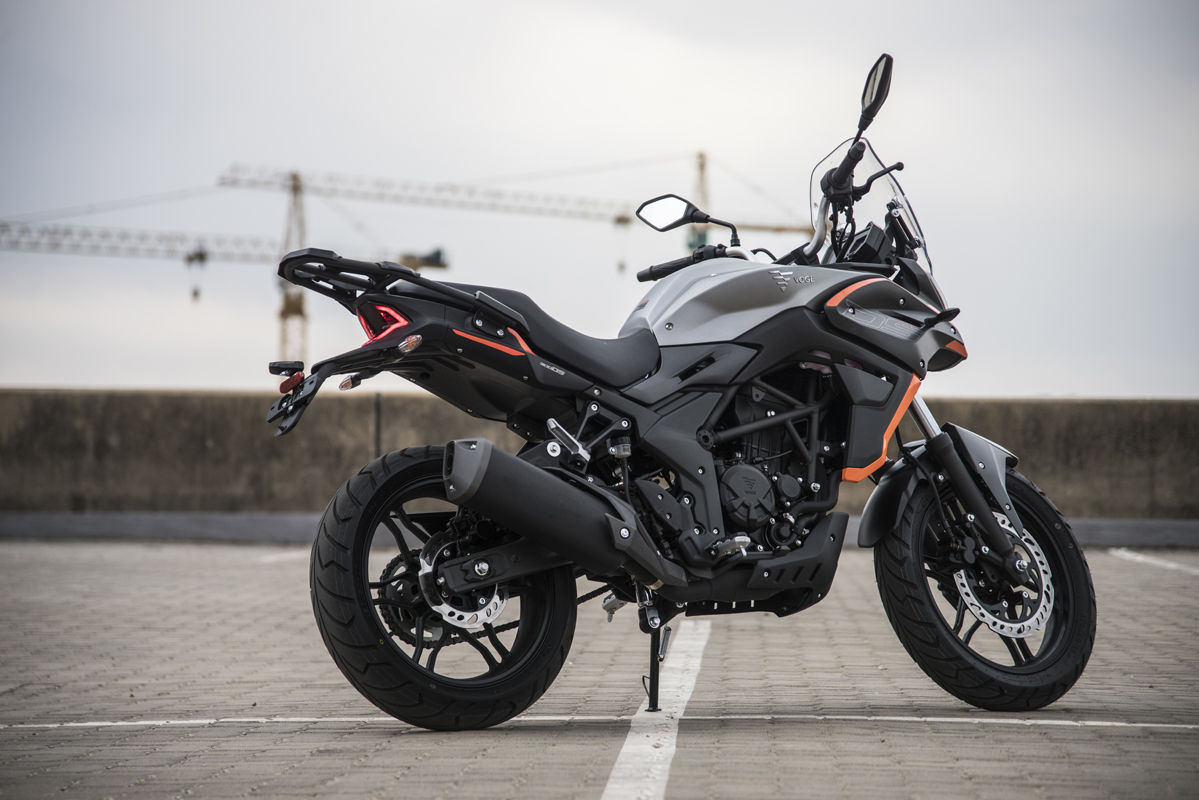
Right now the 300 to 400 cc market has shown us some real potential with brands like BMW, KTM, Honda and Kawasaki bringing us some really awesome adventure bikes that work seriously well as daily commuters too. The thing is, over the years pricing has started to get a little steep to the point where you need 100k to afford your entry into adventure or your perfect daily commuter. This is where SAM (Southern African Motorcycles), the importer of VOGE motorcycles comes to the show with their affordable and good-looking adventure-styled VOGE 300DS.
The question is, does the VOGE 300DS fill a vital gap in the small-capacity adventure motorcycle market?
Photo credit: Bjorn Moreira / ZA Bikers
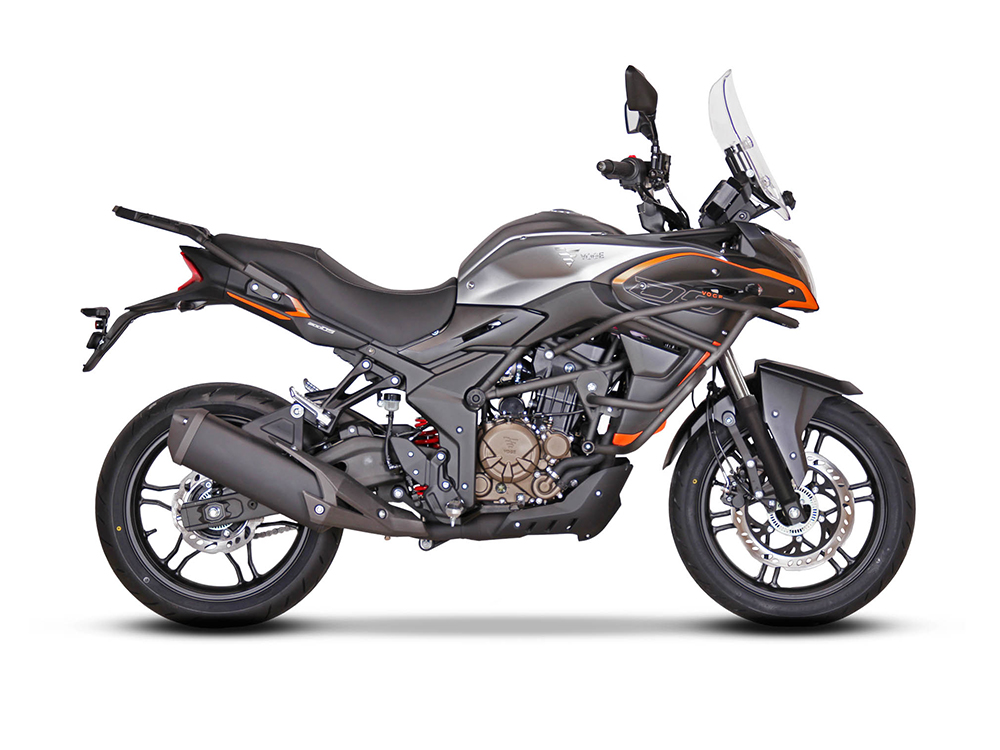
At first glance the VOGE’s subtle adv styling sort of allures to the fact that the ‘DS’ is more of a soft-roader, rather than a fully-fledged adventure, but aren’t most of them anyways? The design is clean and the finishes impressed me, as I was expecting a budget bike. Then you get the subtle design cues like a VOGE emblem in the LED headlight, Corbin-like seat, adjustable screen and neat features like the USB charge port and clear LCD display that definitely don’t shout budget, but rather quality. For a bit more spend you can order the DS a bash plate and crash bars from VOGE’s optional extras catalogue—for that extra protection or better off-road look.
Photo credit: Bjorn Moreira / ZA Bikers
Yes, the elephant in the room is the 17” rims, but we are talking about an entry-level adv-based commuter. A set of aggressive tyres should keep most demons at bay and take nothing away from the DS when it comes to handling on the road, and handle it does. The DS offers a plush ride with good enough damping to ride on the rough stuff we call tarred roads. Although more road-biased with its little suspension travel the DS still has 190 mm of ground clearance and a stiff setup makes up for the lack of travel—so light off-road duty and curb hopping are a breeze.
Photo credit: Simon Morton / ZA Bikers
Once seated on the VOGE you will notice its mid-level seat height of 810 mm, this is a great height for shorter riders and provides confidence when coming to a stop or when faced with a tricky situation. Most of the competitors hover around the 850 mm seat height which almost makes it impossible for shorter riders to get started in the first place, especially when you think a BMW R 1250 GS Adventure’s seat height starts at 790 mm. VOGE have also made the DS’s seat narrow so when standing it gives you a more natural leg bend and combined with the bar risers almost perfect ergo’s for riders between 160 to 175 cm.
Photo credit: Bjorn Moreira / ZA Bikers
The VOGE 300DS is driven by a 292 cc single-cylinder, liquid-cooled, electronic fuel-injected motor. Although only 300 cc, the DS feels way more competent—both on the open road and in the slower stuff, too. It’ll sit at a comfortable 120 km/h at 7,000 rpm, with 2,000 more revs to spare, but also effortlessly lugs at under 3,000 when negotiating tight single track. This is thanks to its smooth 6-speed gearbox, which almost works as an overdrive once you pop it into sixth.
With 28 hp and 25 Nm, the DS won’t pull much “skin off a rice pudding” but competes with the likes of the BMW G 310 GS with one less Nm and only 6 hp down (bearing in mind there is an R47 000 price difference between the two bikes). This should put things into perspective of how competitive this DS really is. Another interesting fact, is that the VOGE 300DS is built by Loncin Industries, who builds a certain parallel twin for BMW’s F 850 GS—this explains then why the bike has got such good build quality and riding feel.
Photo credit: Bjorn Moreira / ZA Bikers
The DS won’t blow the minds of the tech-savvy with its LCD display, but it more than makes up for it with its contemporary well-designed layout that shows the rider all they need—it’s better than what we see on most entry-level Japanese equivalents.
As already mentioned the DS isn’t all about the latest software, but hardware is a different story with electronic fuel injection, an electric start, tubeless tyres, strong disc brakes, full LED lights, a rear luggage rack for a top box (or mounting point for a tail bag), USB charge port and an adjustable rally-style windscreen that offers much wind deflection.
Photo credit: Bjorn Moreira / ZA Bikers
With VOGE combining all of this with a smooth gearbox, a good economy of just over 30 km/L, its 16-litre fuel tank and an impressive 155 km/h top speed, they have made the DS a capable motorcycle to comfortably tackle some lightweight adventures.
The VOGE 300DS ultimately punches above its weight, and will happily ride alongside its fellow 300 cc odd adventure bike brethren. It also answers the question I asked myself earlier, by offering riders a lightweight and affordable start to adventuring at just R62,999.
Photo credit: Bjorn Moreira / ZA Bikers
VOGE 300DS
For more information on the bike featured in this article, click on the link below…
Maybe it’s just me, but I am endlessly curious. I have used a number of Liqui Moly products and consistently found them to be absolutely excellent. I was intrigued to find out more about Liqui Moly the company.
Their story goes back to a post-war occupied Germany. It was difficult to stock the shelves of a General Dealer store in the war-devastated country. You would try and sell whatever you could lay your hands on. The American army sold cans of an oil additive, called Liqui Moly, which contained Molybdenum Disulfide. They say that necessity is the mother of invention, and so it was with Molybdenum Disulfide.
Image source: Liqui Moly
Let’s go back to the First World War and specifically aerial combat. Aircraft were in their infancy, but it didn’t take long for the military to see their potential in a combat role. Aircraft were soon adapted from pilots flying around taking pot shots at each other with revolvers and dropping hand grenades, to machine guns firing through the propeller (without shooting your own plane down) and proper bomb racks.
Machine gun fire raking your aircraft often resulted in oil tanks or lines being hit and a resulting loss of your vital engine lubrication. A seized engine gave you far fewer options of a suitable crash landing spot. Molybdenum Disulfide came to the rescue. Adding a can to your oil provided enough residual lubrication to keep an oil-less engine running for long enough to give the pilot a fighting chance of landing in one piece. Given the success of the German ace, Mannfred von Richtofen, (the Red Baron) and his Flying Circus, I am sure that Molybdenum Disulfide saved a number of Allied pilots’ lives!
So why is Molybdenum Disulfide so slippery? For those of you boring boys and girls who actually paid attention in your science classes, you will know that Molybdenum Disulfide is what results when you mix one part of Molybdenum with two parts of Sulphur. Doing this results in what scientists call “superlubricity”.
Image source: Liqui Moly
In layman’s terms, the shear strength goes up when the friction is increased, maintaining lubrication. How cool is that? The harder I ride my bike the better it lubricates! Well, sort of…the fact is, it has an almost unparalleled low coefficient of friction. Less friction means more power and extended engine life. It’s a no-brainer really.
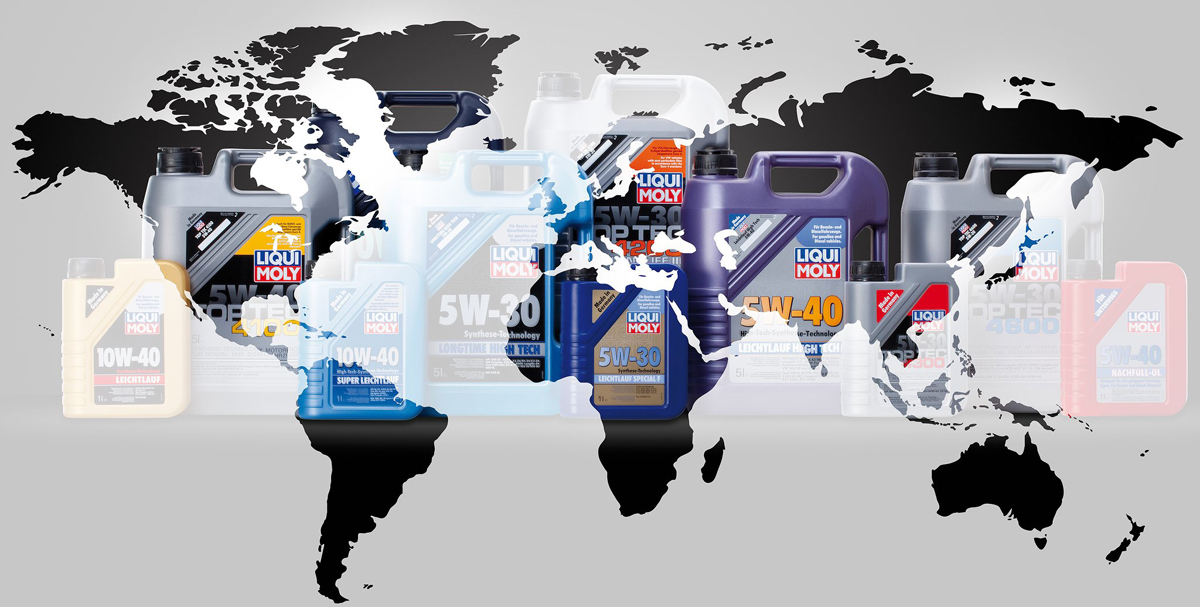
So it was then, that back in 1957, in a town called Ulm, on the banks of the Danube river, Liqui Moly the company was formed. The rest, as they say, is history. Today, Liqui Moly sells a range of around 4,000 products in more than 120 countries.
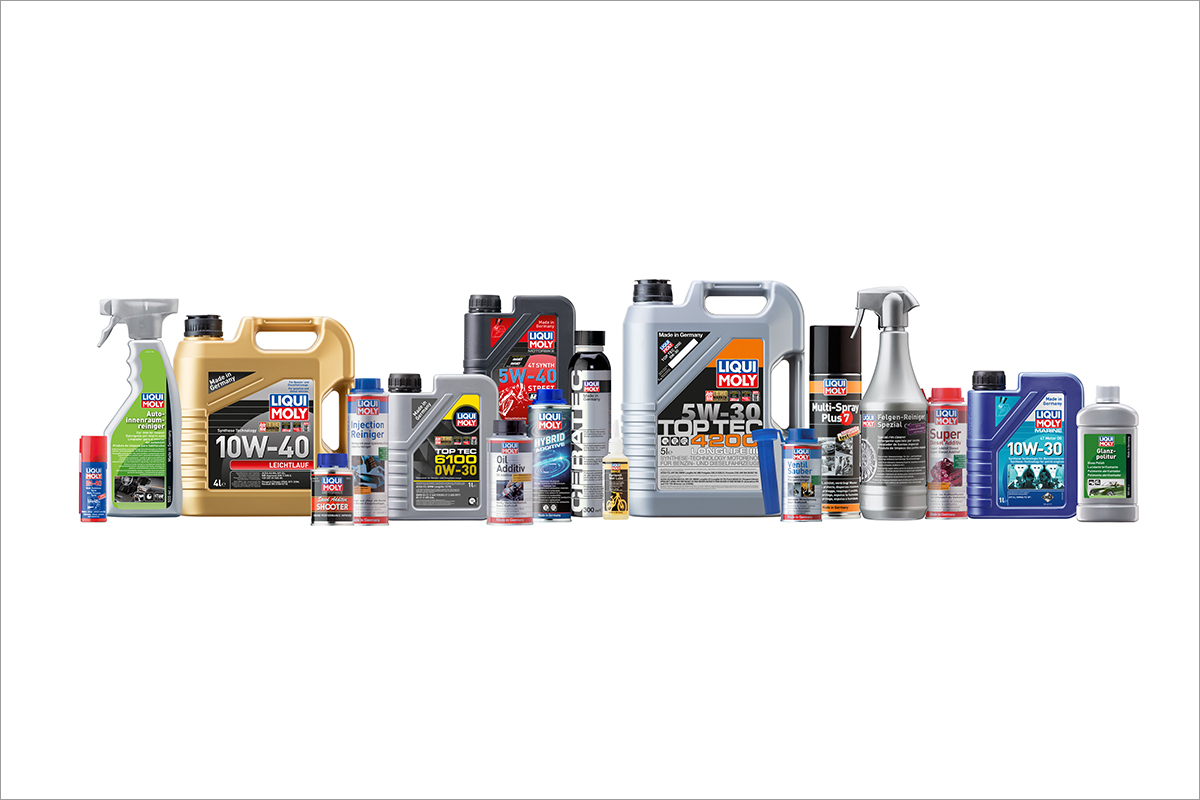
Lubricants form the core of the business, but as you will know from our product posts, they have an amazing range of superb products. Liqui Moly allows you to maintain your bike and riding kit both inside and out, as well as keep pesky rats away from it! It doesn’t get much better than that.
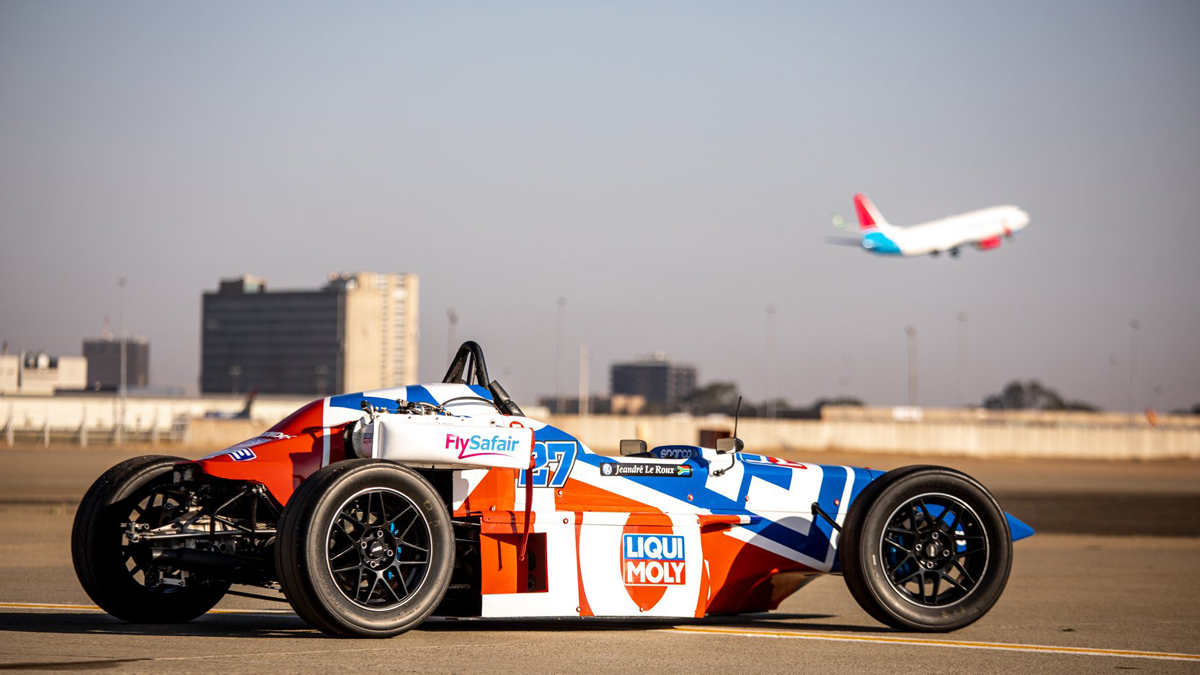
Liqui Moly has a long history in motorsport in Europe, the USA, the Middle East and Asia. Since 2015 Liqui Moly has been the sole lubricant sponsor in Moto2 and Moto3. Formula 1 signed a three-year deal in 2020. If these entities are happy to put their faith in Liqui Moly then count me in too!
Image source: Liqui Moly
For more information on Liqui Moly’s product range, click HERE.
The Roof of Africa is not known as the Mother of Hard Enduro for nothing: the days are long and the riding is as hard as you will find anywhere in the world.
Photo credit: ZCMC
The thing is, the days don’t end when you stop riding. The riders may be able to replenish their depleted energy levels and get some sleep, but the bikes also need a lot of attention if you’re not to be stranded out in the middle of nowhere the next day.
Of course, if it was easy, then the event wouldn’t separate the men from the boys but that’s not to say that you shouldn’t take advantage of any help that’s offered back in the pits.
For the 2022 Roof of Africa event, Yamaha bLU cRU is making an amazing offer to any competing Yamaha rider.
Photo Source: Yamaha
If you have entered the Roof of Africa on a Yamaha, you can expect to be treated like a factory racer for the duration of the event. bLU cRU Yamaha’s Roof support program is there to take the pressure off you and your crew by offering all Yamaha Roof entrants the following services:
The bLU cRU Yamaha Roof Support Centre will be set up at the official Roof Start/Finish area, in a massive 300sqm marquee tent!
Here, as you finish your day’s ride, bLU cRU Yamaha’s technicians will greet you, fill out a job card listing your necessary bike maintenance – and then wish you well as you depart to your accommodation for some well-earned R & R!
Photo Source: Yamaha
The next time you will see your fully prepped race bike will be on the start line the following morning! During that time, bLU cRU Yamaha technicians will take care of all your bikes requirements, which include:
Cleaning your bike
Changing your tyres/mousses
Air filters change
Oil changes
Chain lubes
Set up adjustments
In fact, whatever you require, they will be able to do it for you.
So, right now, you are asking yourself, ‘yeah, but how much will that cost?’ Well, we’re not sure if you’ll believe this but all of this is a FREE service provided to you by bLU cRU YAMAHA.
Photo Source: Yamaha
You will not pay for any labour, lubes, tyre changes, bike washes, or security – it has all been laid on for you courtesy of bLU cRU Yamaha! The only items you will have to pay for are any spares that you may require, of which they will have stock of most key items right there in the Maluti Mountains!
Also, you won’t need to stress about the safety of your bike overnight! Yamaha bLU cRU will have a security system in place, and your bike will be secure inside the marquee each night.
It’s all very well having the overnight maintenance and cleaning figured out but what about during the day, out in the middle of nowhere? Did you have to ask?
bLU cRU Yamaha will have a dedicated service crew at each DSP, offering mechanical and refuelling assistance to any Yamaha rider (or their crew) requiring these services. Gazebos, lubes, enviro-mats, fire extinguishers, and selected spares will be available to keep your race going! All your crew will have to do is ensure that your race fuel and body fuel arrives at the bLU cRU Gazebo situated at each DSP – the bLU cRU boys will do the rest for you!
Photo Source: Yamaha
So now, there really is no excuse not to get your entry in for the Roof of Africa. You don’t have to take our word for it: for more information, email Mark Roach at [email protected] or call him on 083 651 1677 or head to your nearest bLU cRU YAMAHA Dealer for any additional information.
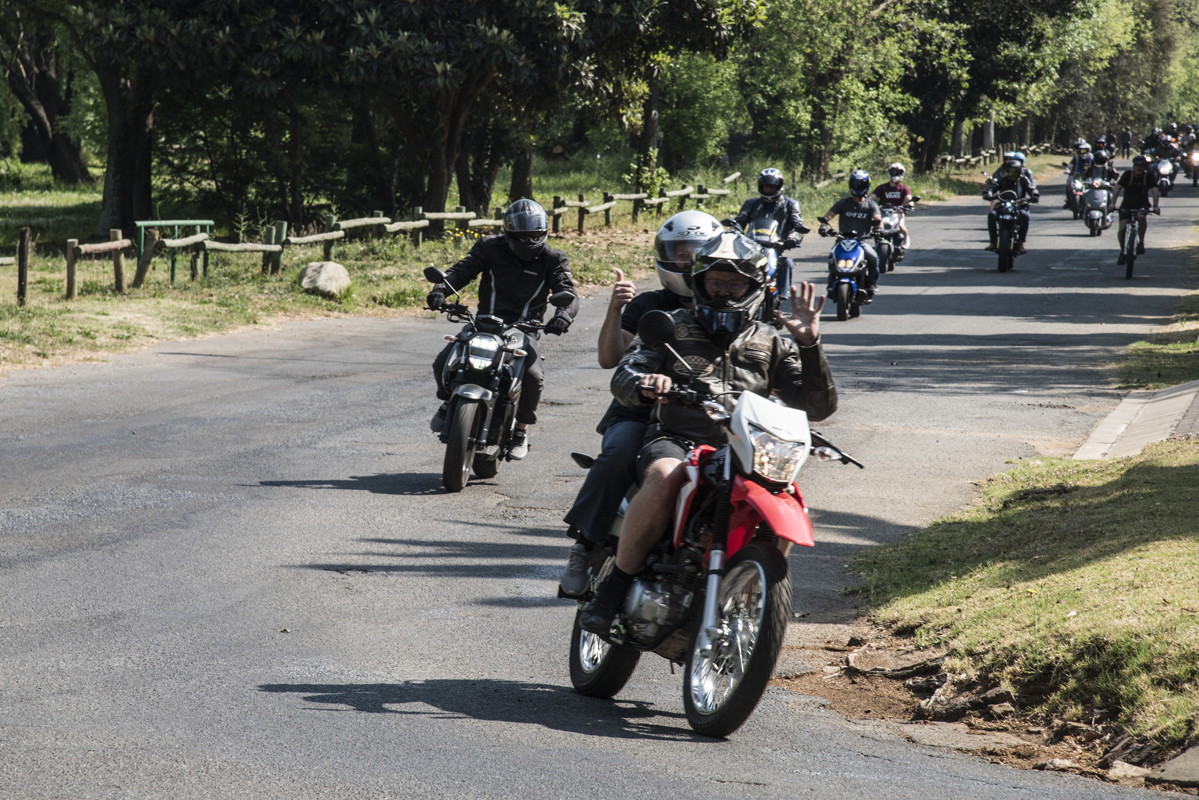
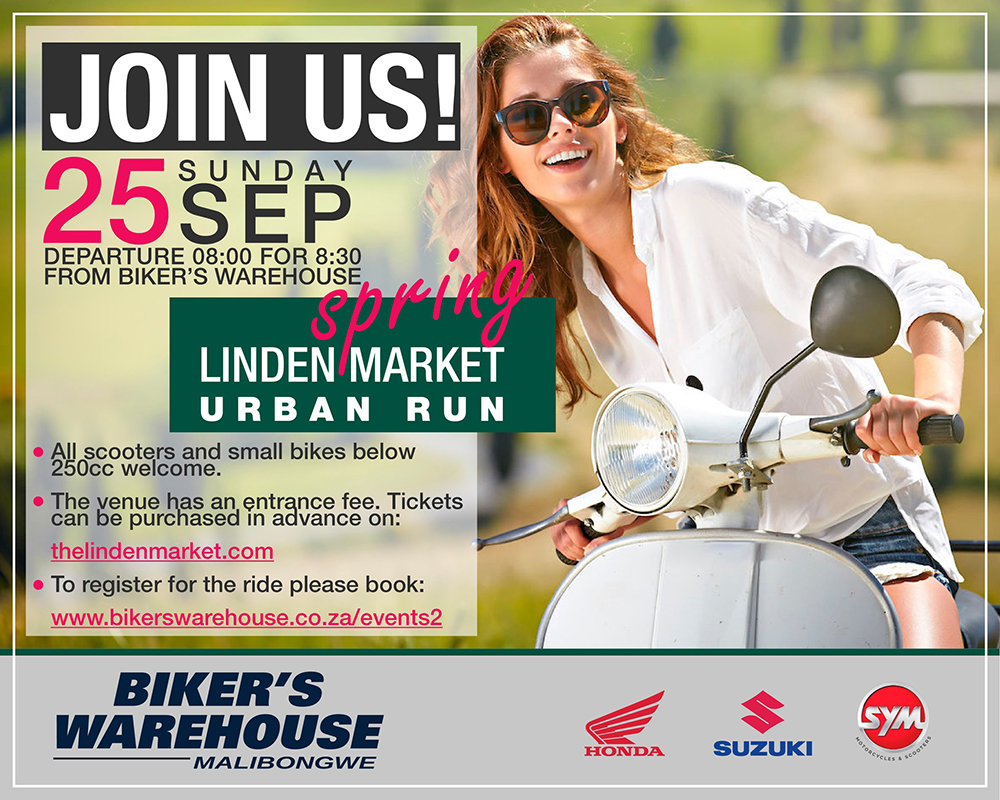
Spring has arrived and so too has another Biker’s Warehouse Urban Commuter Run. The second edition took place this past Sunday and with it arrived a fresh new group of riders, tweaked 250 cc beasties and some familiar faces from the motorcycle industry. As mentioned before, the Urban Commuter Run initially started its life as an ‘ease’ into biking for newer riders and late bloomers, but now it has too sparked an interest in those who ride big motorcycles but long to ride their small bikes with a bunch of fellow “little bike” lovers—those that appreciate the fun in the little things.
Photo credit: Bjorn Moreira / ZA Bikers
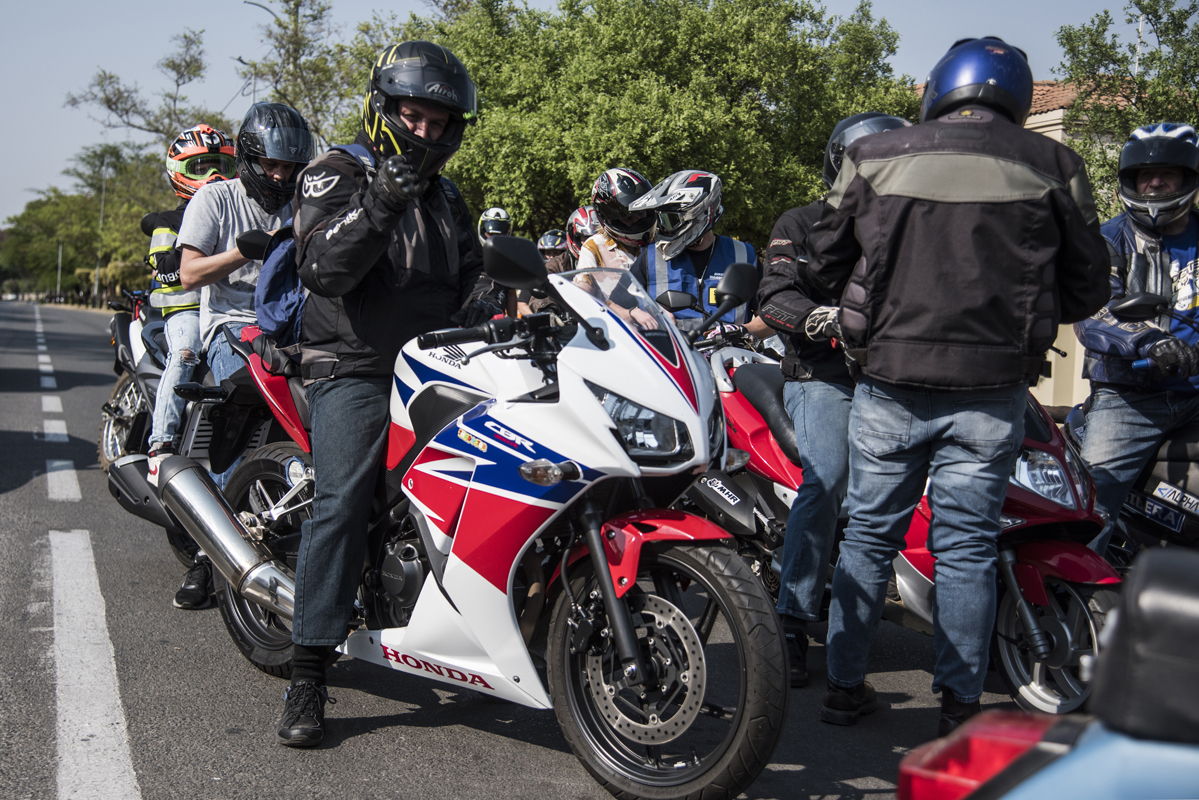
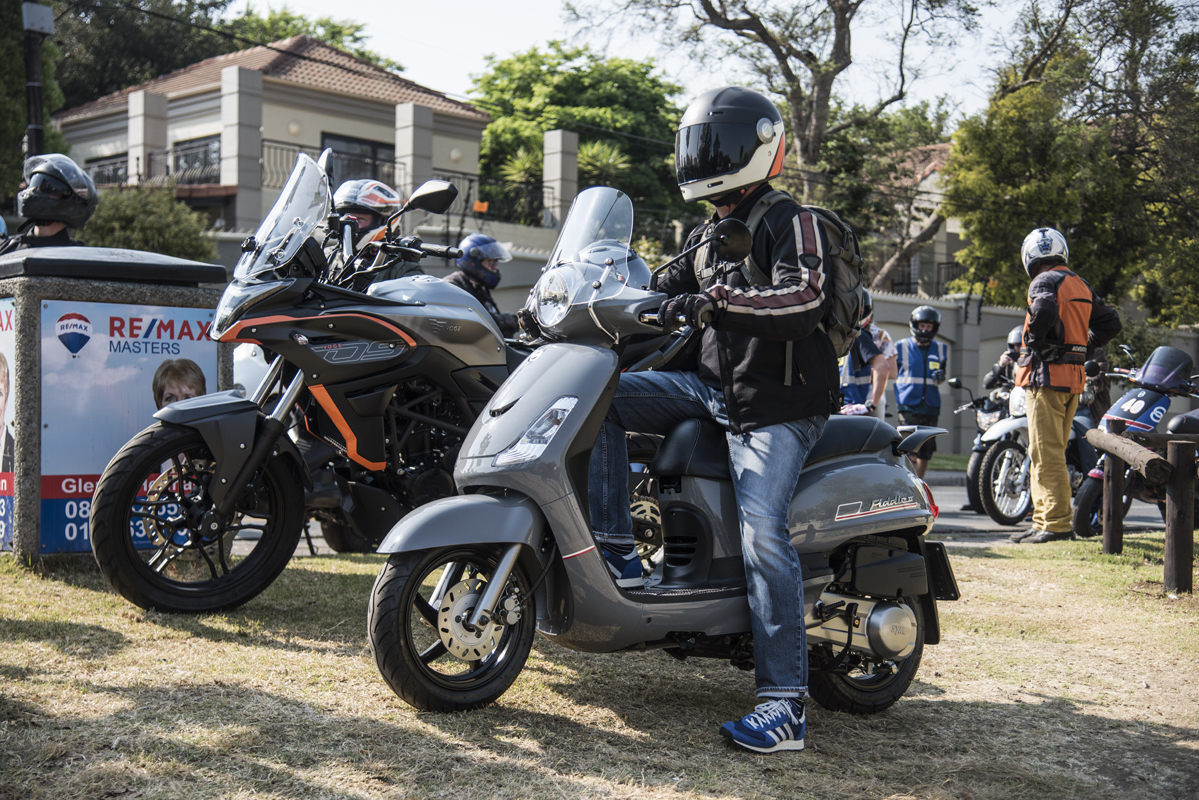
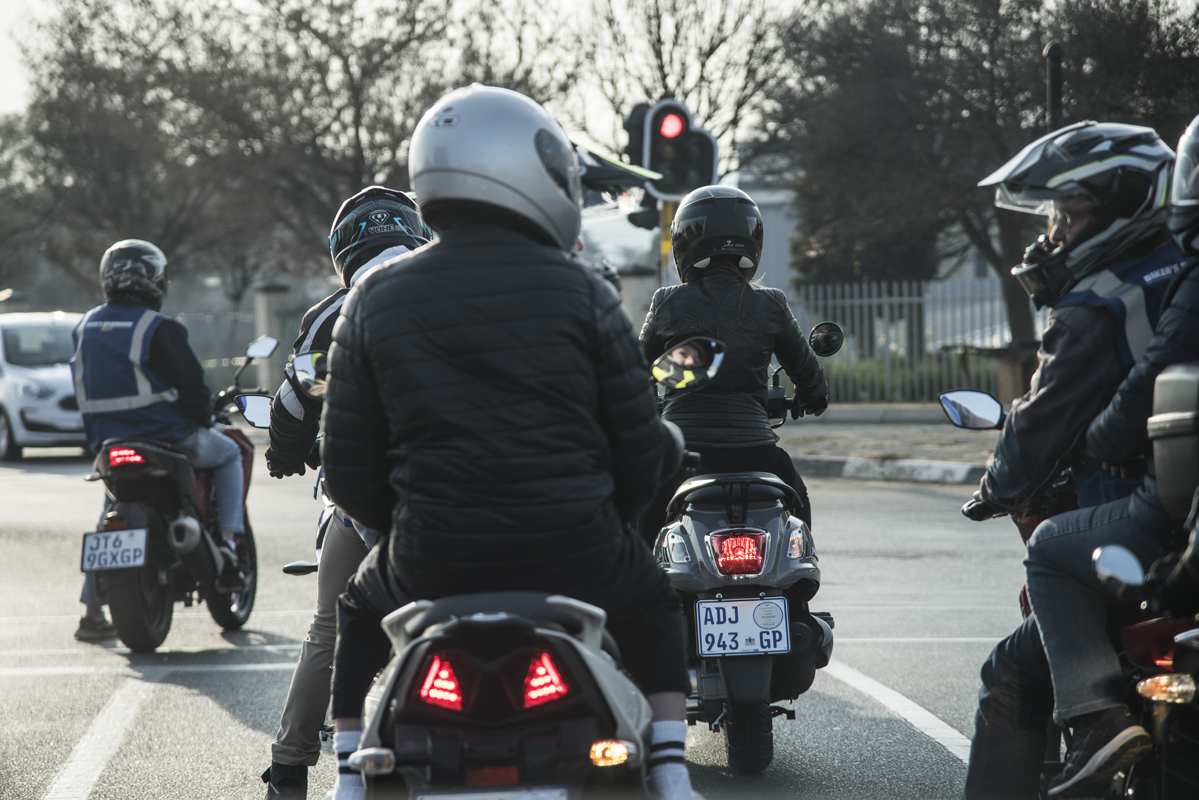
We arrived at Biker’s Warehouse (BW for short) early Sunday morning to a crowd of scoots, custom builds, 2-strokers and urban missiles, all under the 250 cc limit. Camaraderie comes with much time spent with one another but in the motorcycle community, it’s something that is almost sparked instantly, when the same interests spark the fuel-enriched friendship. This camaraderie was seen at our meetup point and continued throughout the ride and day.
Photo credit: Bjorn Moreira / ZA Bikers
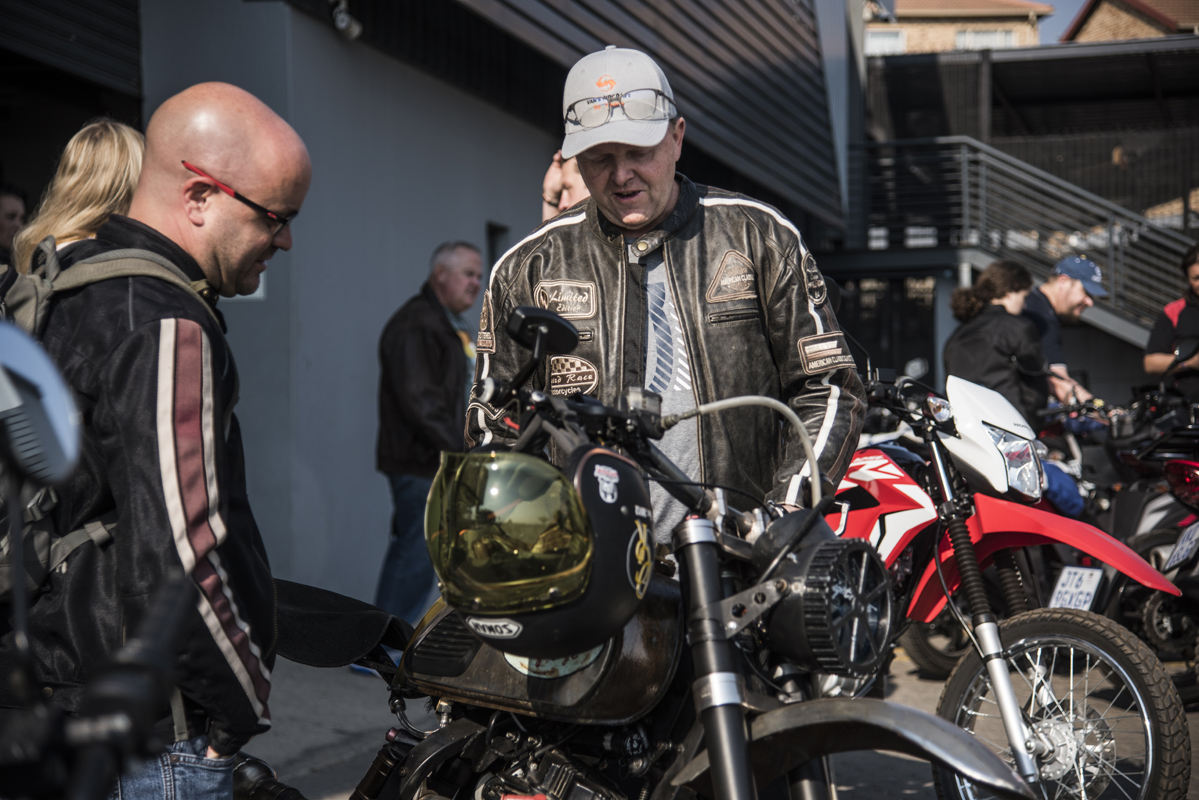
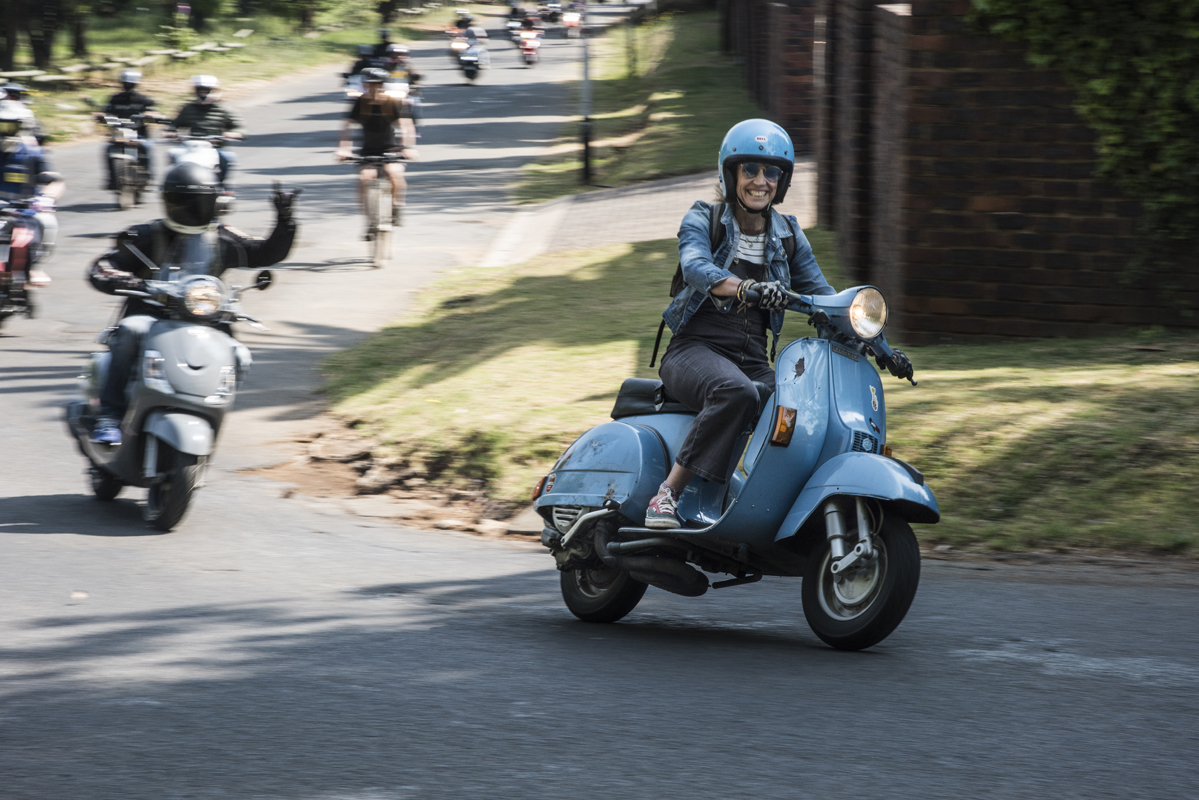
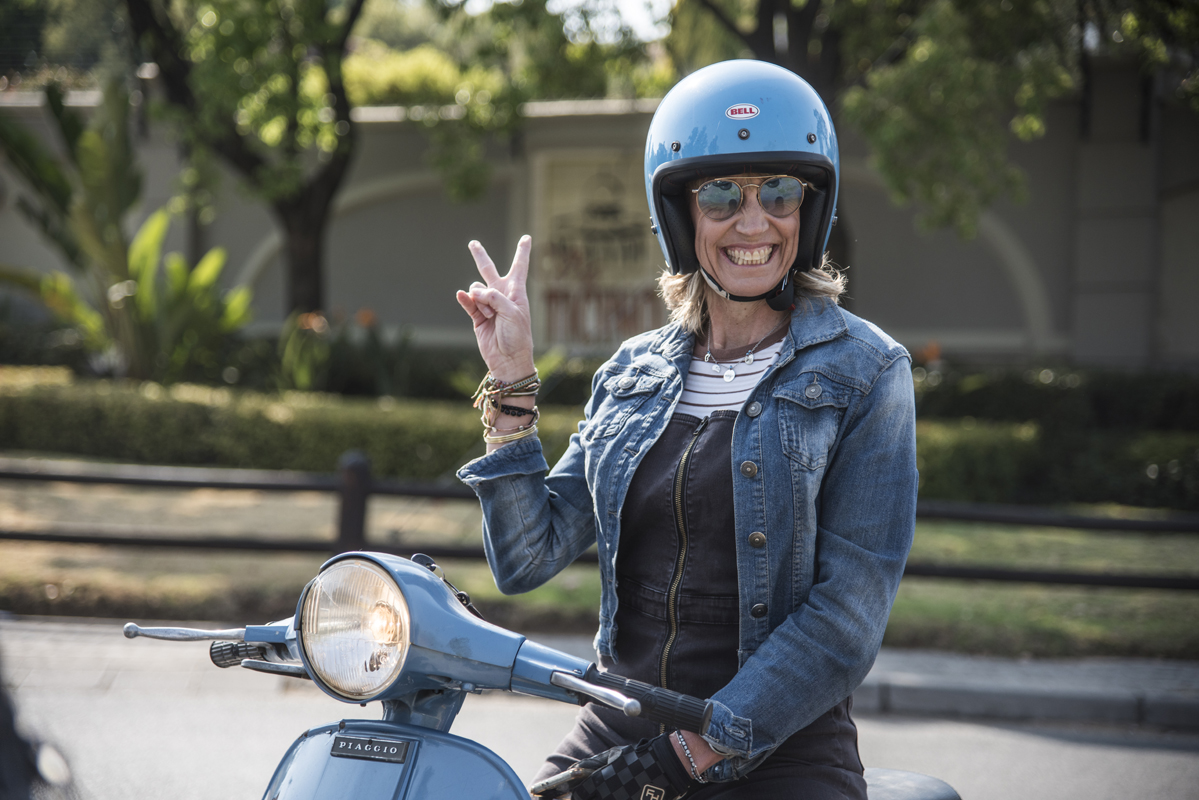
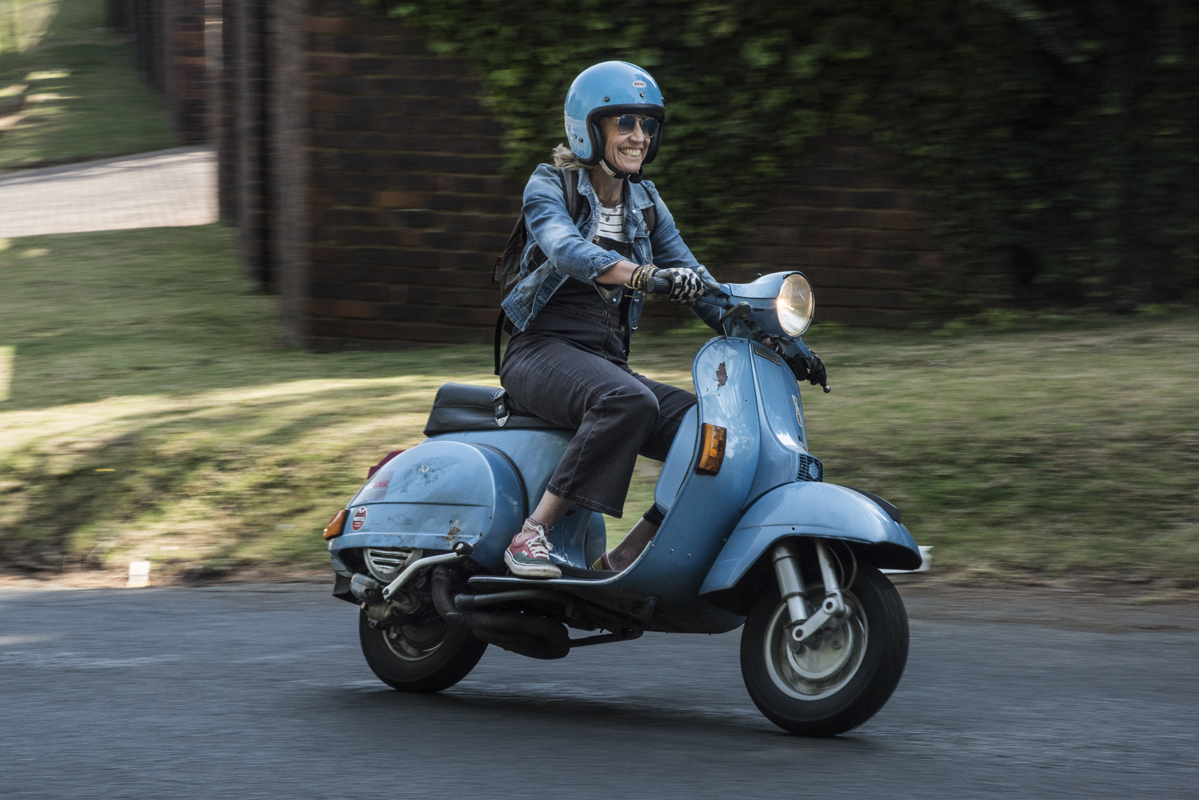
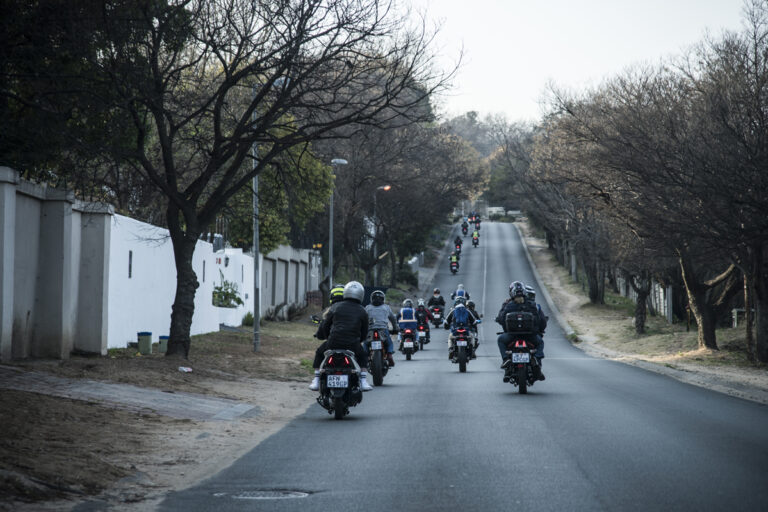
We rolled out of ‘BW’ just after 8:30 and filtered our way through some of Johannesburg’s back roads and inner city routes, before making our stop at the Linden market. Not only was the ride fun, but seeing the smiles and laughter made it so much more enjoyable. Mercia Jansen’s (Motul Area Manager for Southern and Eastern Africa) classic 2-stroke Vespa definitely took the cologne of the day award.
Photo credit: Bjorn Moreira / ZA Bikers
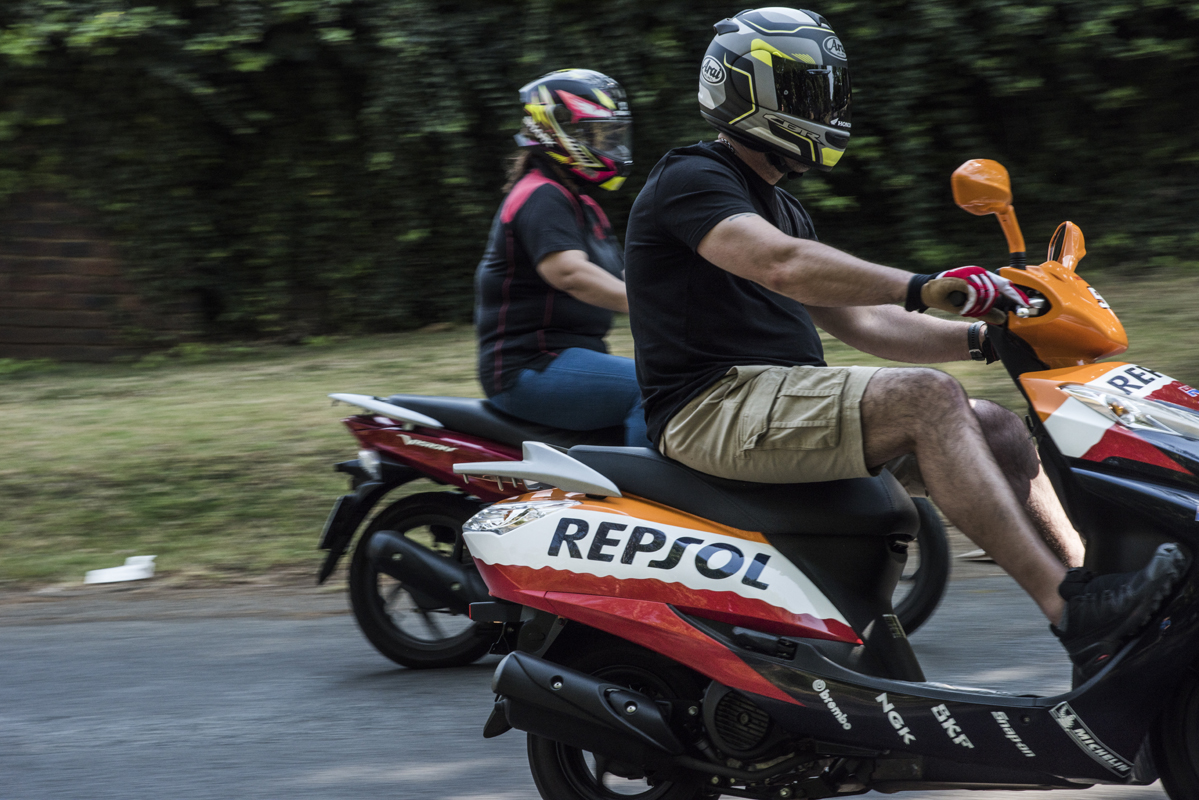
Riaan Fourie’s (Head of Motorcycles at Honda SA) Repsol wrapped Honda Elite 125 scooter certainly kept my mind wondering about how Marc Márquez was going to perform at Motegi.
Photo credit: Bjorn Moreira / ZA Bikers
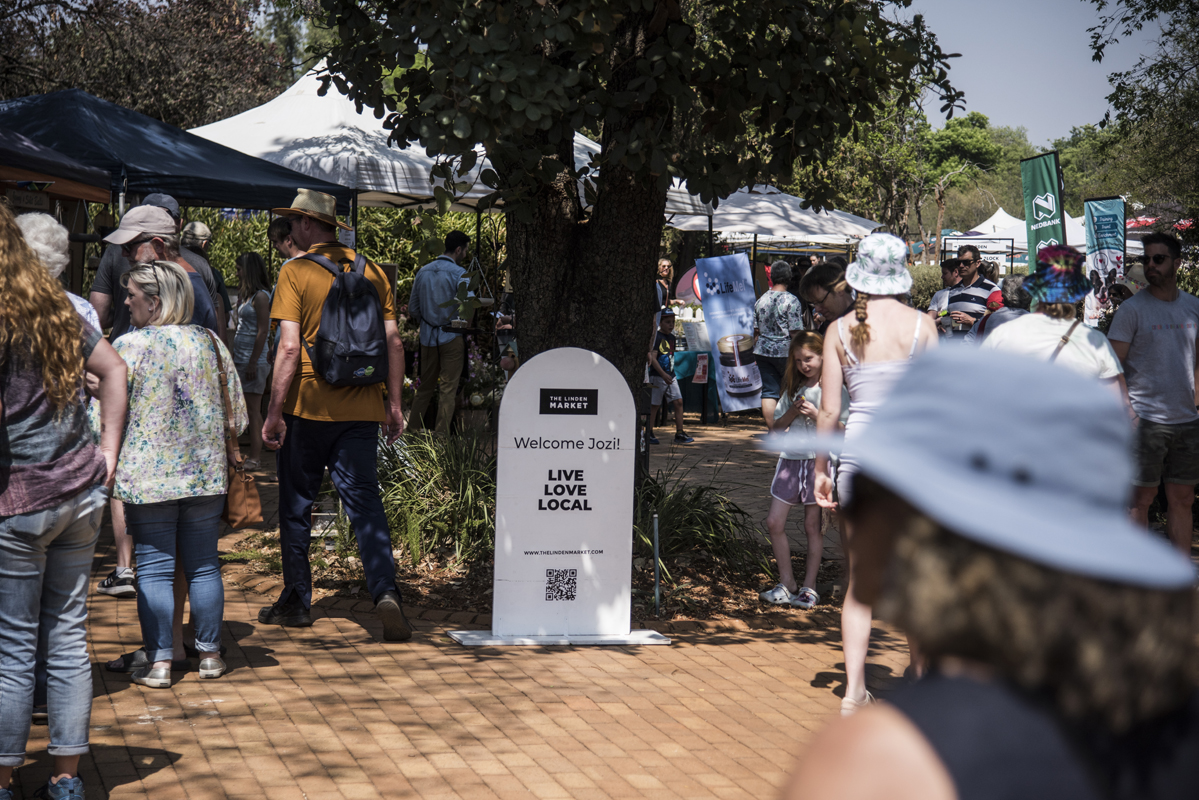
The Linden market soon greeted us 30 odd riders after our loop around the burbs with live music, food, clothing stalls and just about everything you can imagine bringing our ride to a happy close. The ride left us with much to socialise about and for the newcomers, excitement for the next ride was already brewing.
Photo credit: Bjorn Moreira / ZA Bikers
What a cracker this last Urban Commuter Run was, if you haven’t managed to join the last two please keep your eyes on the Biker’s Warehouse events section for their upcoming rides and other fun events. So, there you have it another successful event that has also picked up speed and a few new fans, who I’m sure will keep attending this event, especially if Biker’s Warehouse makes it a regular ride.
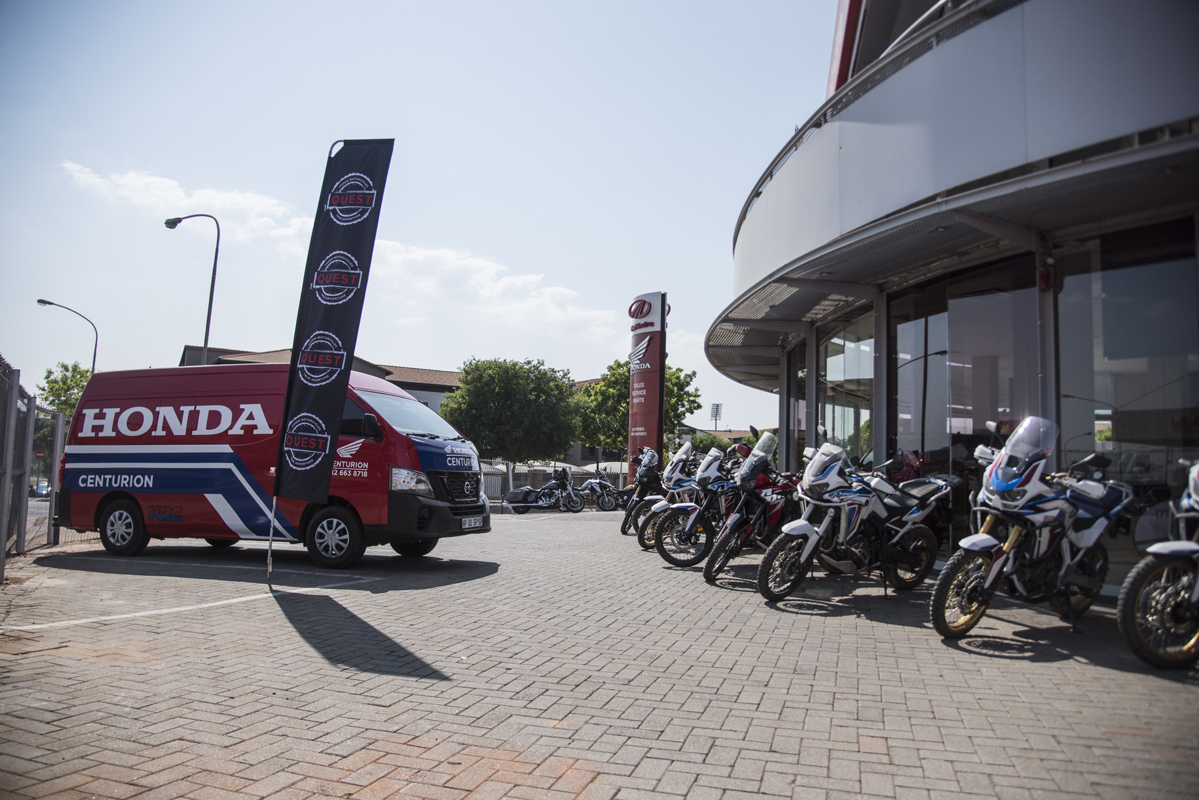
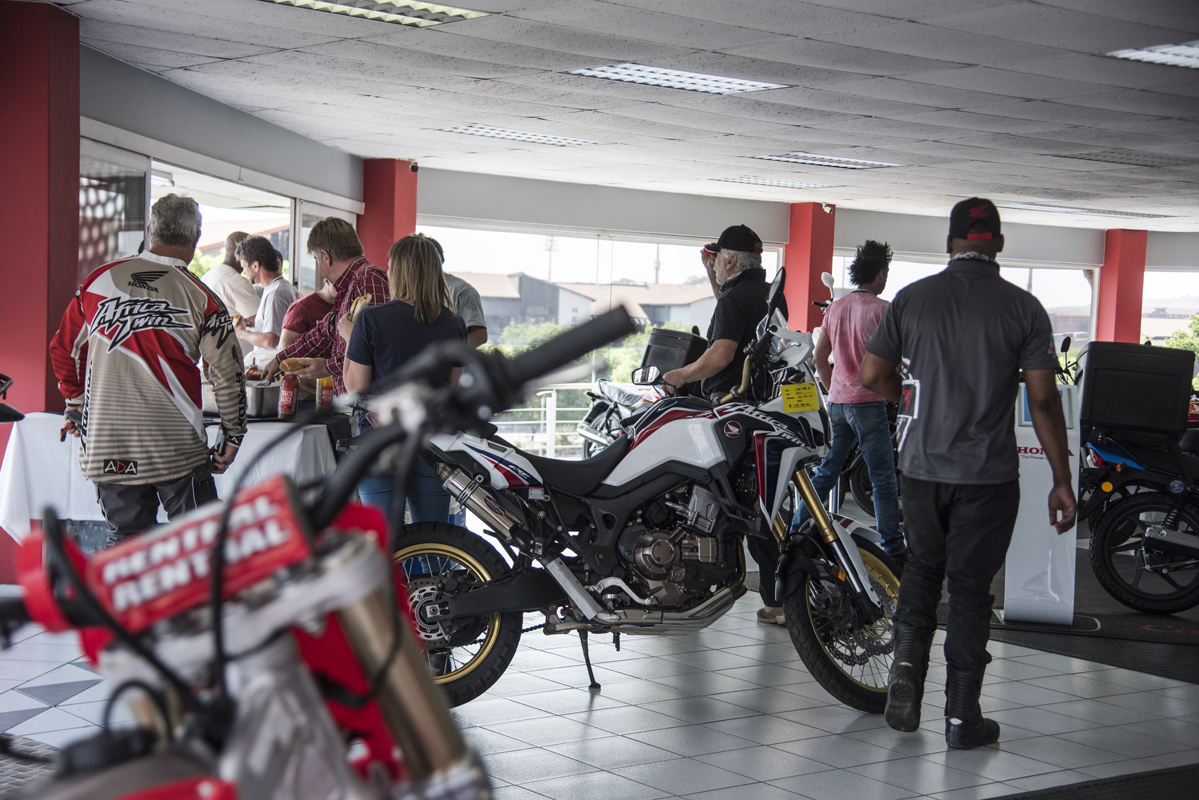
As we reported here, Honda South Africa has realised that its brilliant Quest adventure riding challenge needs a shot of publicity to bring it to the wider public’s attention.
To that end, Honda is sending a fleet of Africa Twins around the country to Honda Dealers to promote the event and not only give people the chance to ride the Africa Twin but also to encourage them to register to take part in the event.
Photo credit: Bjorn Moreira / ZA Bikers
Not that Honda has been short of entrants in the past, with 3-4,000 entries coming in which were then whittled down to 30 who would go on to attend a Boot Camp which would see the final 14 go through to the event itself.
As my esteemed colleague, Dave Cilliers, said, “In the past, Honda has not got the mileage out of Quest that was intended or deserved.” This has spurred Honda South Africa, most ably led by Riaan Fourie, to revise its approach, not to the event itself, but to the buzz around it.
Photo credit: Bjorn Moreira / ZA Bikers
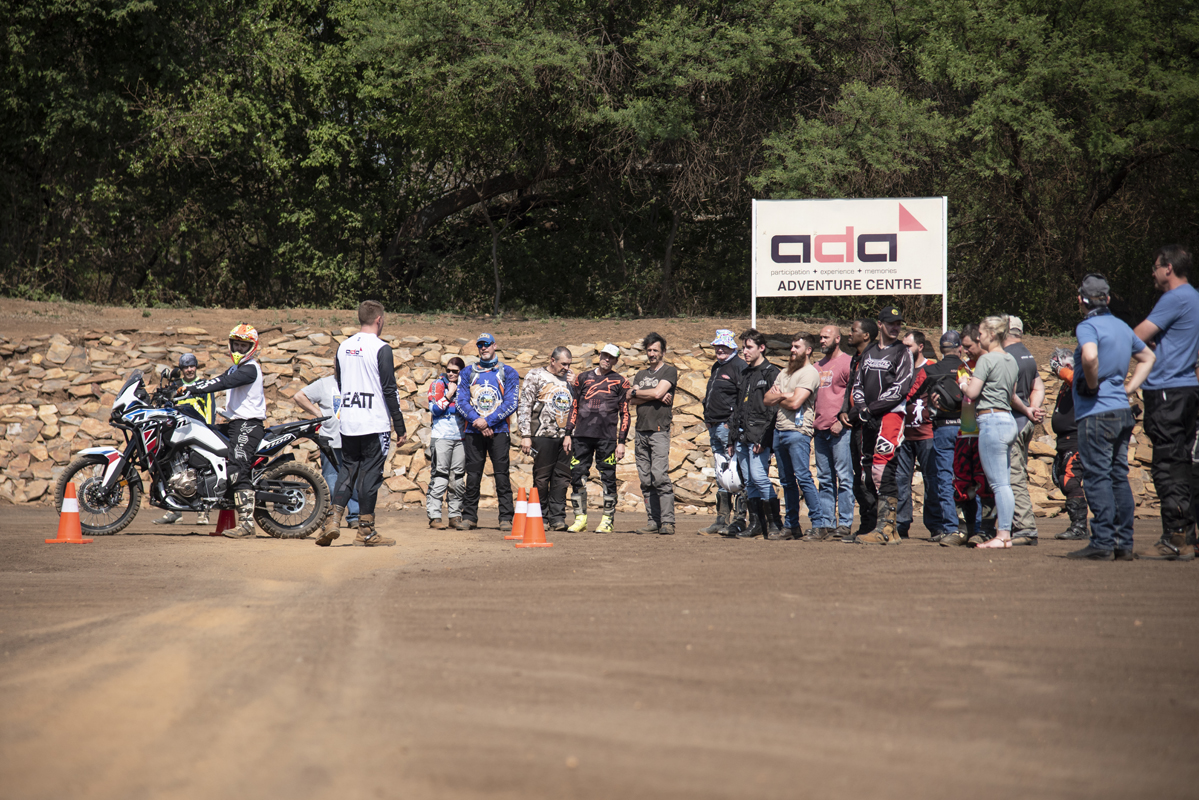
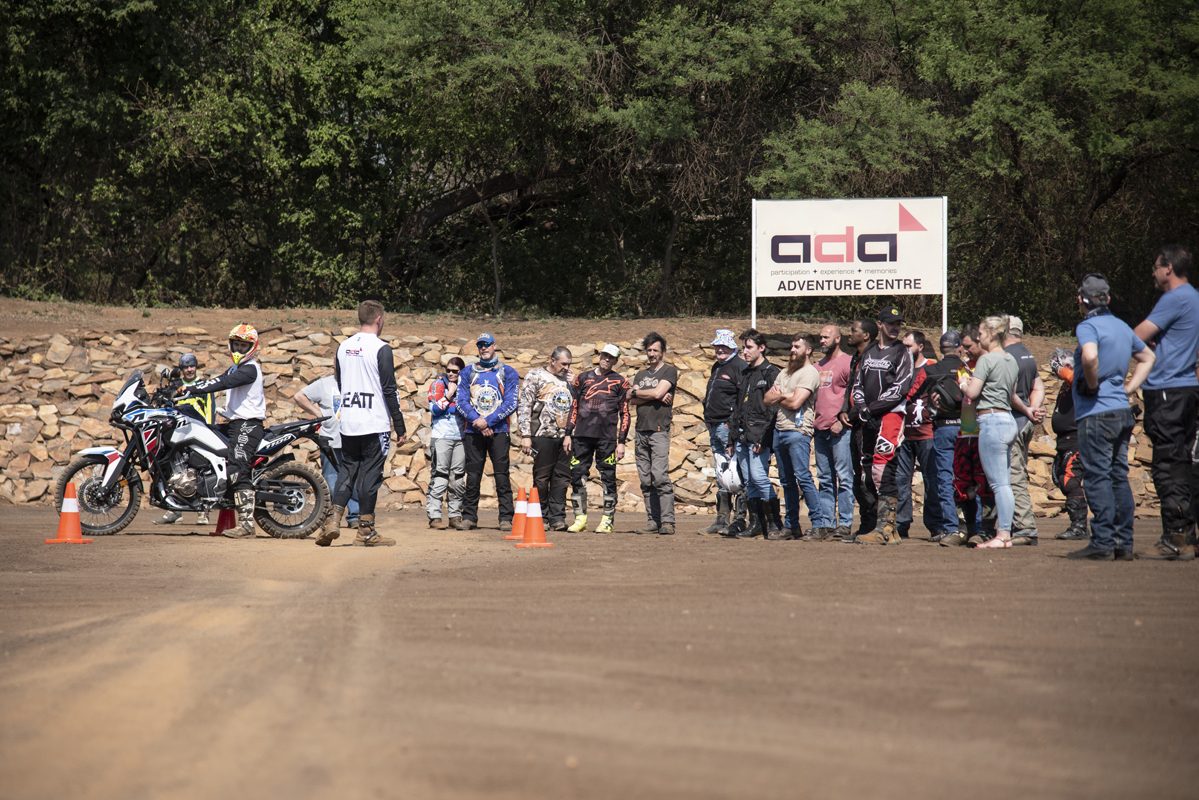
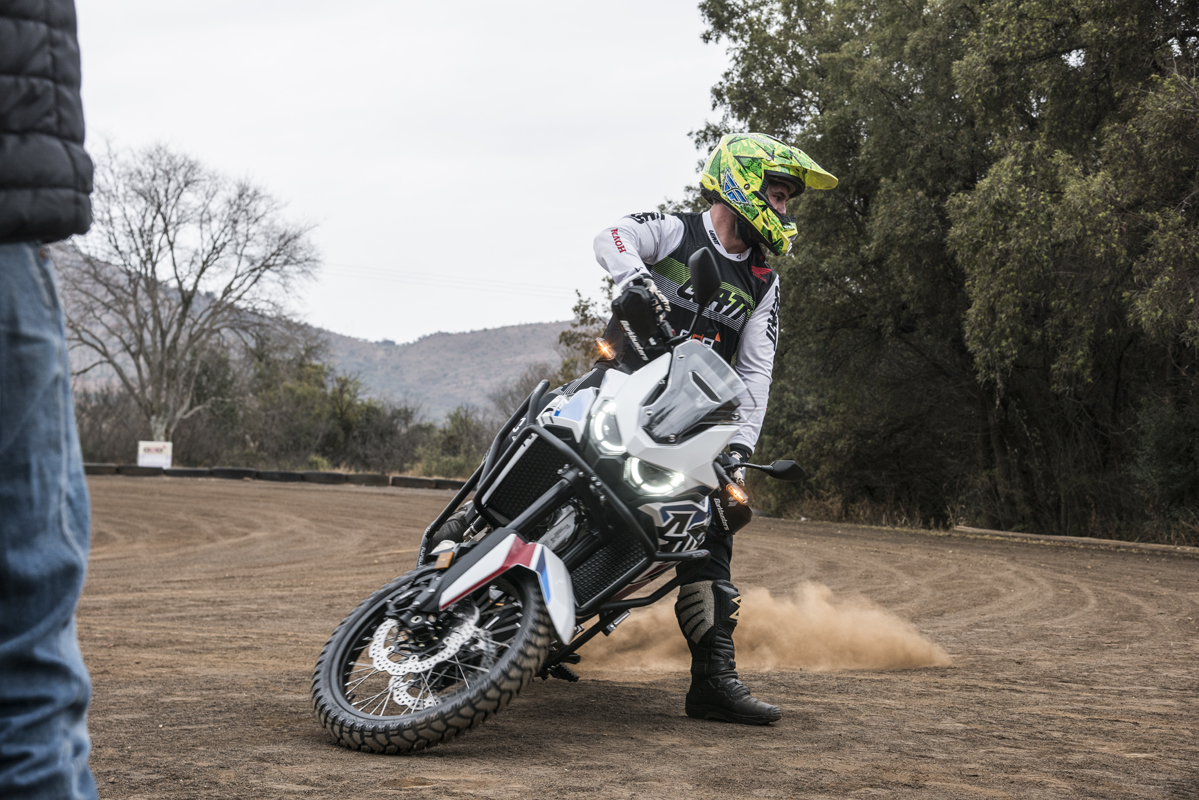
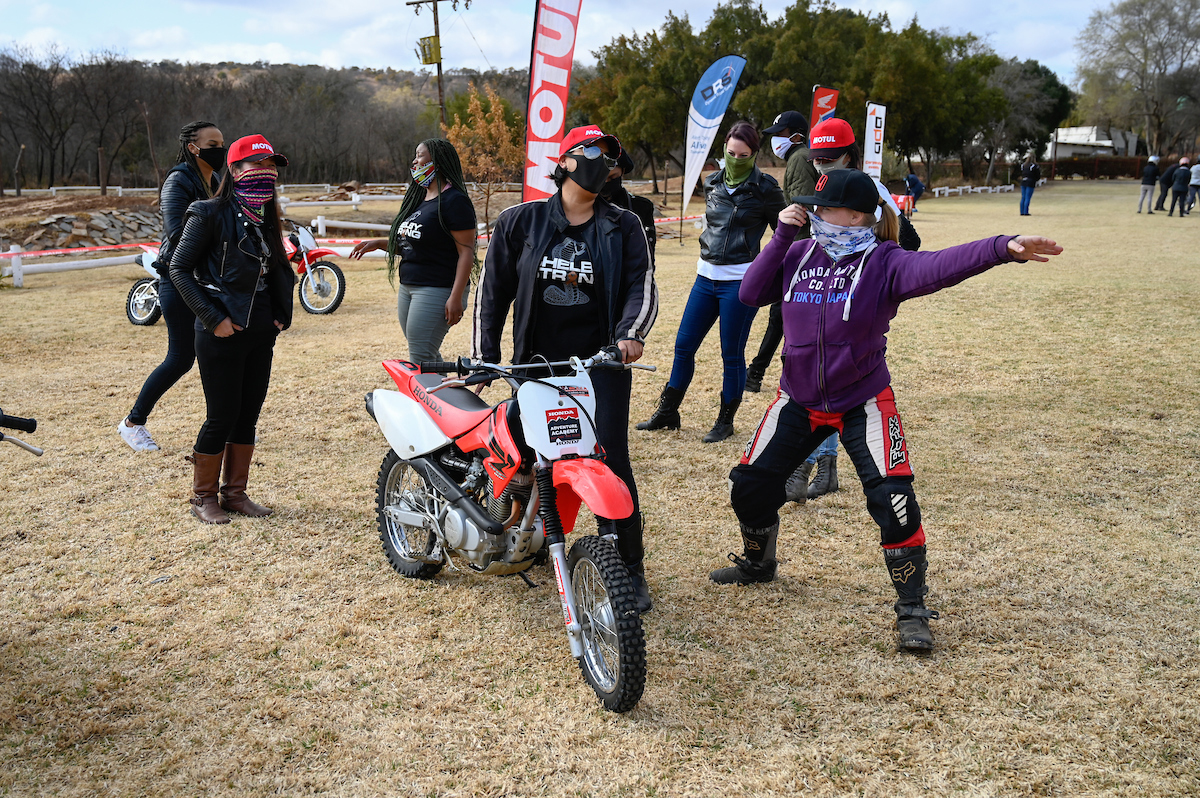
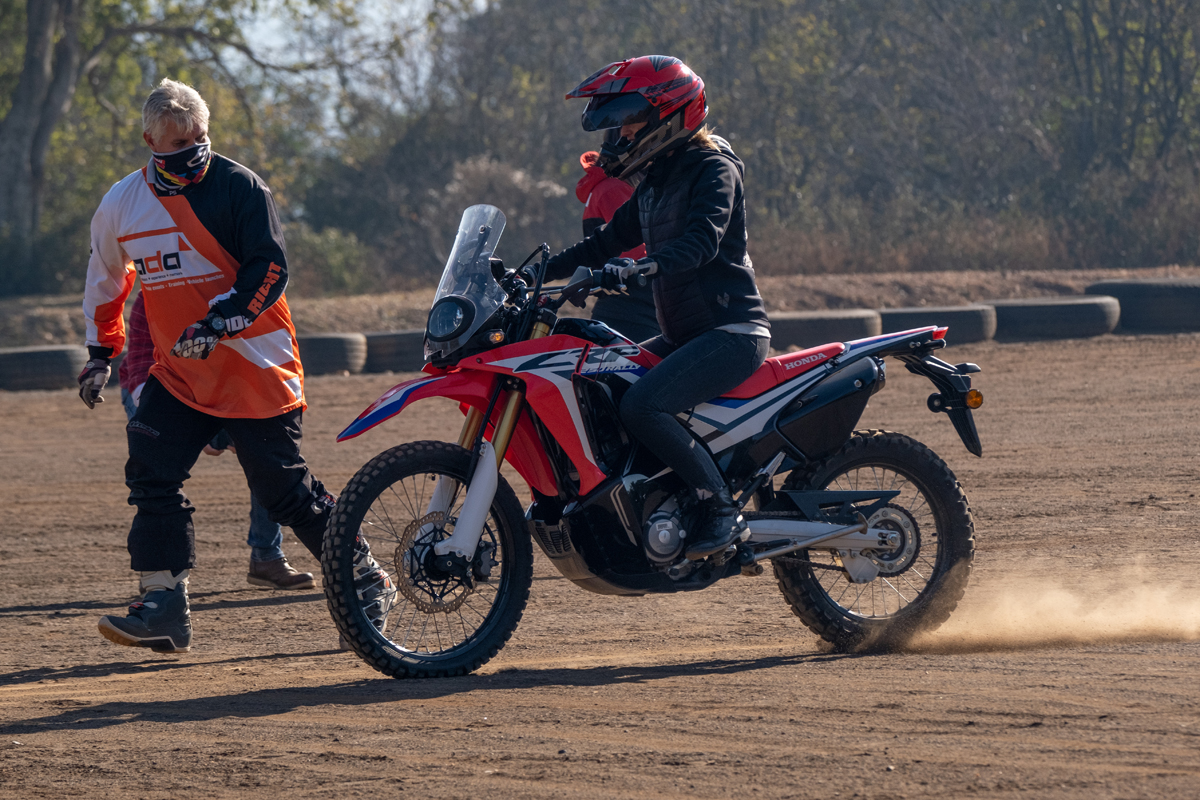
In order to do this, there will not only be the aforementioned Road to Quest events at dealers around the country but training days held at venues such as the ADA Training Facility near Hartebeespoort Dam.
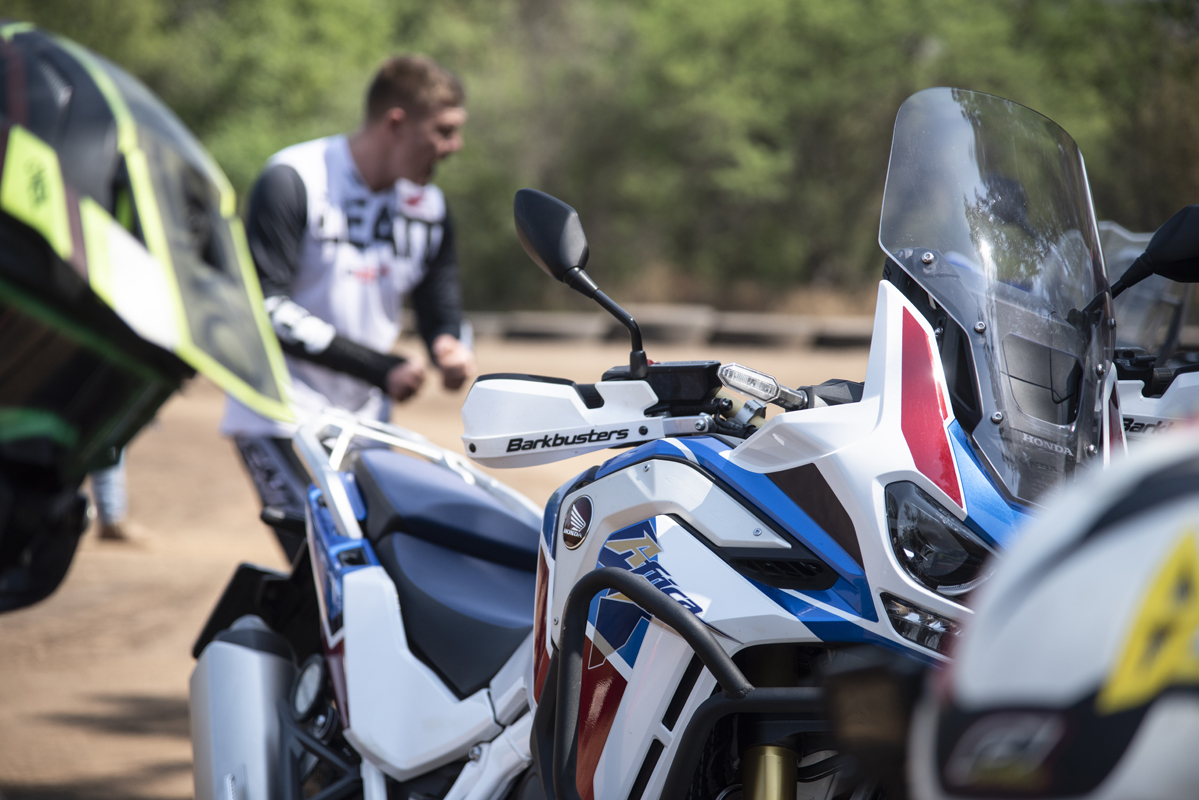
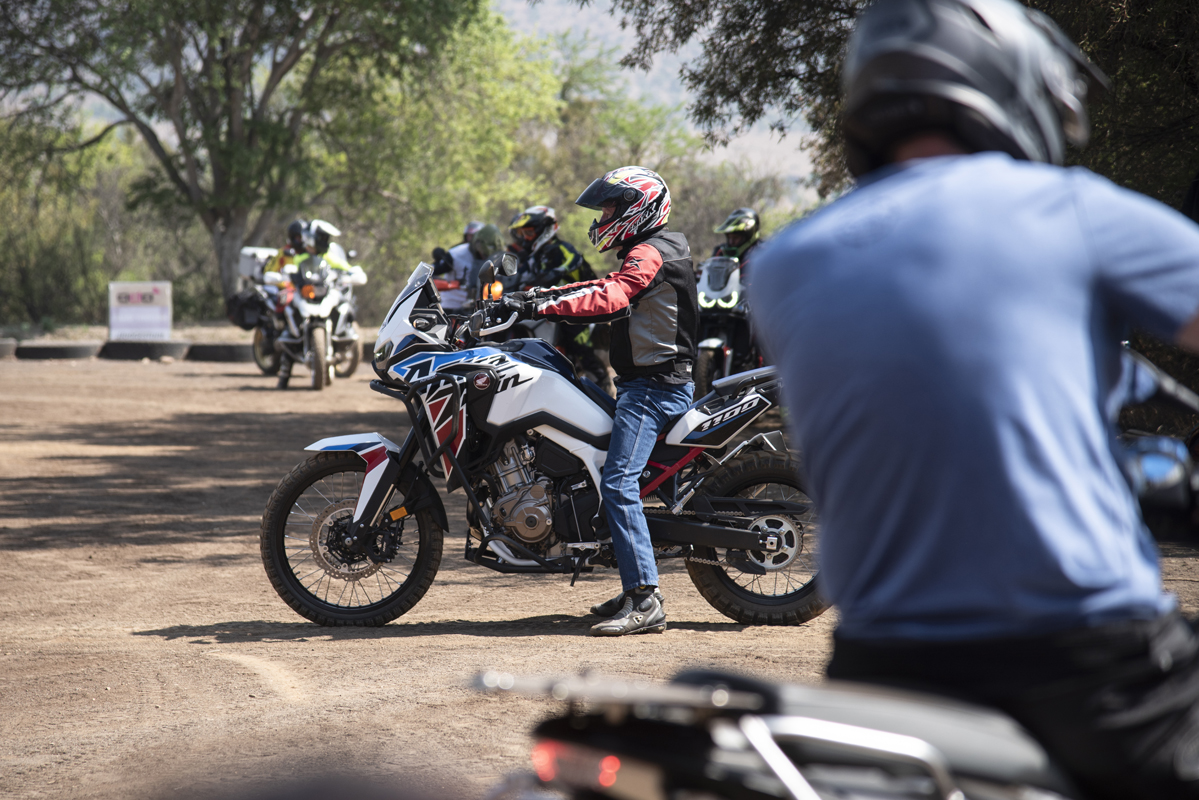
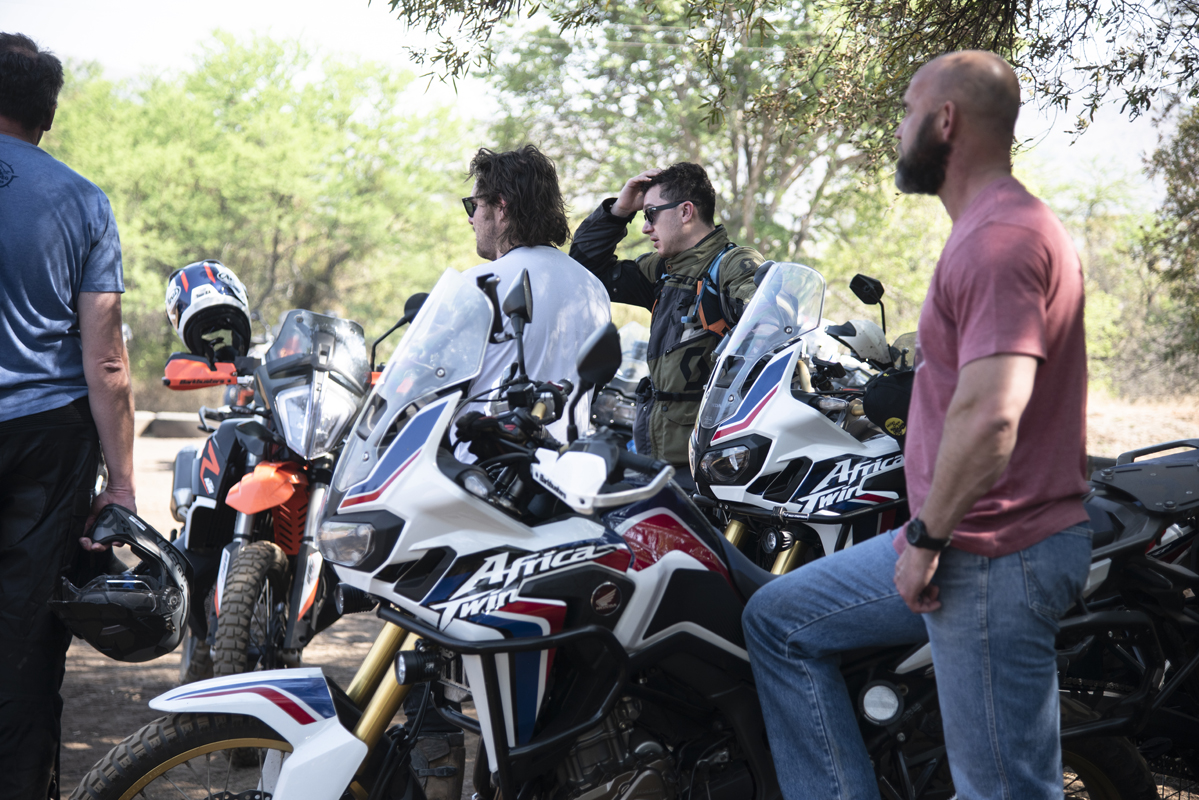
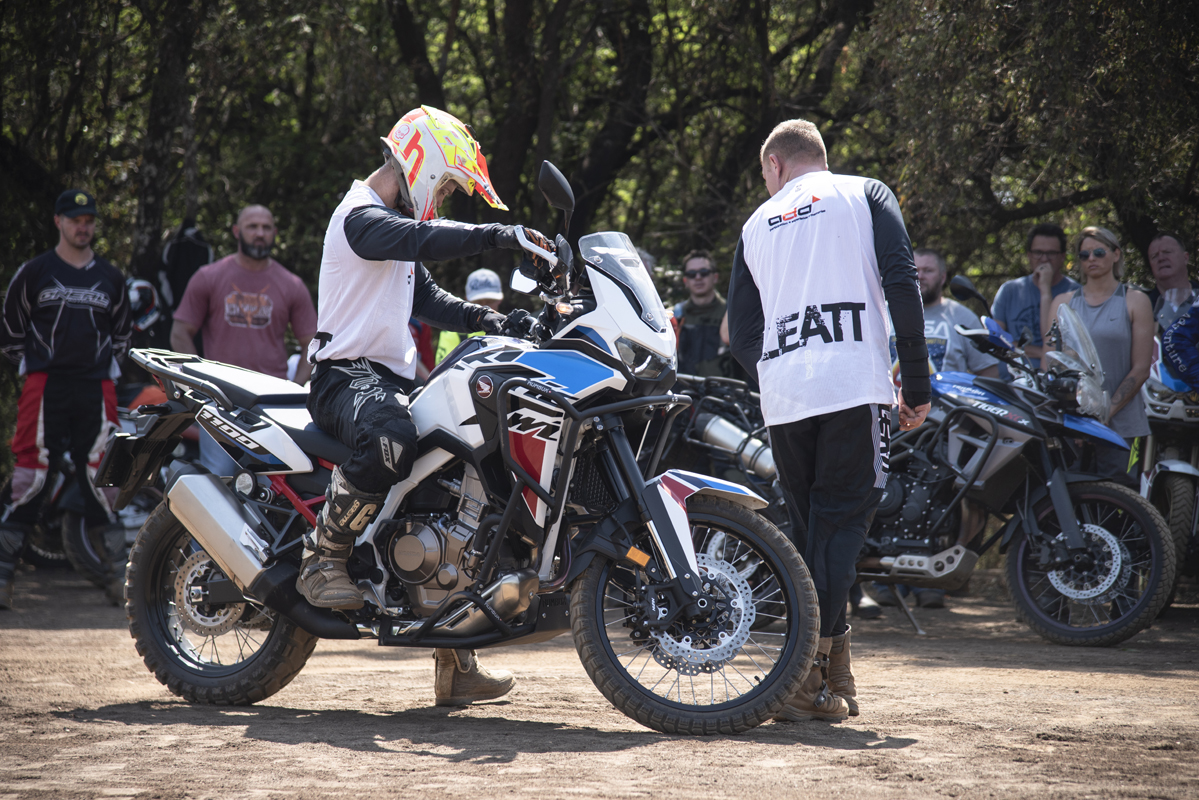
Riders of any make of adventure bike were invited, not just Honda and around 30 riders arrived on a mixture of KTM, BMW, Triumph and Honda motorcycles for what proved to be a relaxed but instructive morning in the capable hands of Diete Engelbrecht and the team at ADA.
Photo credit: Bjorn Moreira / ZA Bikers
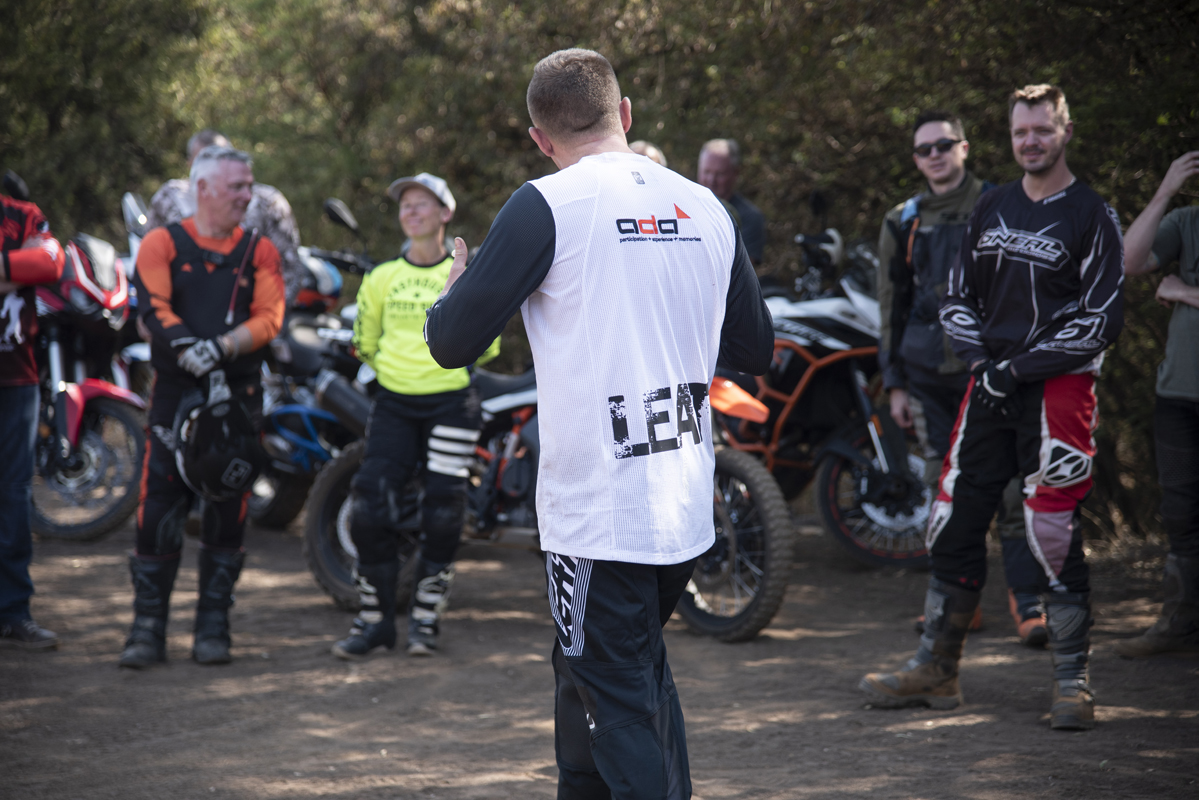
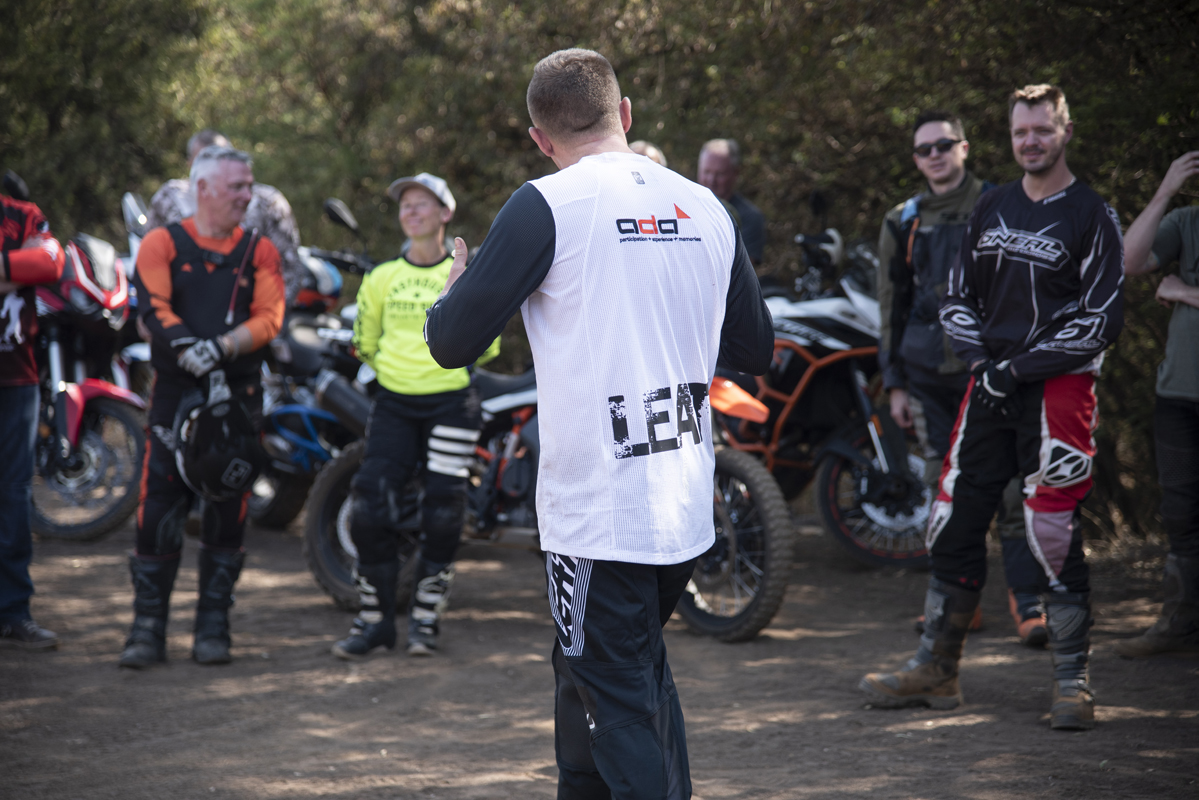
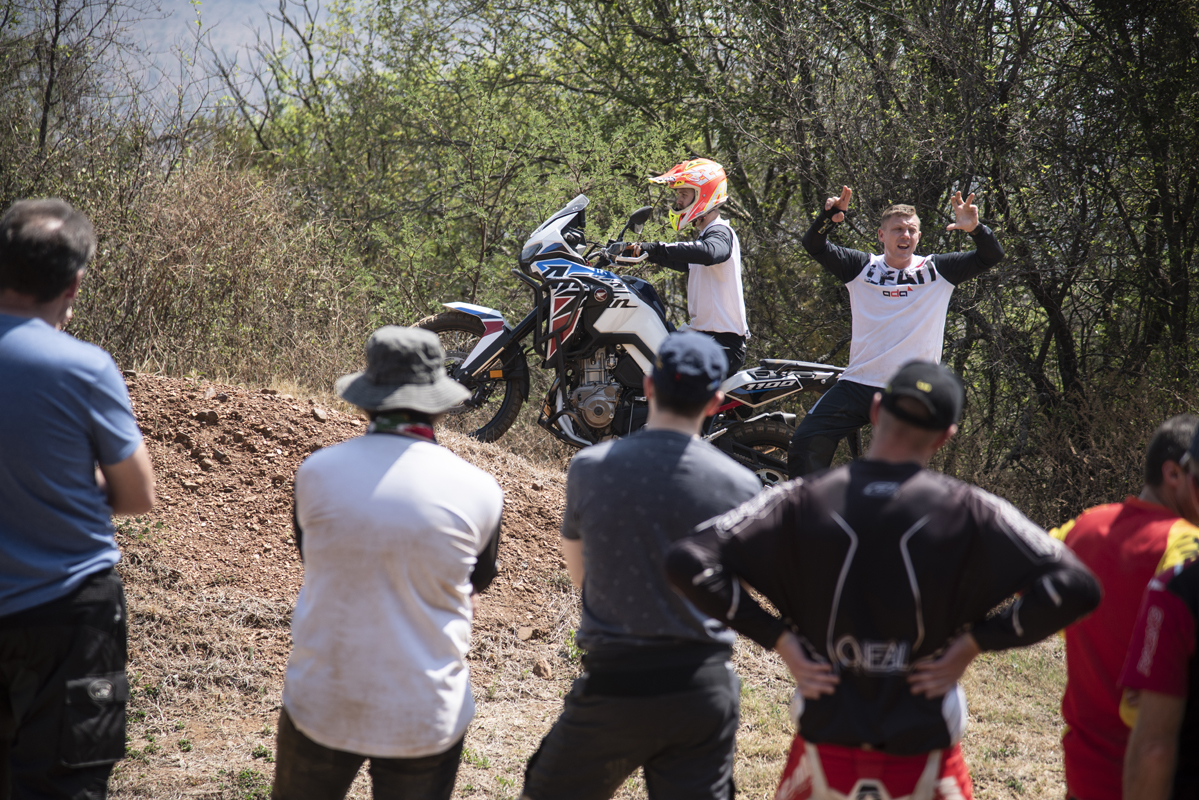
The team at ADA are well versed in the different skill levels of riders who visit them for training and know that pushing riders too far too fast will only lead to them becoming discouraged rather than encouraged, not to mention damaged motorcycles and riders. Diete managed the morning with a nice line of humour and he also has the knack of making you believe you can do anything with the right approach.
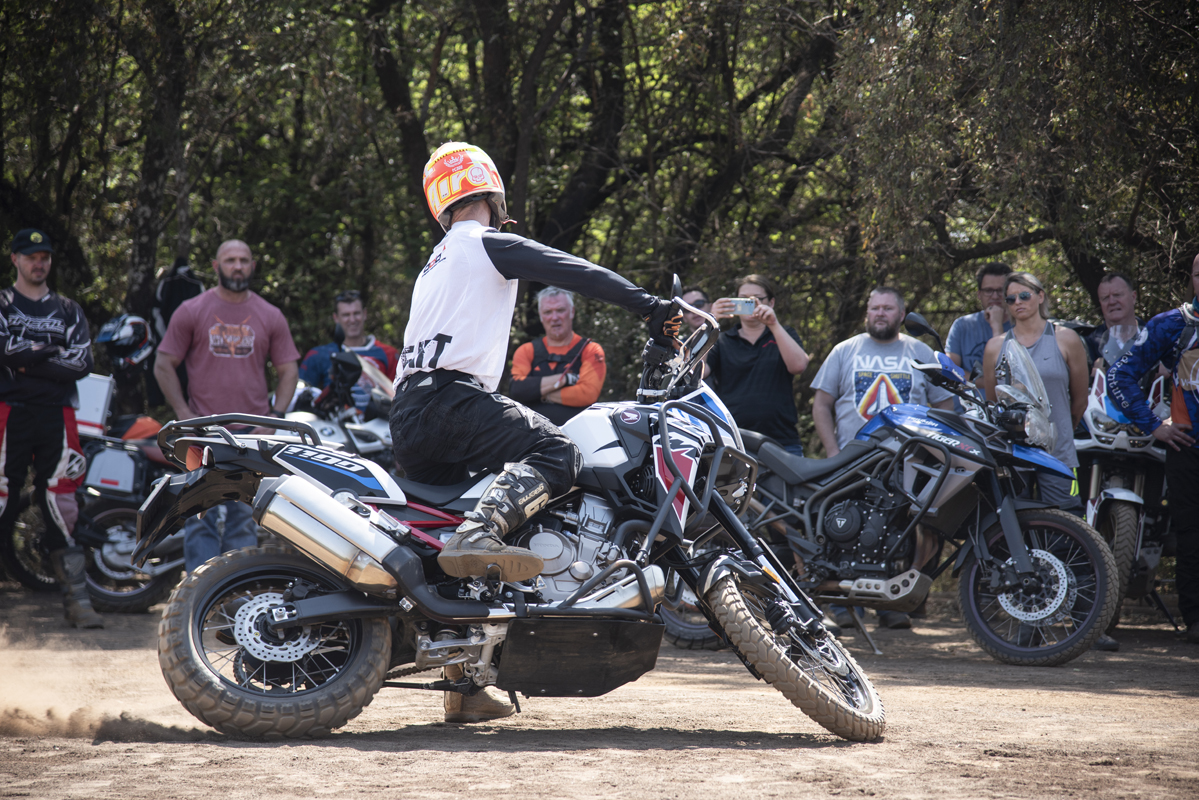
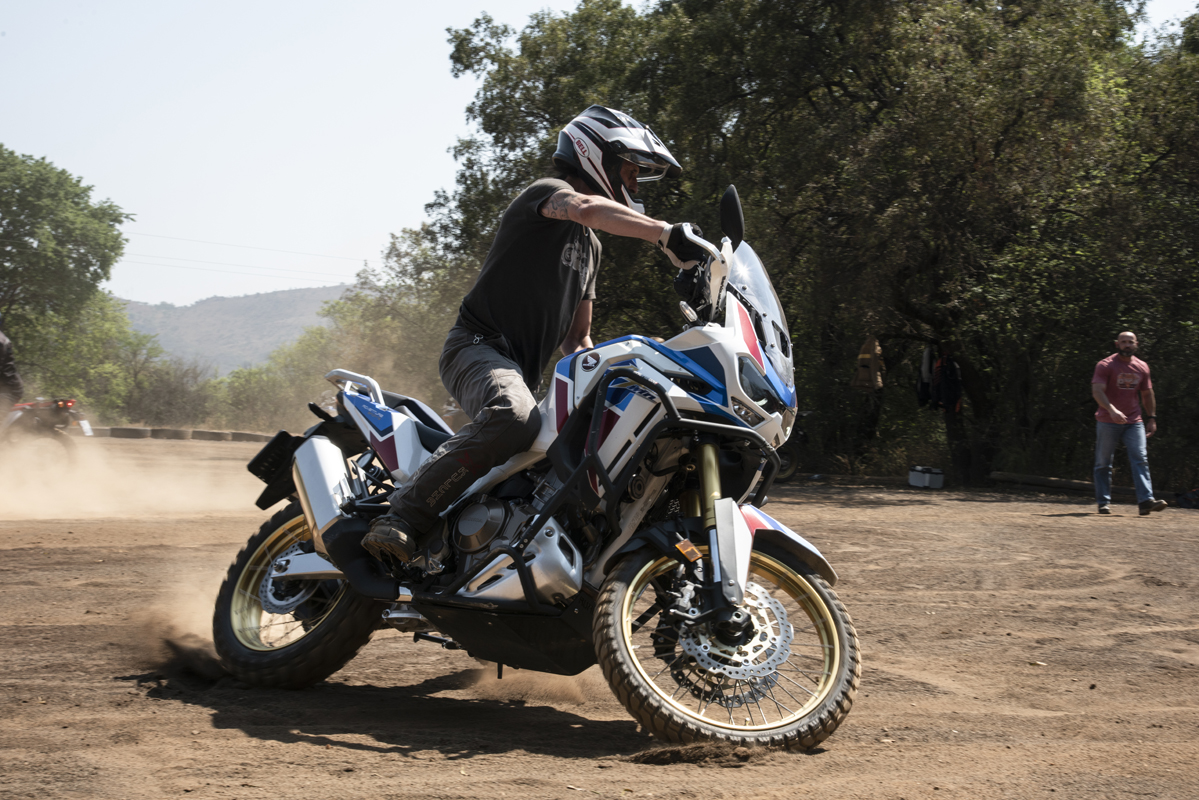
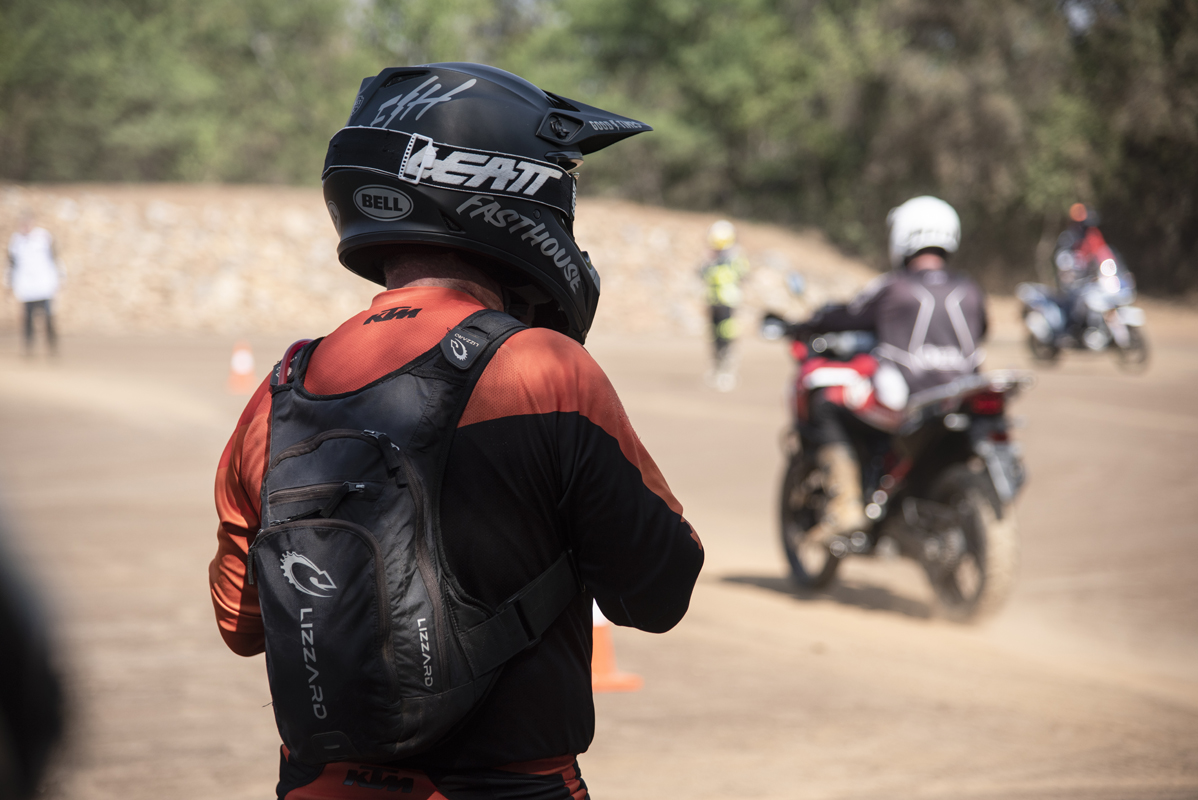
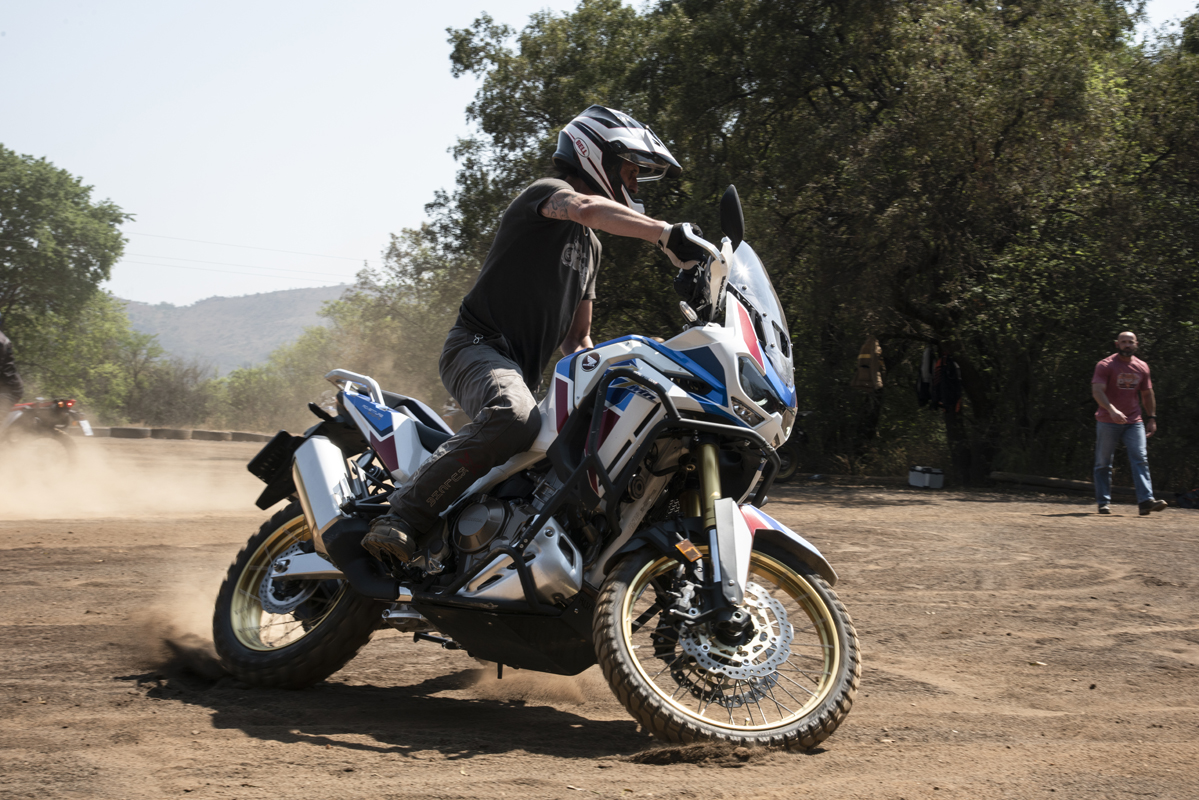
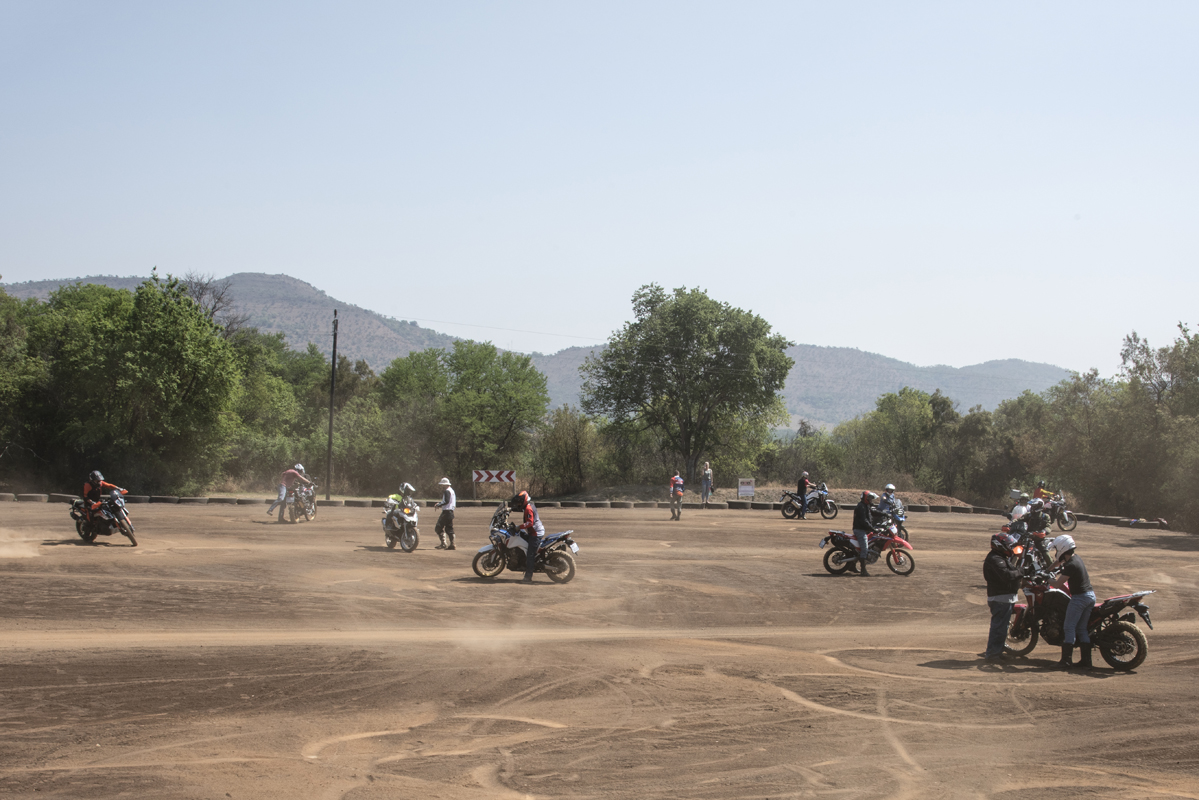
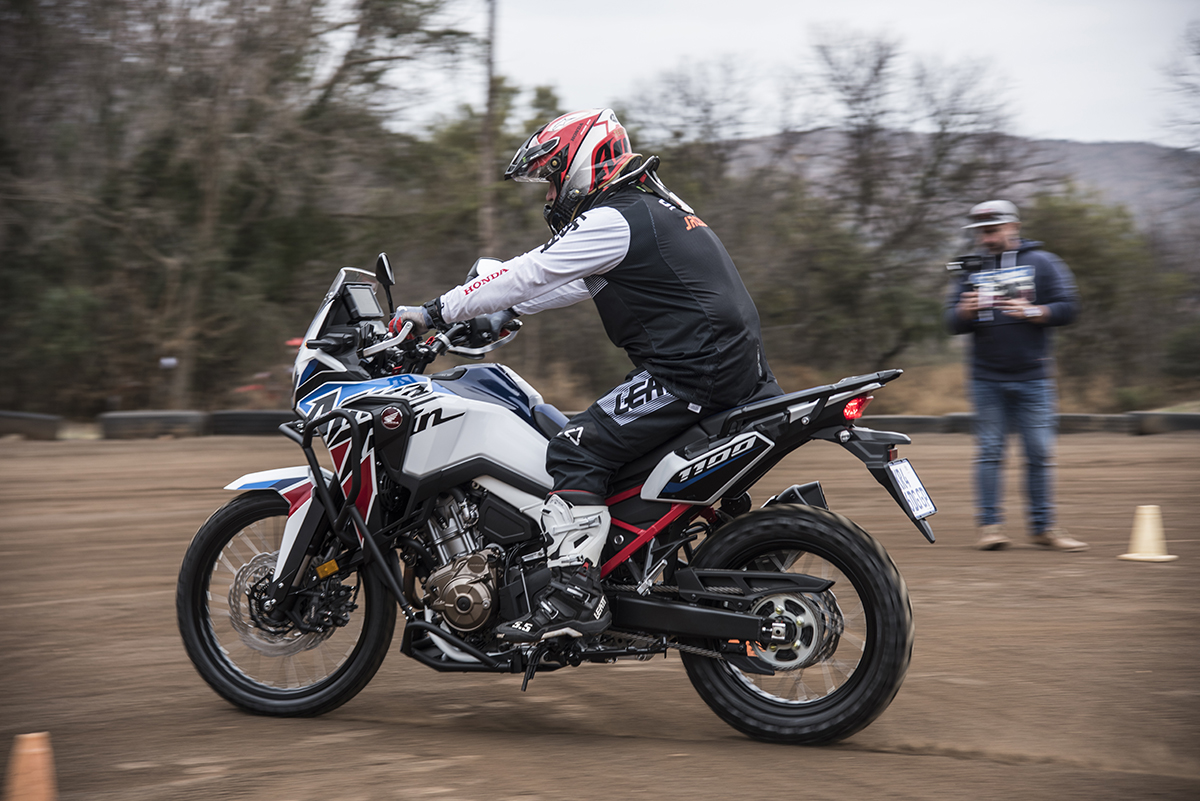
Nothing we did was extreme or dangerous but that’s not to say it wasn’t challenging. The majority of the day took place on the skid pan and concentrated on the basics: picking up a bike on its side, skid braking (with rear brake only), skid turns and pivot turns.
Photo credit: Bjorn Moreira / ZA Bikers
At all times, we were encouraged to leave our own personal bubbles and take a look around to see how others were faring. Invariably, that involved noticing that nearly everyone else was just as bad as you were and that bikes were on their sides left, right and centre. Clever psychology, that: it made you feel as if you might not be the worst rider there and that, just maybe, you had a handle on the techniques and skill required.
A couple of exercises on small, but steep, slopes and a spell in the sand pit rounded off the day and, while all that might sound rather tame to those of you who ride adventure trails weekend in, weekend out, there are many of us who only manage to do it once in a blue moon and a short reminder course such as this is the perfect way to get your eye in again.
Photo credit: Bjorn Moreira / ZA Bikers
I’m not sure there wasn’t one attendee who didn’t regret the day was over so soon nor, similarly, that there wasn’t anyone there who hadn’t surprised themselves. With the right instruction, you quickly discover new and unsuspected depths to your talents.
Of course, the main thrust of the day was to let people know that you don’t have to be an expert to enter the Quest. There are many entrants who have got through to the final stage who have never so much as imagined they could ride through thick sand, let alone do it. Many of the successful entrants are committed road riders with absolutely no experience in adventure riding. Very few are Roof of Africa-quality riders.
Photo credit: Bjorn Moreira / ZA Bikers
The ultimate skill is not the purpose of the Quest: the thinking behind the event is to take people out of their comfort zones and watch how they cope with adversity, and how it brings out the best in them. Are they team players? Can they see further than their own challenges and consider others and the environment through which they are travelling? Can they lift up those who are struggling both physically and mentally while maintaining their own morale? Do they constantly put themselves second?
If the answer to any of these questions is yes, then you need to stop procrastinating and get your entry in. They are not open yet but will be soon. Keep an eye on Honda Wing SA’s Facebook page for further notices.
Photo credit: Bjorn Moreira / ZA Bikers
Will I be entering? You bet I will. Right now, after the couple of years we’ve all endured, I need something to remind me to take more time to push myself and realise that I’m not alone: that others might be worse off than me and that maybe I can help them. If it involves riding a motorcycle through this incredible country we call home, then so much the better.
See you at the starting line!
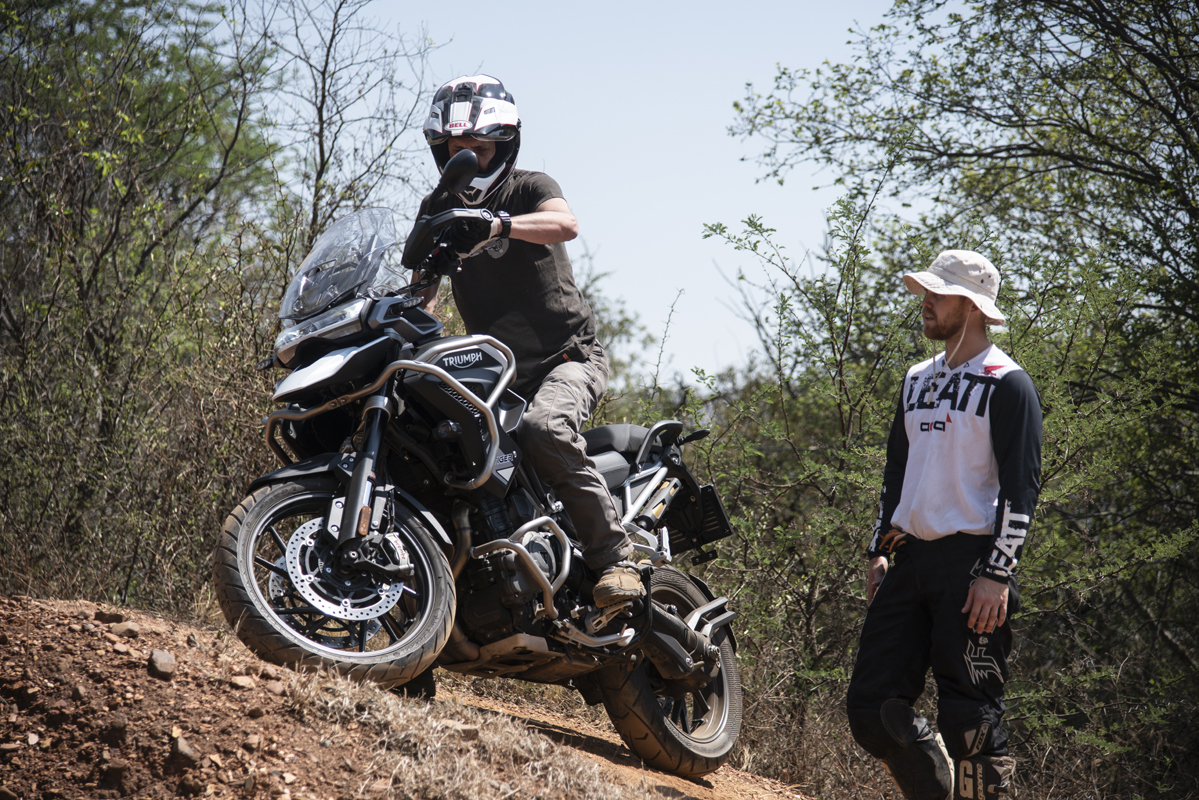
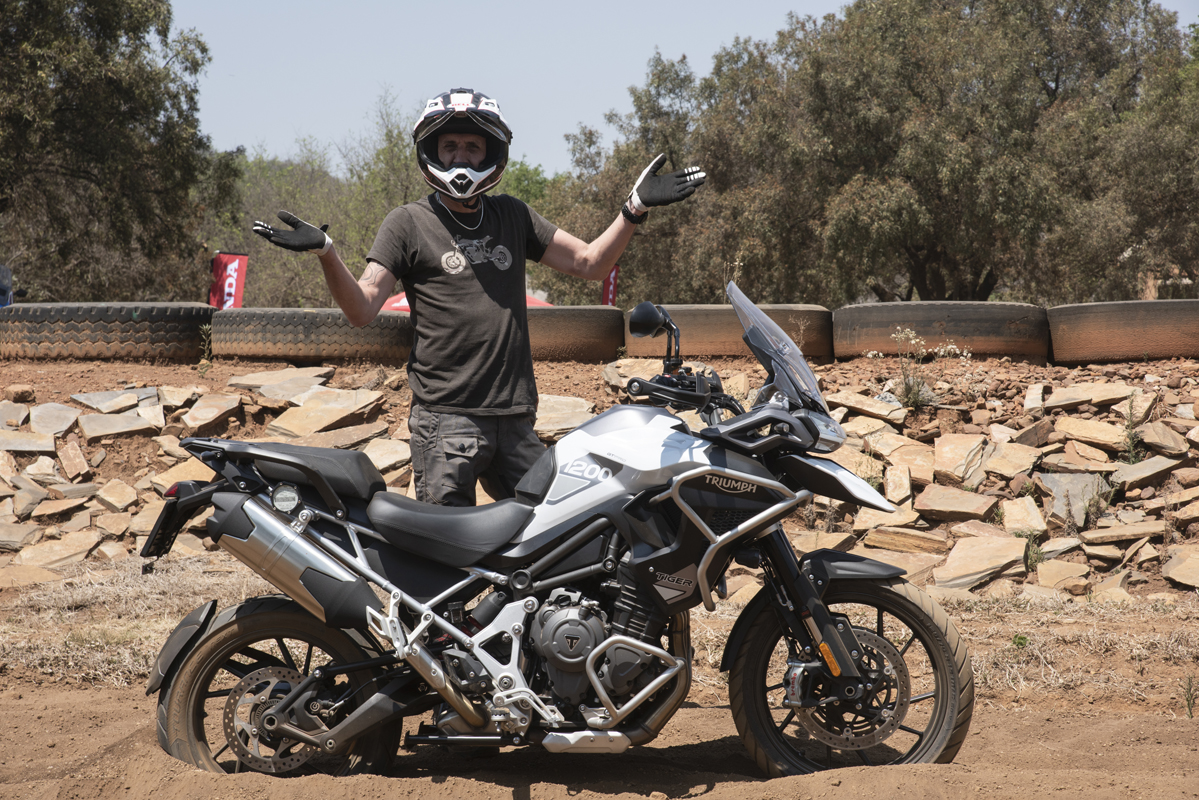
Huge thanks to Triumph South Africa for the loan of a stunning Tiger 1200 to use at the training day at ADA. Among the massed ranks of KTMs and Hondas, it got a lot of attention, all of it justified. On the skid pan, it proved totally stable and forgiving, with near-perfect weight distribution and balance. On the road there and back, it just had so much ability, comfort and dynamism, not to mention a fantastic exhaust note thanks to the new 1, 3, 2 firing order and the T-plane crankshaft.
Photo credit: Bjorn Moreira / ZA Bikers
The 2022 Tiger 1200 will rightly go down as one of the great adventure bikes, an impressive achievement by Triumph when the previous Tiger 1200 was already so good.
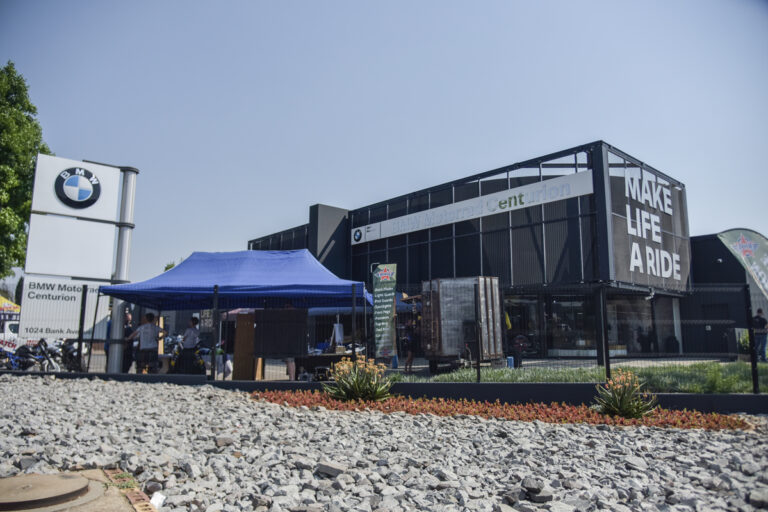
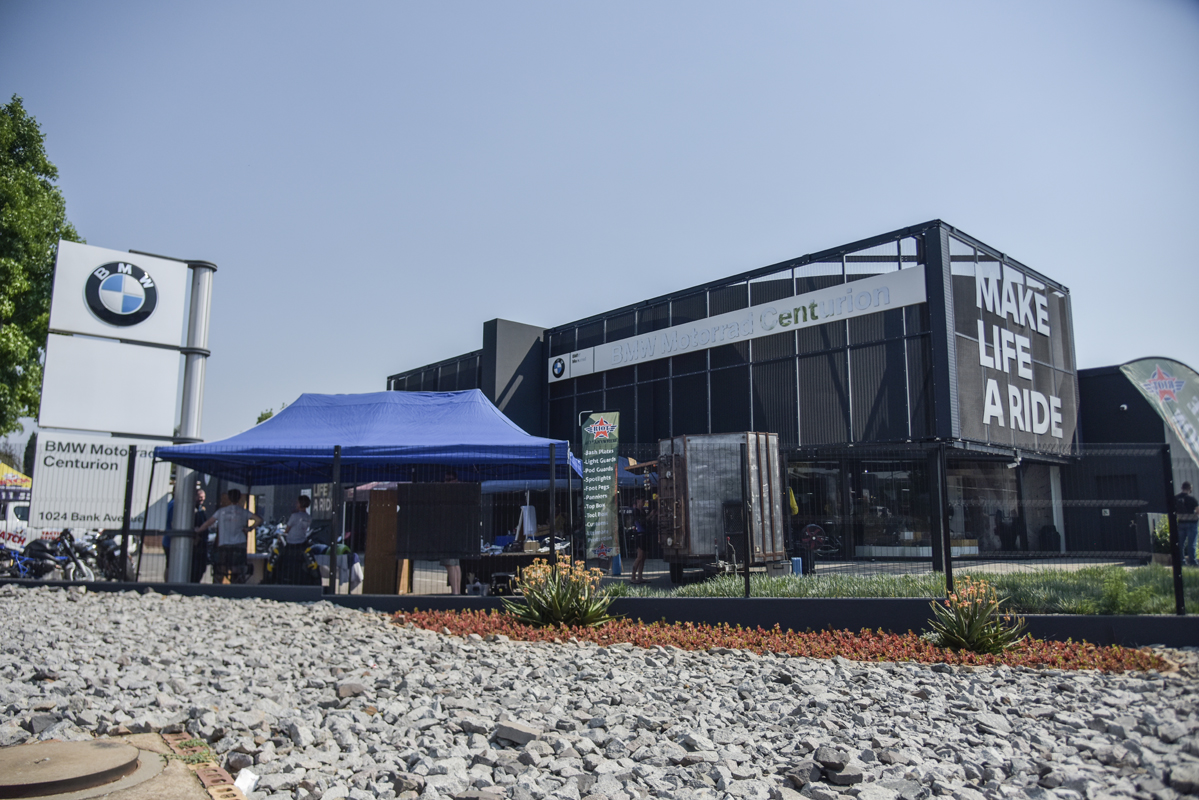
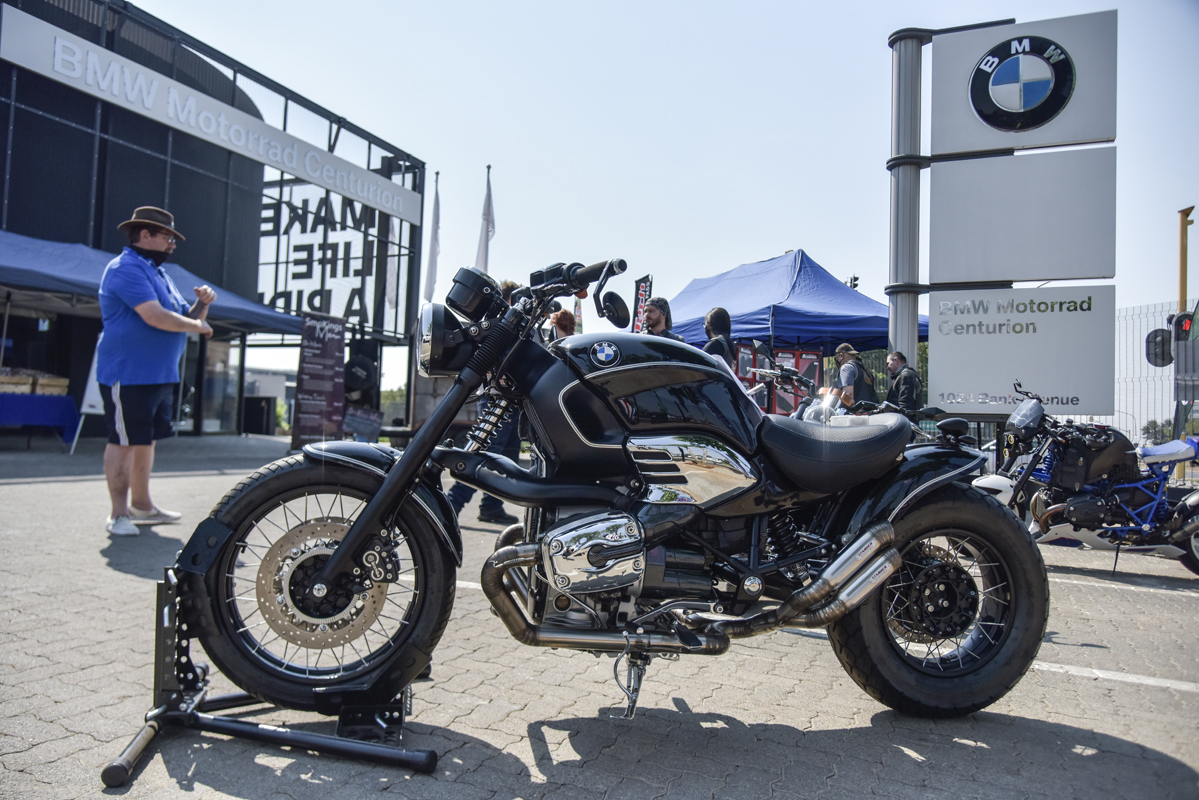
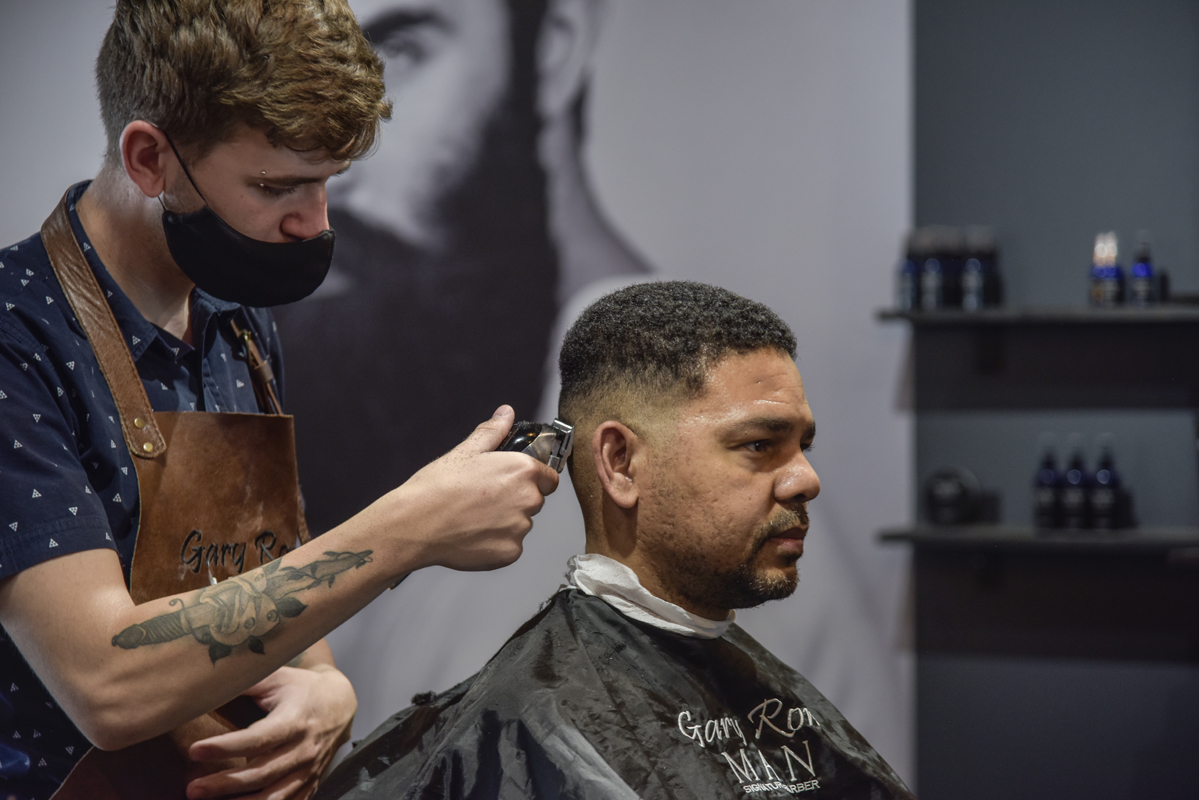
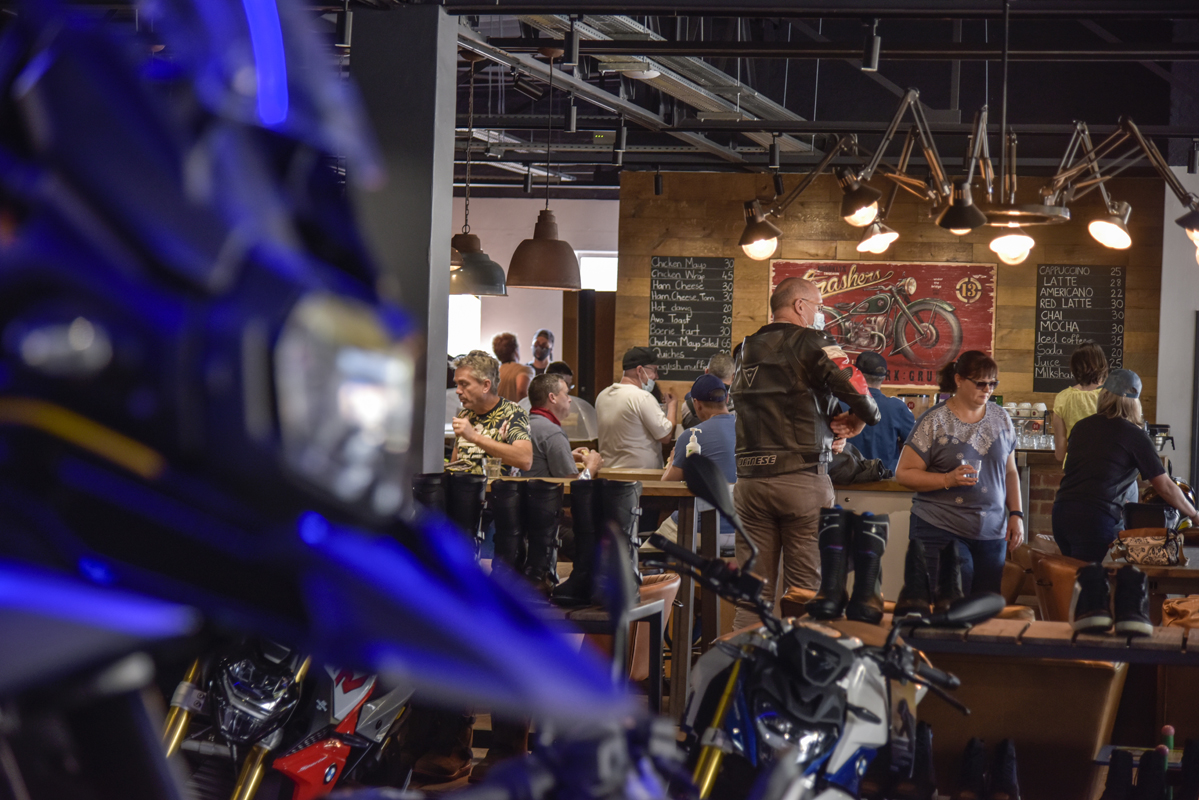
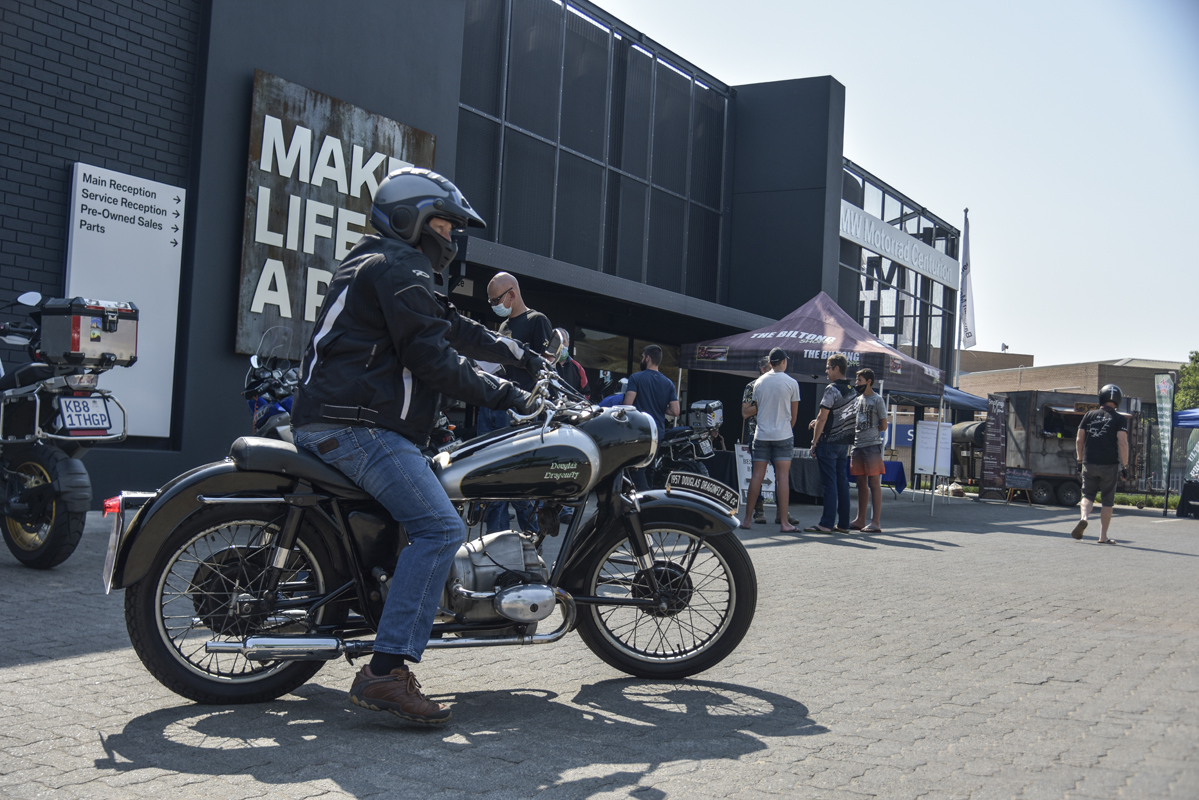
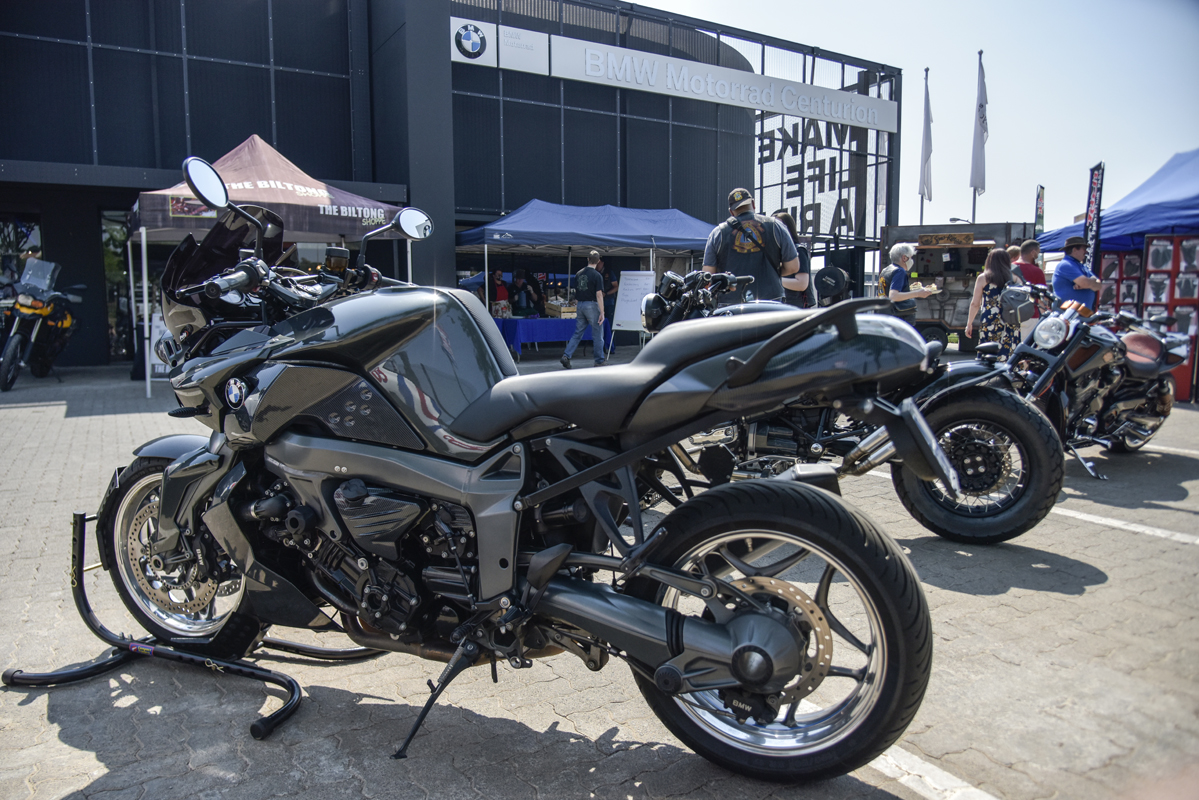
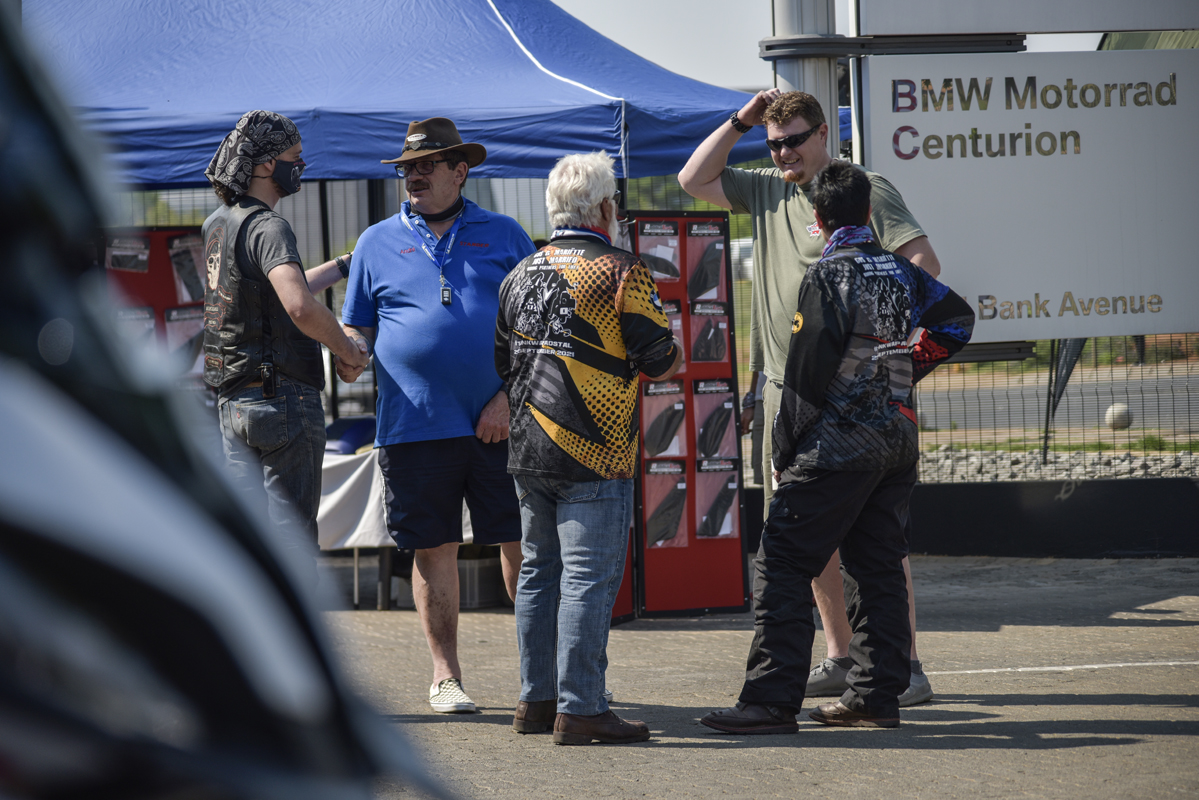
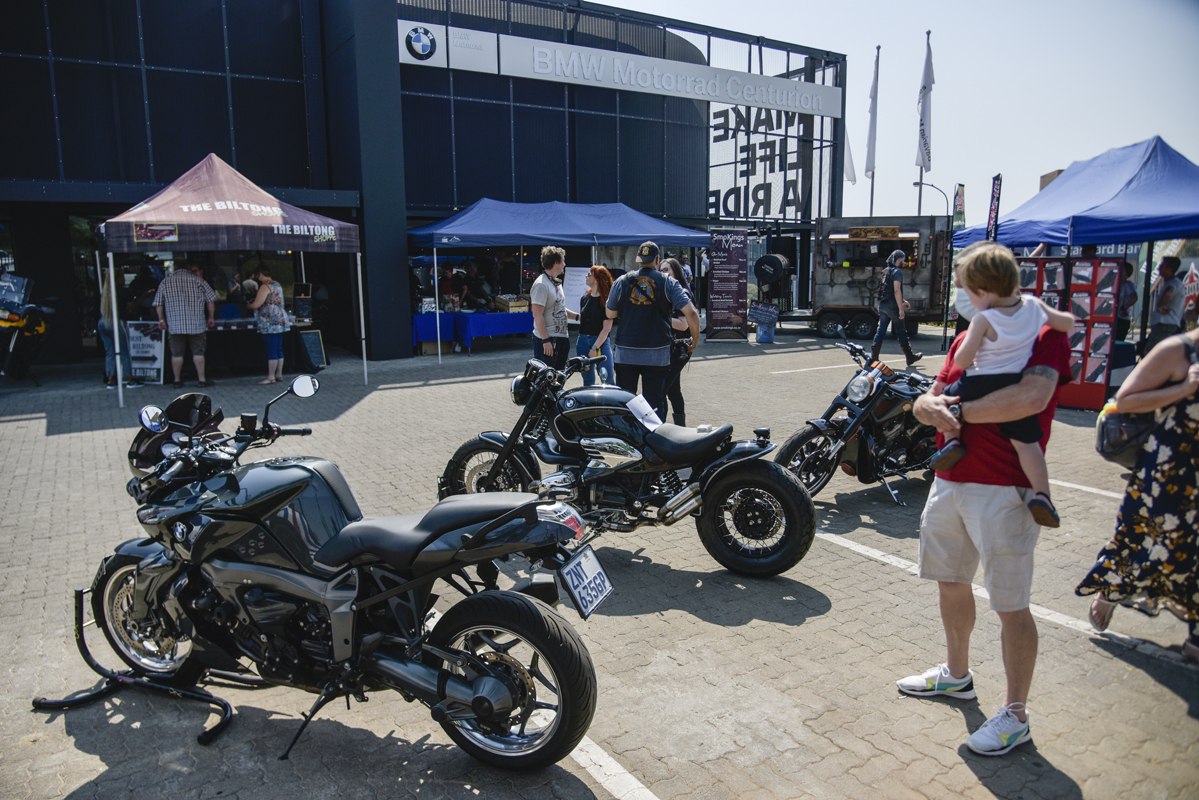
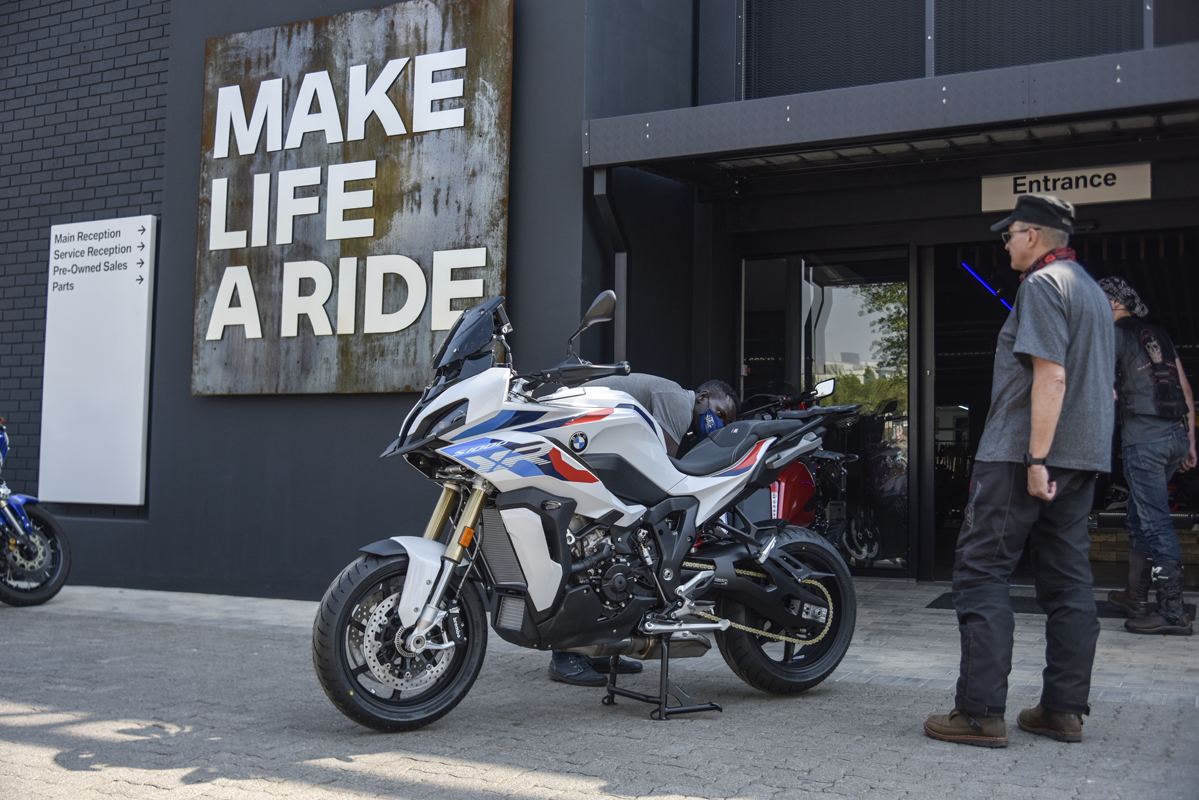
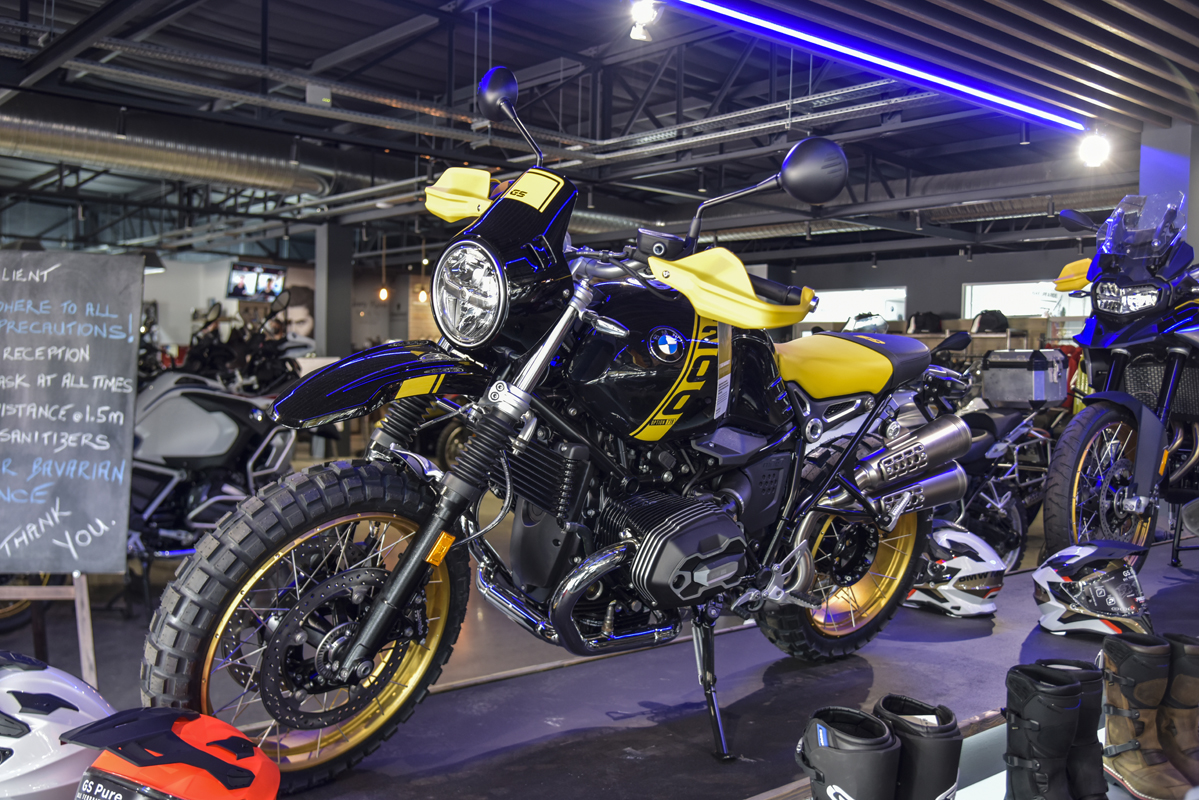
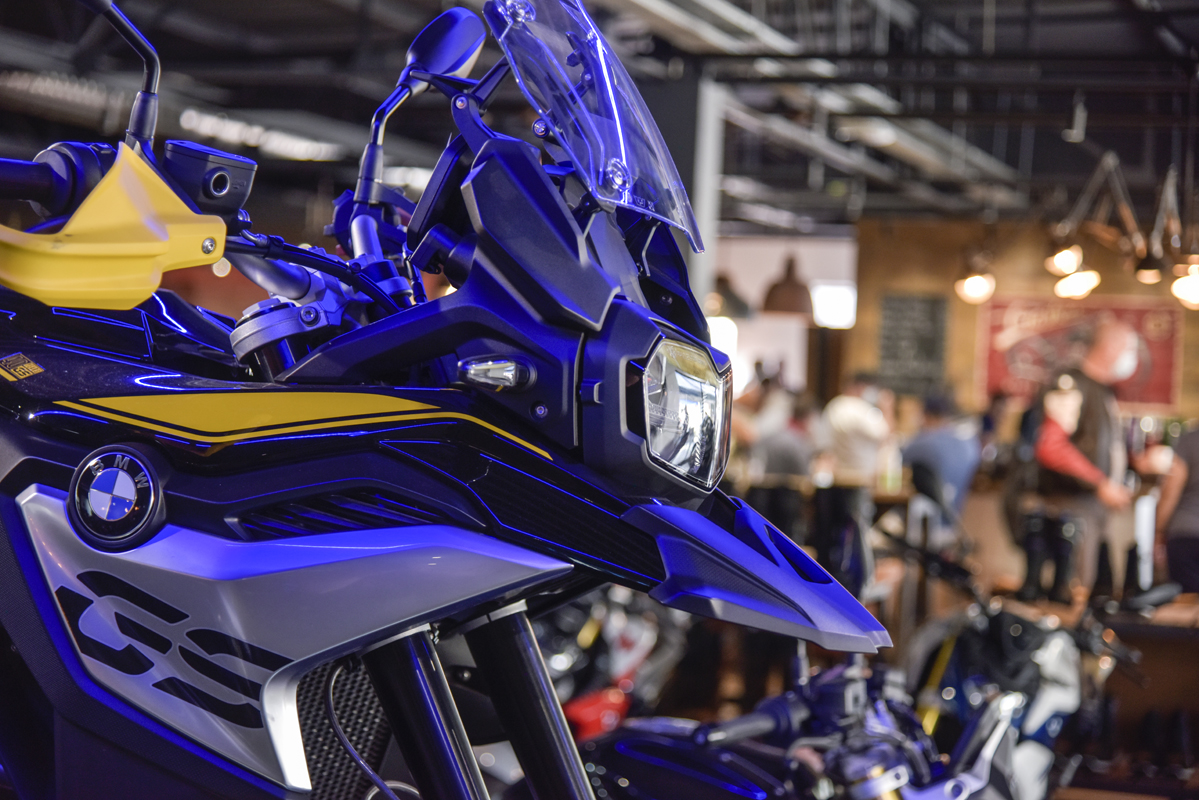
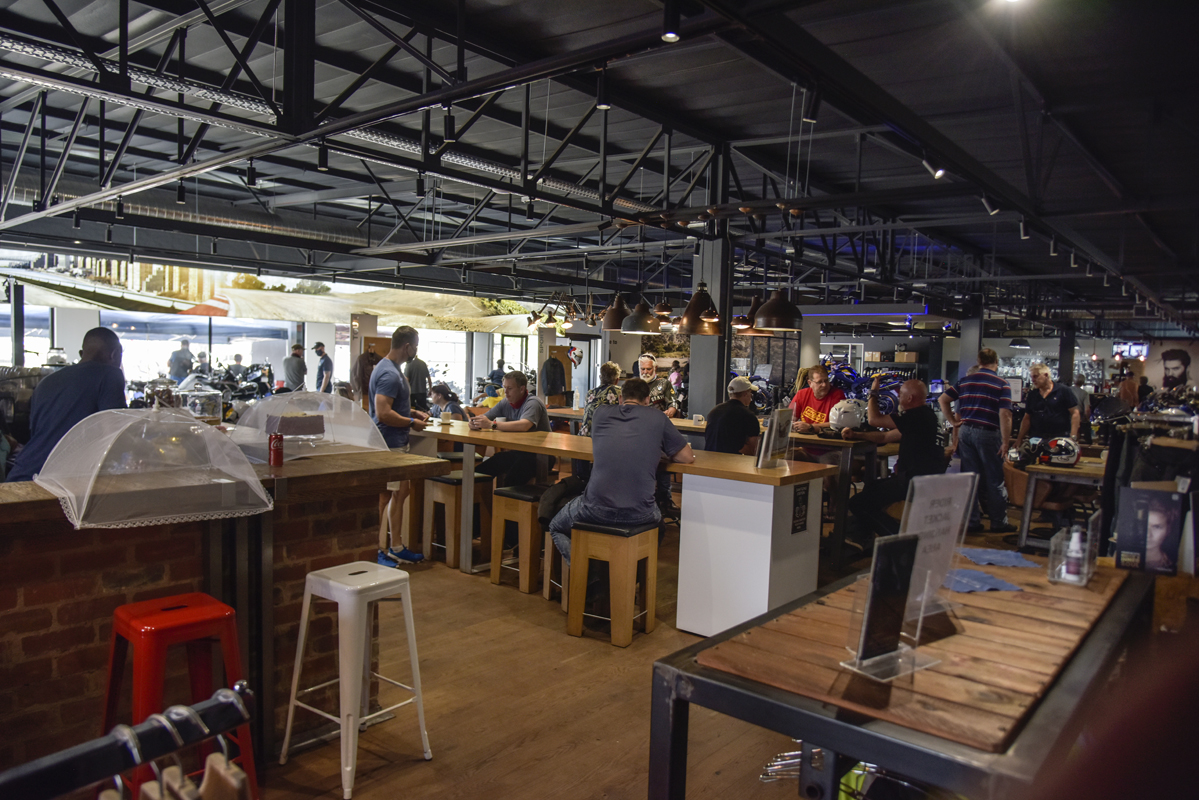
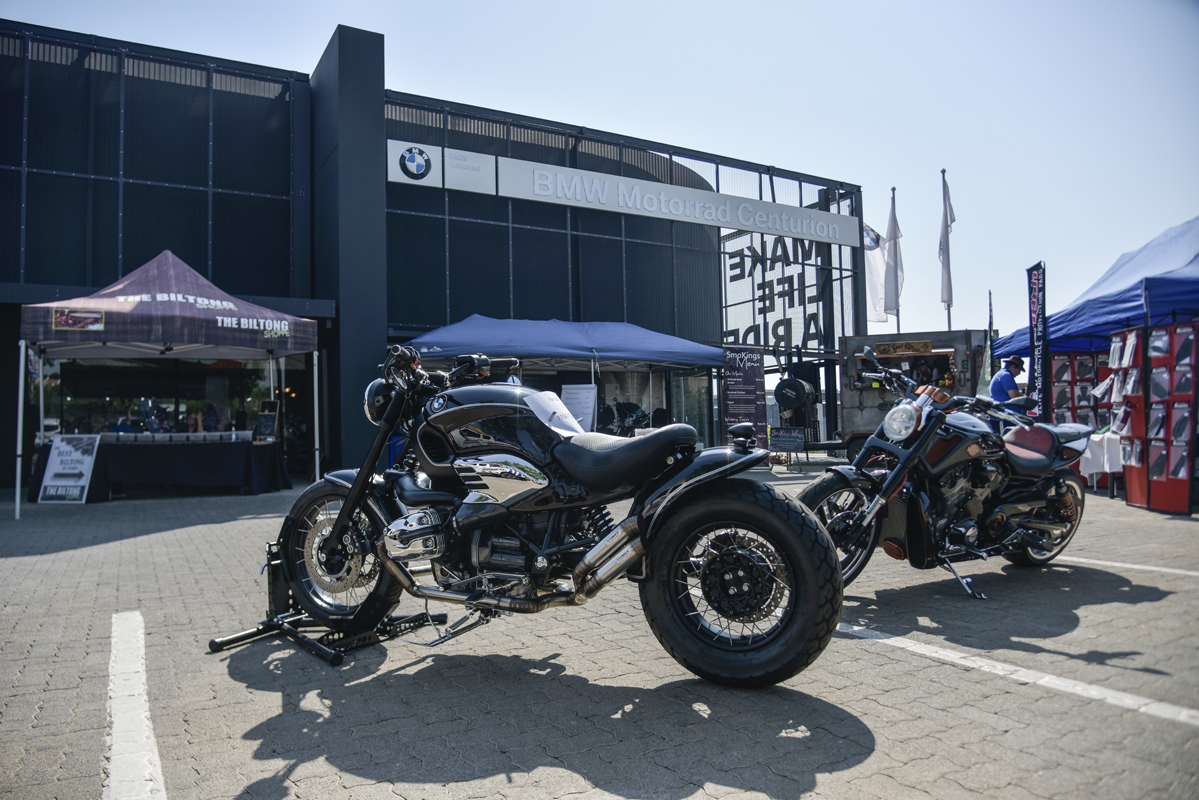
After last year’s successful October Fair held at BMW Motorrad Centurion (formerly Bavarian Motorcycles), the team have decided to bring it back and in spectacular fashion. On the 15th of October ‘Bavarian’ will be kicking off the proceedings with good food, accessory stalls, demo rides on a variety of BMWs, music played by Clint Cunningham and both Christelle van der Meulen and Warren Venter from the SA GS Trophy winners team will be joining in on the festivities.
After having attended last year’s event one thing is for sure, Bavarian’s October Fair is an event for those looking to enjoy a sunny social morning with like-minded company. So, bring a friend or your family with you and enjoy a festive day at BMW Motorrad Centurion’s new home from 08:30 to 1 pm.
A taste of what’s to come…
1 of 13
BMW Motorrad Centurion
1024 Bank Avenue
Centurion, Pretoria
Gauteng
South Africa
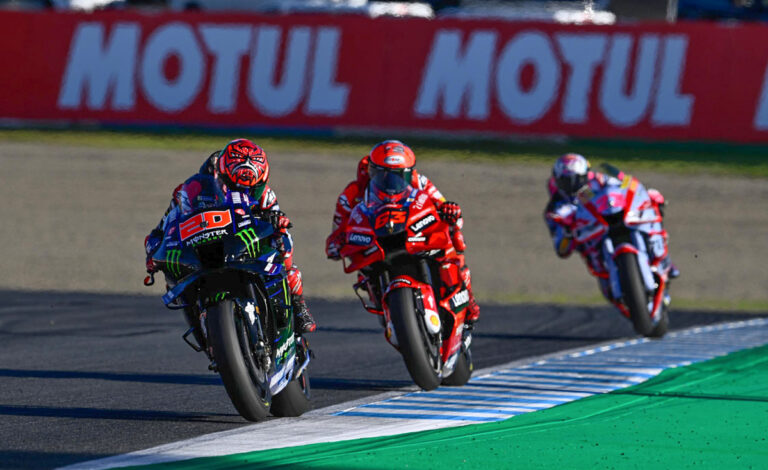
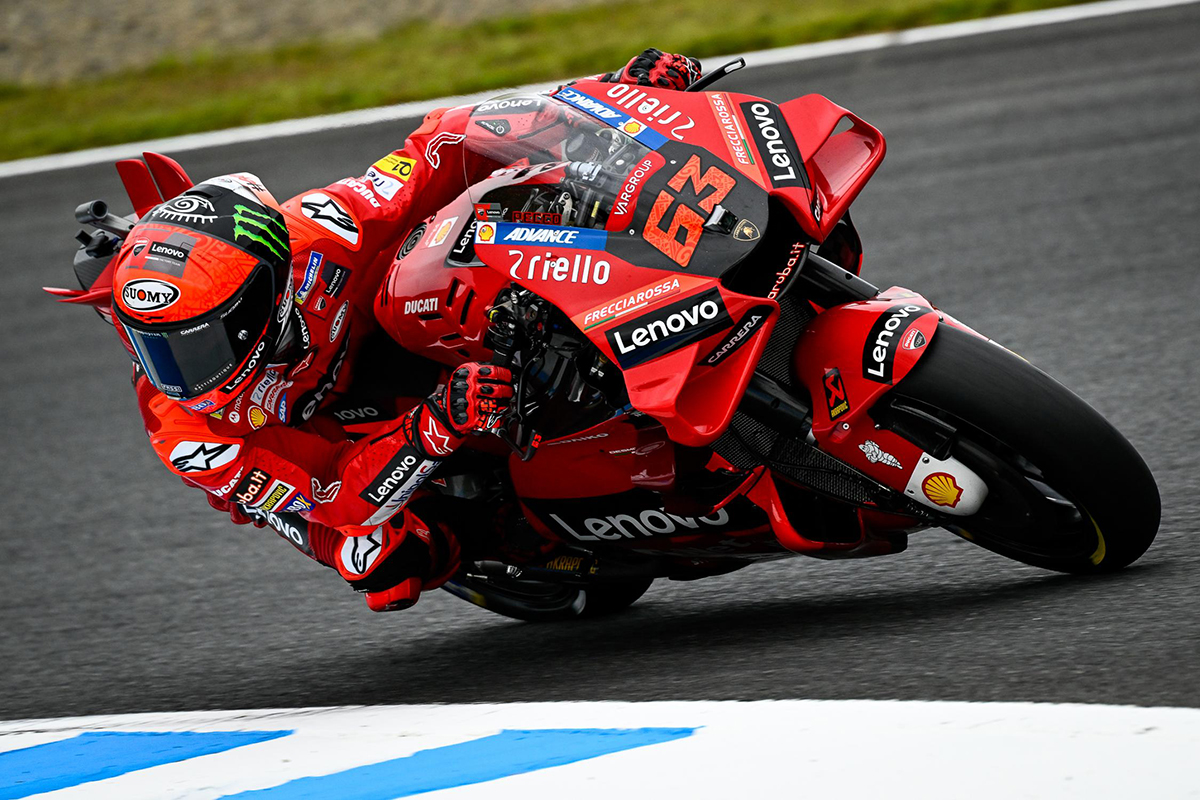
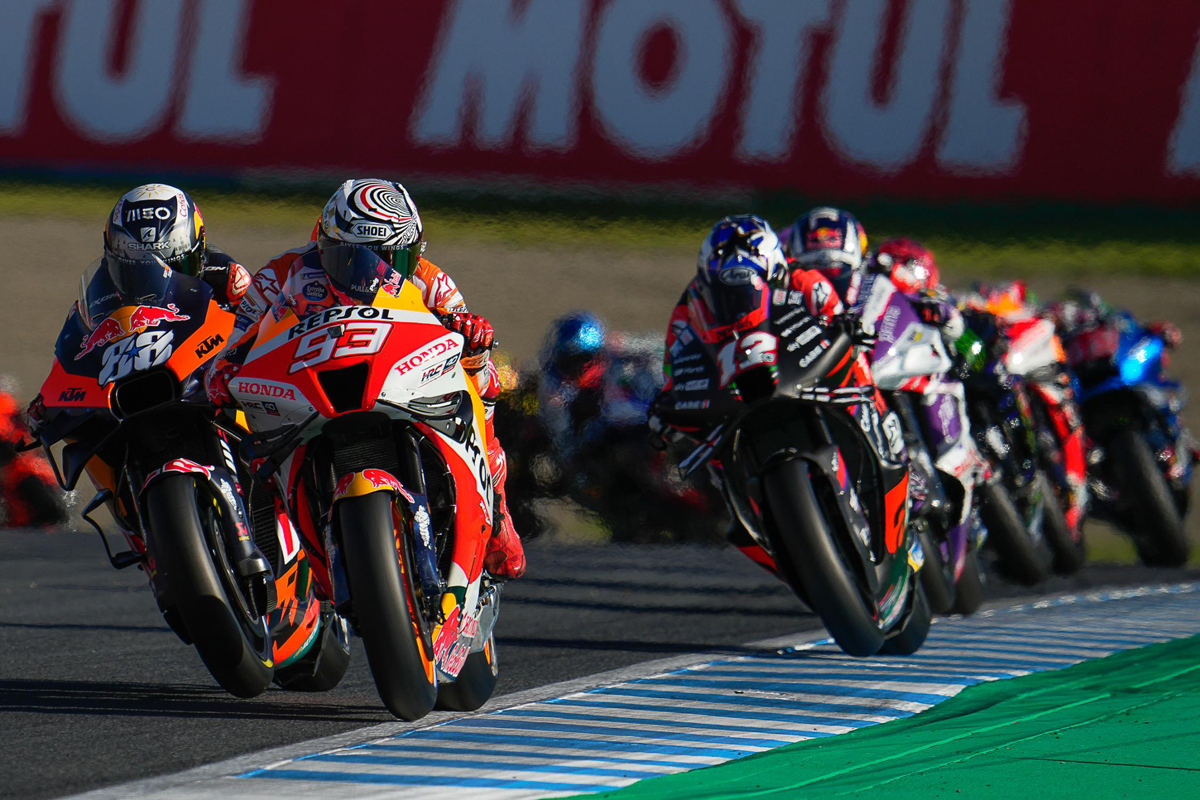
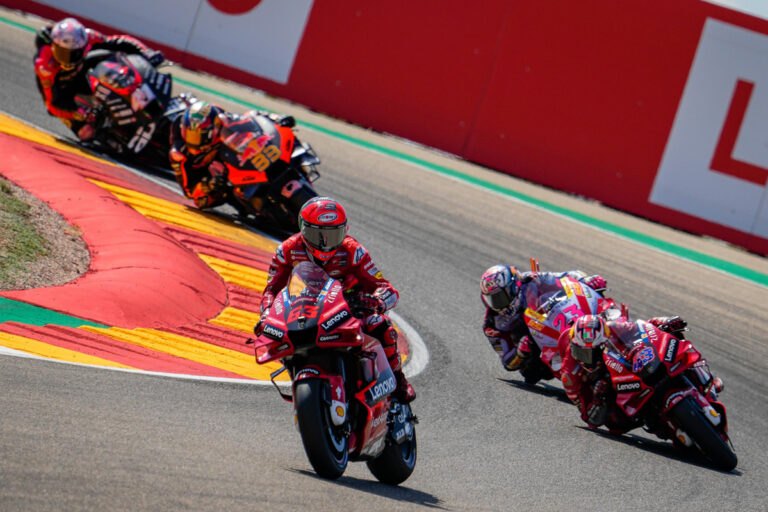
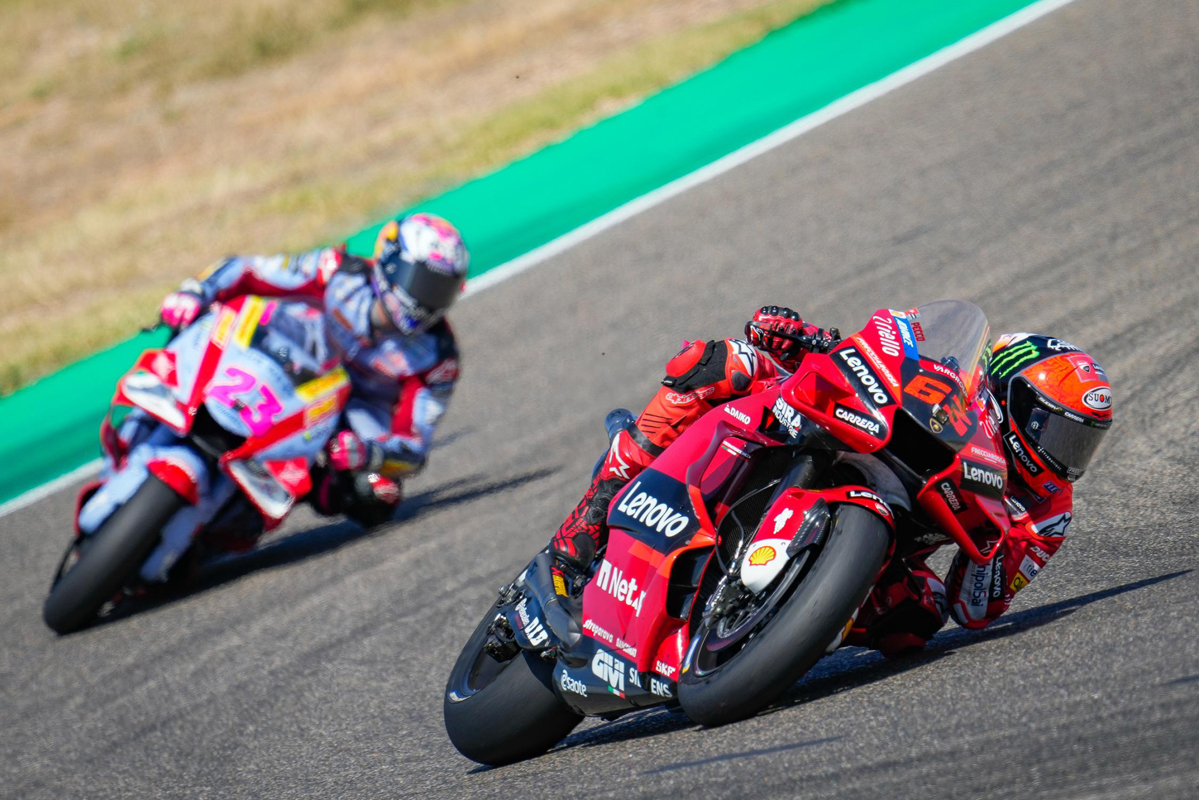
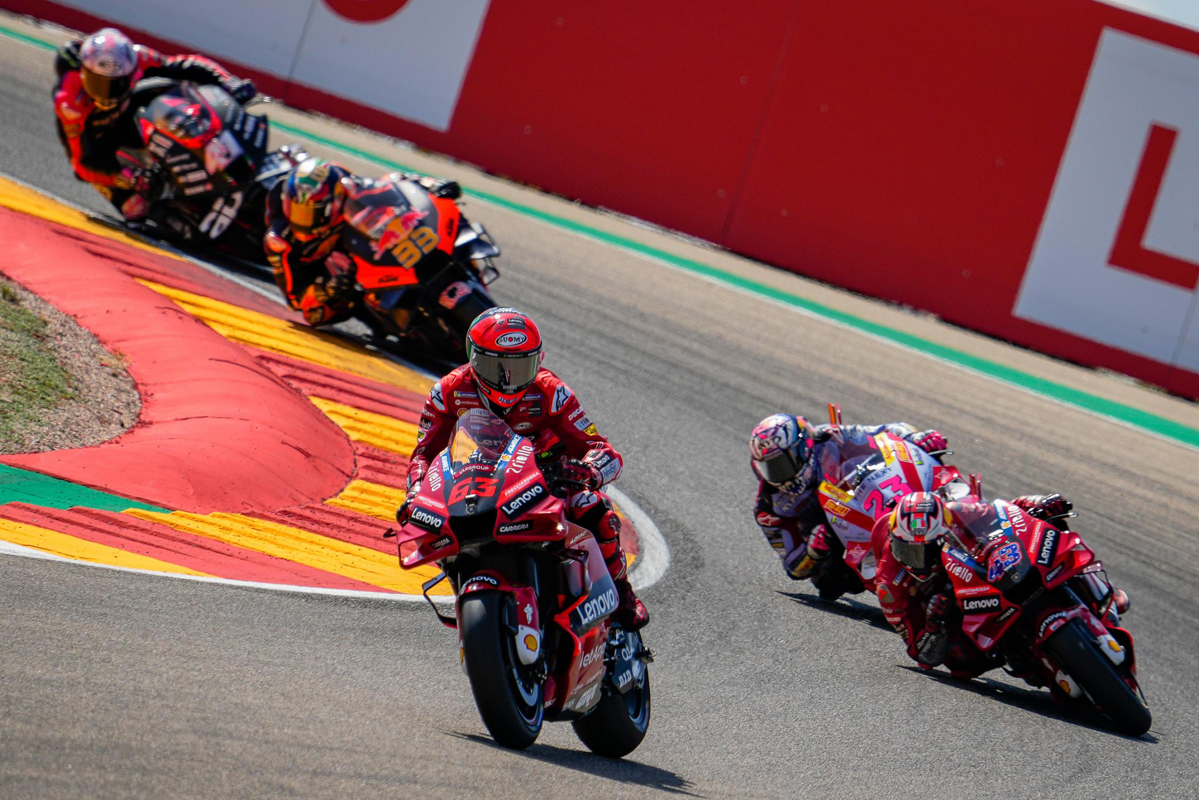
They had him on the ropes, reeling and waiting for the knockout blow, but it never came. Instead, Quartararo’s closest rivals for the 2022 title, Bagnaia and Espargaro, let him off with a light slap. If Quartararo had managed to finish any higher than eighth, there wouldn’t be any contact between hand and face at all.
Espargaro blinked first, his Aprilia’s electronics having not been set properly on the grid. The bike was left in a special fuel-saving ‘Eco’ mode, normally used solely for getting from the pits to the grid. Espargaro’s frustration was laid bare as he trundled back to the pits at no more than 100km/h to swap bikes, desperately trying to get there before the flag fell. Starting from the exit of pit lane is one thing, but to still be riding down pit lane when the lights go out is doubly galling.
Image source: www.motogp.com
This was to be no Assen-like meteoric recovery ride: 16th at the flag was all he could achieve, despite riding at the race leader’s pace. Not a single point after qualifying so well in sixth. Not only that, but the Aprilia was completely new to the Motegi track: the last time they raced there, it was the old Aprilia with the 75° V-four. The current 90° V-four is a completely different beast and two seconds a lap faster than the old bike, while other bikes had only gained one second in three years away.
Given all that, a podium was absolutely on the cards. Maybe he couldn’t have beaten Miller but a second place would have left him but five points behind Quartararo. Of such mistakes are championships lost. It wasn’t his only handicap, however:
“I changed bikes in the pits but the second bike had the soft rear tyre and I can’t ride with that tyre, the bike was pushing the front everywhere. I was also nervous and made a lot of mistakes. It was a huge mistake but we are humans, we’re a team and I will try to win in Thailand.”
Image source: www.motogp.com
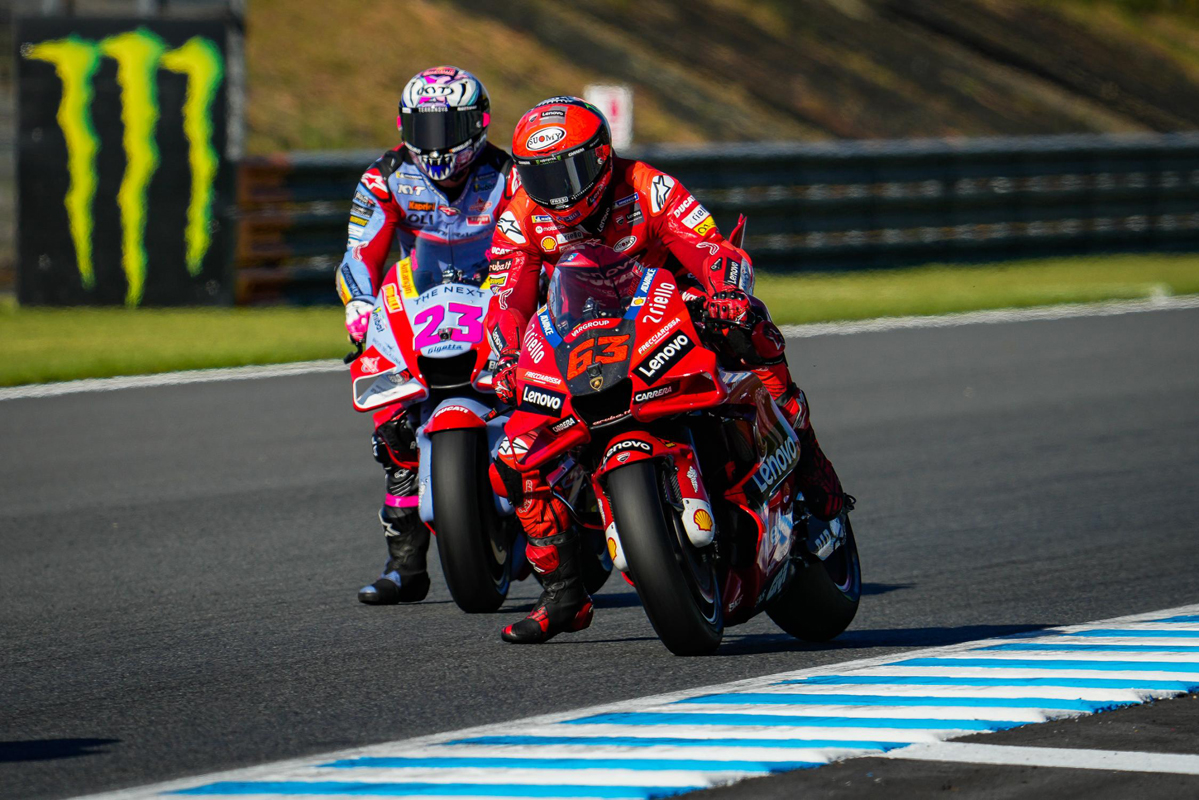
It was hardly any better for Bagnaia, who qualified an uncharacteristically lacklustre twelfth. During the race, he messed around at the blunt end of the top ten, always behind Quartararo but never able to get past. Desperation seemed to be setting in, even though finishing behind Quartararo would lose him only a couple of points to the championship leader.
On the last lap, it happened: Bagnaia tucked the front when trying a late lunge up the inside of Quartararo and it was a miracle that he missed the Yamaha as he slid to the outside of the track and into retirement.
Image source: www.motogp.com
He really didn’t need to try and make the pass, but he’s a racer: what would you expect him to do? But for the whole race, he was suffering from front tyre temperature.
“My front pressure was very, very, very high, so I was struggling to stop the bike,” he said. “This was one of the first times this year I was in a big group, so we weren’t prepared for that.
“One point can make a difference, so I was trying to do it,” he explained. “I was too ambitious – finishing behind Fabio or waiting for a safer opportunity to overtake would’ve been better, but I’m trying to win the championship.”
Image source: www.motogp.com
Ironically, the front tyre temperature issue is of Ducati’s own making: after all, it was they who introduced aero technology to MotoGP, the same aero that disturbs airflow behind the bike so much that the following bike is riding in lots of heat coming off the bike in front and also affects braking performance, putting further stress on the front tyre.
Bagnaia was undone not only by the rain-truncated practice sessions, which left him too little time to set the bike up but also by the horde of hungry Ducati riders all around him on track. There are still no team orders from Ducati and this could be Bagnaia’s undoing as none of the young guns are under any obligation to leave him alone or make his life easy. When will Ducati do something about this? After it’s too late for the championship? Three consecutive manufacturer’s titles are one thing, but it’s the rider’s championship that everyone remembers.
Image source: www.motogp.com
It’s not a complete disaster for the title top three: Bagnaia’s deficit has gone from 10 points to 18 and Espargaro’s from 17 points to 25 but it could have all been so different. This was one of the tracks that were meant to suit the Ducatis and, indeed, it did, with Miller taking a dominant and untroubled victory. No one will begrudge him the victory but this was meant to be the race that cemented Bagnaia’s challenge: not delivering the knock-out blow to Quartararo but getting in another punch before the circus heads to a more Yamaha-friendly track.
Image source: www.motogp.com
As it was, Quartararo was let off the hook by both his title rivals but still didn’t capitalise as much as he could have done. Eight points should have been, perhaps, 20 for second place (no one was beating Miller) but if Bagnaia wasn’t getting past Quartararo, then Quartararo wasn’t getting past anyone, either.
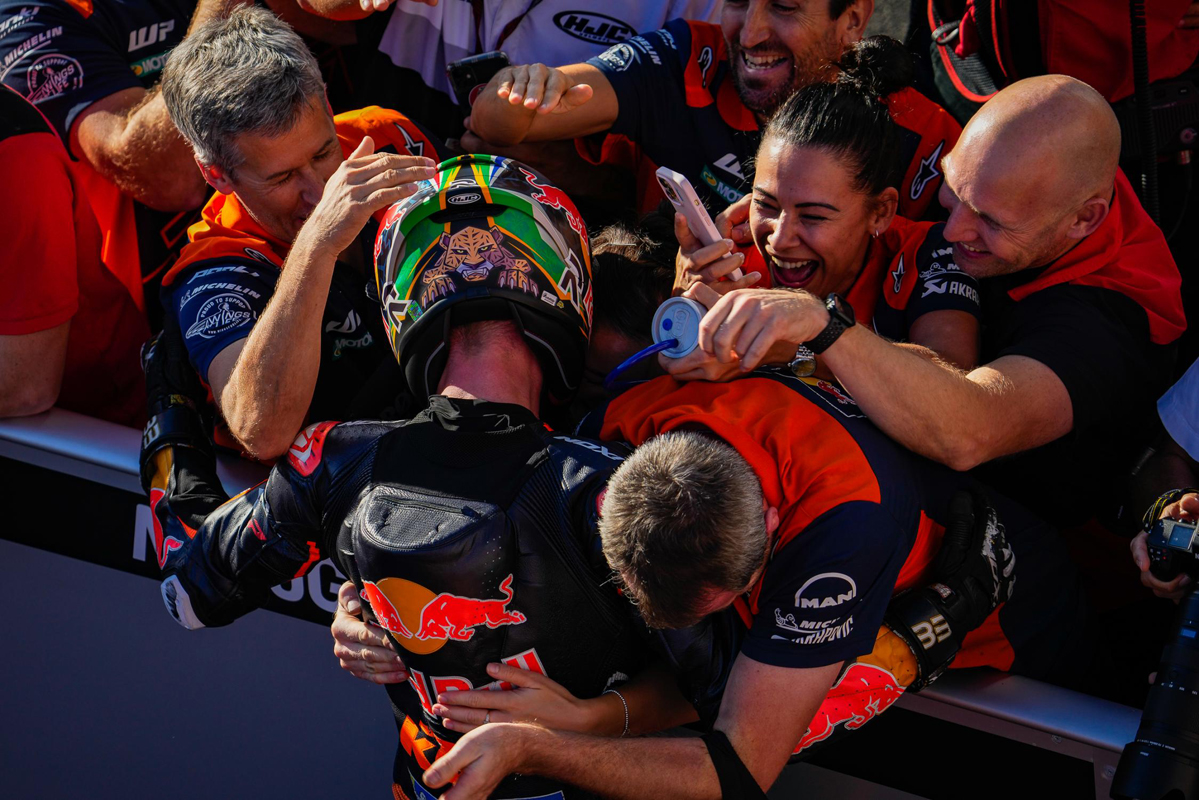
It wasn’t a vintage race but, by the same token, it wasn’t unexciting, especially with Brad Binder running in a podium position for the majority of the race. Second place was a brilliant reward for a gutsy ride on a rear tyre (hard) that he hadn’t tried the whole weekend. The gamble paid off and reinforced what Aleix Espargaro said after the Aragon round last weekend: that Binder on the KTM is one of the best riders on the grid at the moment.
Image source: www.motogp.com
After his pole position, much was expected of Marc Marquez, although there were doubts about his ability to last a whole race with his compromised fitness. However, even though he dropped out of the top three right from the get-go, he ran consistently in the top five and finished an impressive fourth, after a penultimate-lap overtake on Oliveira. The smile on his face as he sat back in his pit box will be worrying for the rest of the grid: Marquez is back and I for one will not be betting against him taking a win before the season is out.
Image source: www.motogp.com
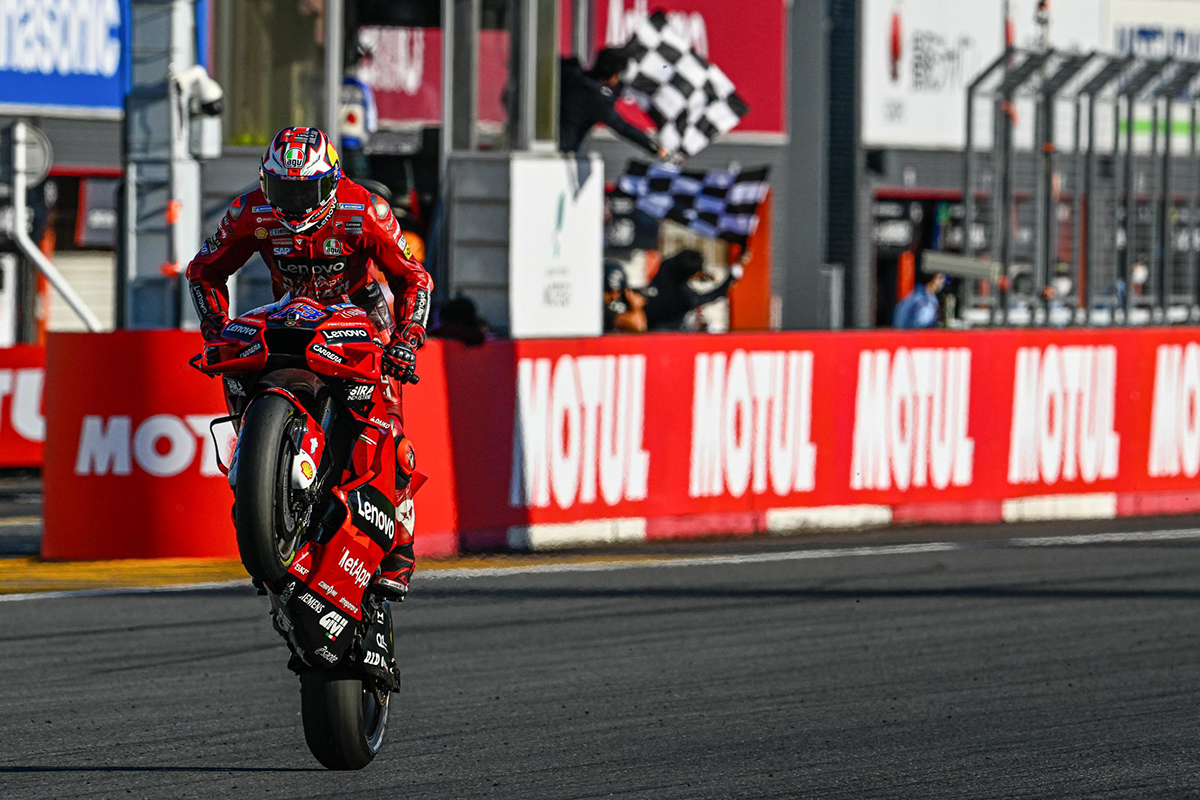
But what of Miller? What a sublime demonstration of pace: completely demoralising for everyone behind him and yet there would be not one begrudging voice in the paddock afterwards, such is the measure of affection everyone feels for him. For once the luck was with Miller and he ended his 18-month victory drought in fine style.
“Congrats to Jack, he was on another level today,” stated future team-mate Brad Binder. “When he passed me, he literally disappeared in about three or four laps. I could see he was on a roll and knowing Jack I thought he’d have the hard tyre too. By about Lap 10, I knew we weren’t gonna see him again. Hats off to Jack and it’s gonna be awesome having him on the team next year.”
My guess is that Miller will be formidable on the KTM next year. As long as he’s not too formidable and beats Binder!
2022 sees the Motul Roof of Africa back in full swing continuing to build on its stature as one of the toughest Extreme Enduro events in the world, with a legacy dating back to 1967. Over the years, the event sponsors along with many motorcycle dealers have tried to make the ‘Roof’ and all its rules more manageable for teams and riders. RAD KTM is one of those dealers, and this year they are offering riders an affordable service package.
One of the most commonly asked questions when competing in the Roof of Africa is: can you compete without a service crew? The answer to that question is no. This is because riders need at least one person to transport their fuel, help with hydration and carry nutritional products to the designated service points on each mountain race day.
Photo credit: Bjorn Moreira / ZA Bikers
RAD’s service package ticks all these boxes whilst keeping your ride in tip-top shape. RAD will be able to engage with all competitors, from professional riders to “weekend warriors”, by providing technical expertise, advice and services to participants through their premium service package.
The package will cost you R4000.00 and will include the following:
2 qualified technicians
Pre-service at RAD_KTM (Includes a full check-over & an oil change)
2 filter services (pre-service and one on day 1)
10% Discount on Parts and Accessories (excluding tyres and sale items)
Overnight Technician service to prep and repair bikes for the next day
Technicians will be present at the starting point, DSP, and finishing line
In case of an emergency, part boxes will be available for card purchases
The RAD_KTM branded pits will be set up at Lesotho Sun, opposite the KTM SA pits.
Bikes will be serviced and washed daily
Park your bike at the RAD_ pit after each finish
You are welcome to leave your drinks and food with our technicians so they can have them ready at the DSP points
All bookings are to be paid and submitted before 1 October 2022 HERE
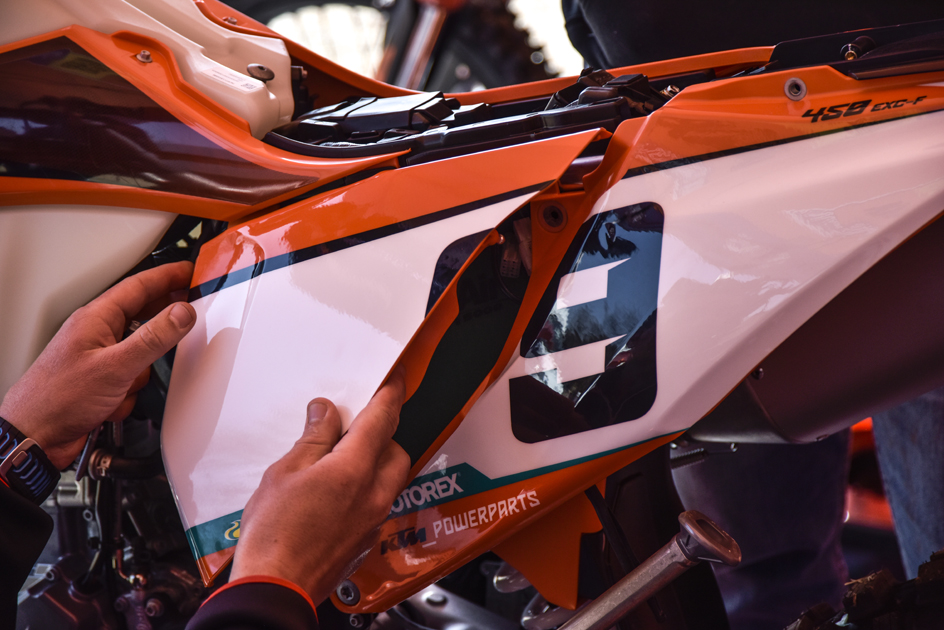
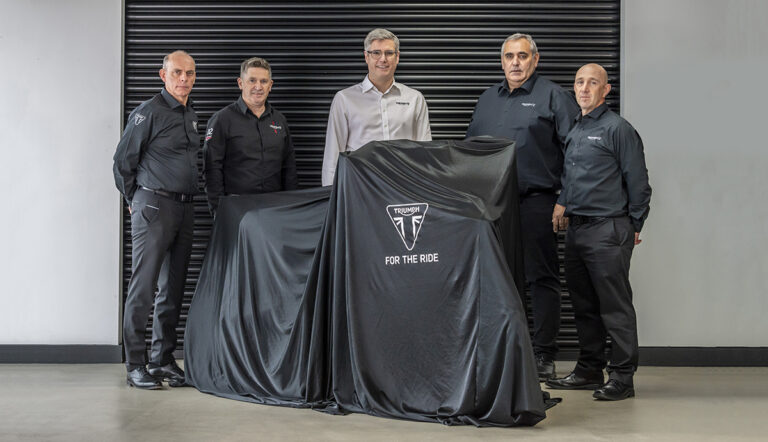
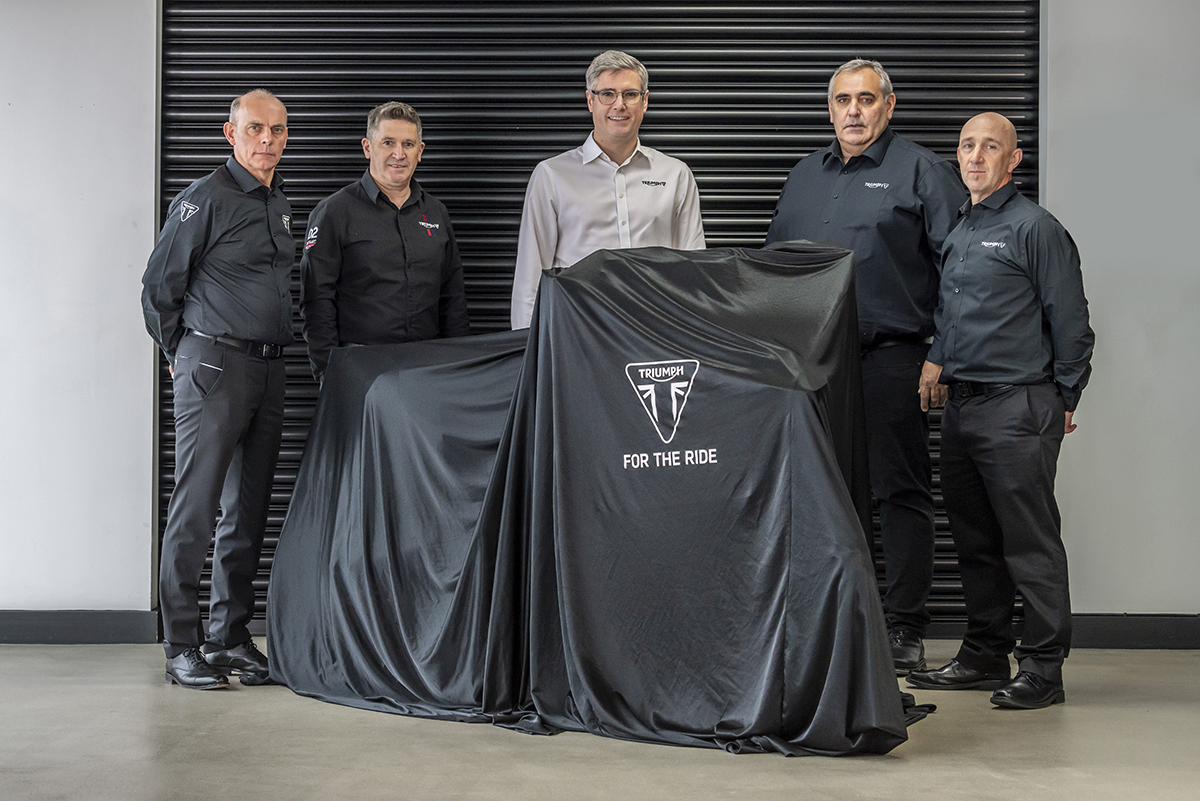
For about 12 months, it has been common knowledge that Triumph is taking a serious left turn and is working on a range of MX and Enduro bikes. No timeline for introduction has been given, although it was assumed that they would appear sometime in 2023 for the 2024 model year.
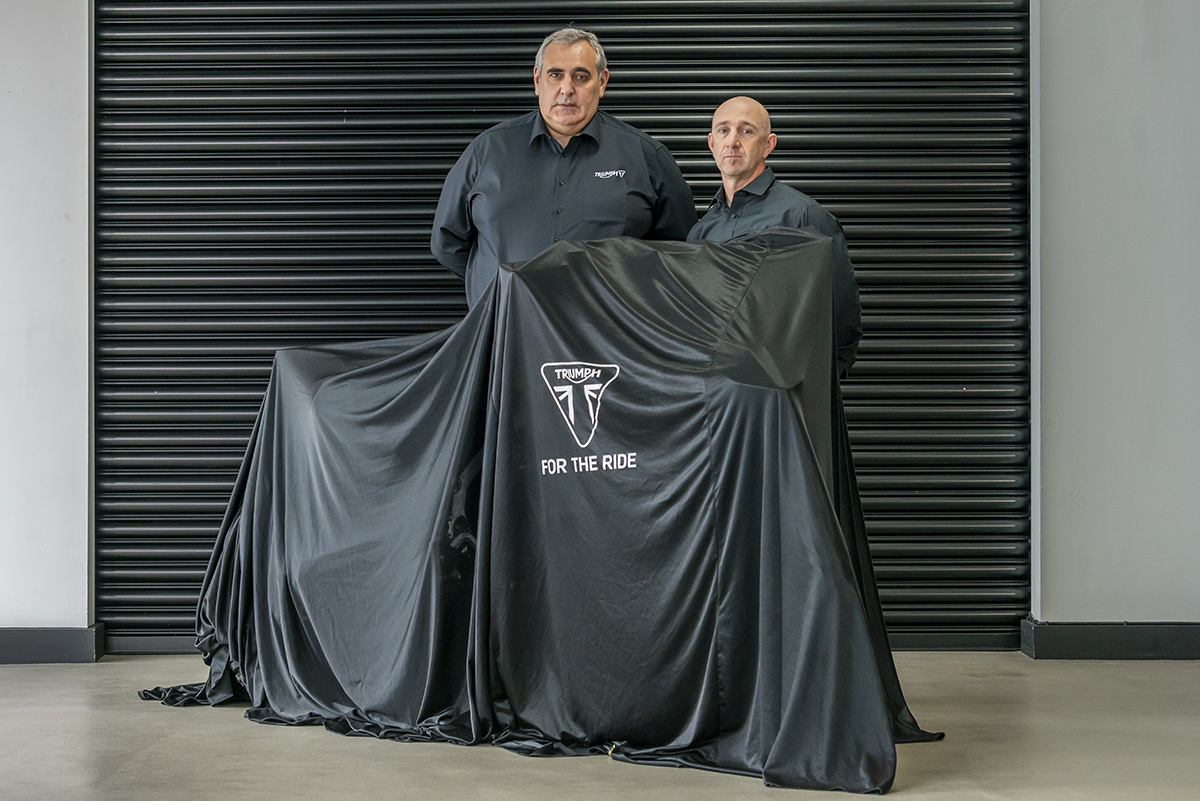
Now an announcement has been made that the company will be entering the FIM Motocross World Championship with a factory team in 2024, utilising an existing team structure in the charge of team owner Thierry Chizat-Suzzoni.
This landmark new Triumph Racing Team has been set up in partnership with, one of the sport’s most experienced and successful team owners, who will field two of Triumph’s all-new 250 cc 4-stroke MX bikes in the 2024 MX2 class and will add an entry into the 450 cc MXGP class in 2025.
Under the new Triumph Racing banner, which will now cover all of Triumph’s racing-related activities including Moto2 and Supersport racing, the partnership between Triumph and Thierry will encompass his well-established team structure and facilities. Further underpinning the ambition and commitment to win central to this new partnership, Triumph is also pleased to announce that his long-standing Team Manager, Vincent Bereni, will continue leading the team with a full crew of highly experienced technical staff all focused on bringing Triumph to the pinnacle of motocross racing performance.
This is a huge move for Triumph who, up to now, has concentrated solely on road motorcycles. But it is clear that the company is serious about this new direction and no one should underestimate the ambition Triumph has in this direction.
Image source: Triumph Motorcycles
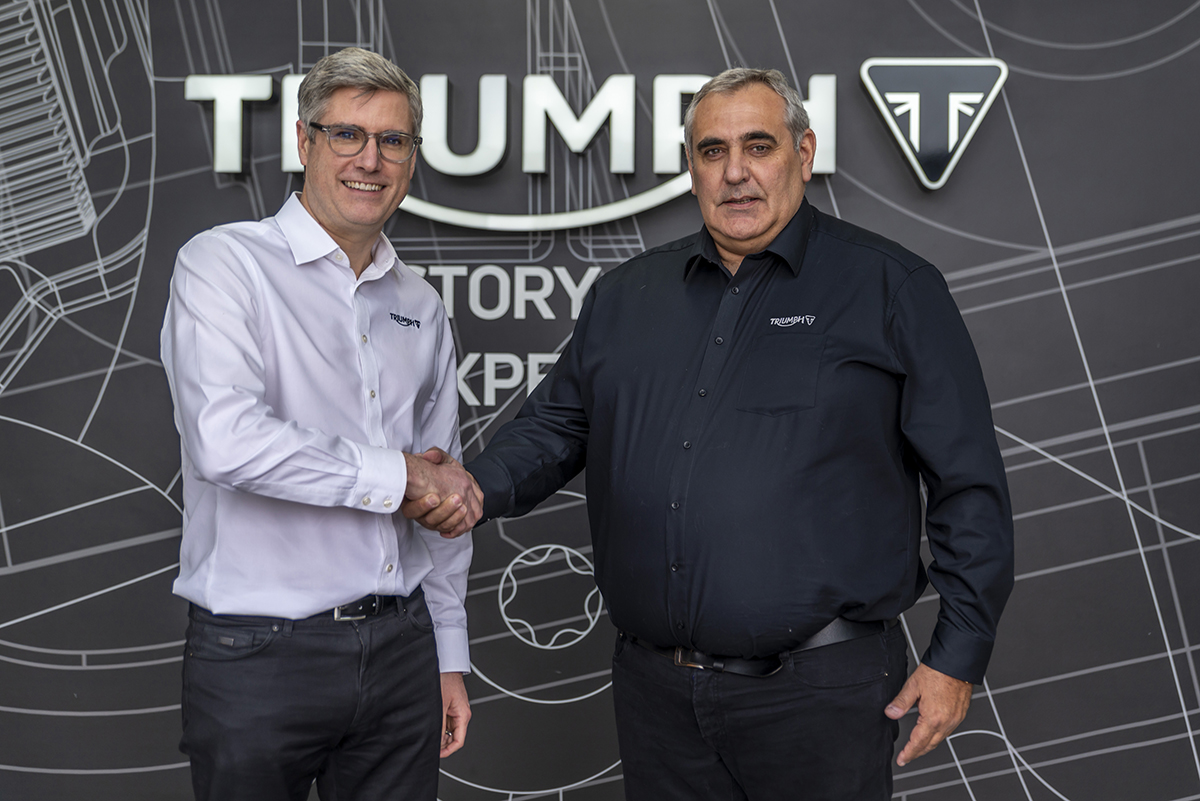
Thierry Chizat-Suzzoni – Triumph Racing Team Owner (MX2 and MXGP) had this to say:
“Triumph have made a major commitment to build an MX bike and go racing in the FIM World Motocross Championship. I am happy that my team is going to be the official Triumph Racing Team in MX2 and MXGP. Nick Bloor and the Triumph Board of Directors have made their long-term ambitions for the project very clear and I see a huge amount of passion from everyone at the Factory. I am happy with the progress on the bike, it looks great, has speed on the track and Vincent and my staff are working with the engineers at Hinckley on building it into a competitive package for entry into the MX2 Championship in 2024. MXGP continues to grow around the world, I am very happy to be back and looking forward to going racing with Triumph”.
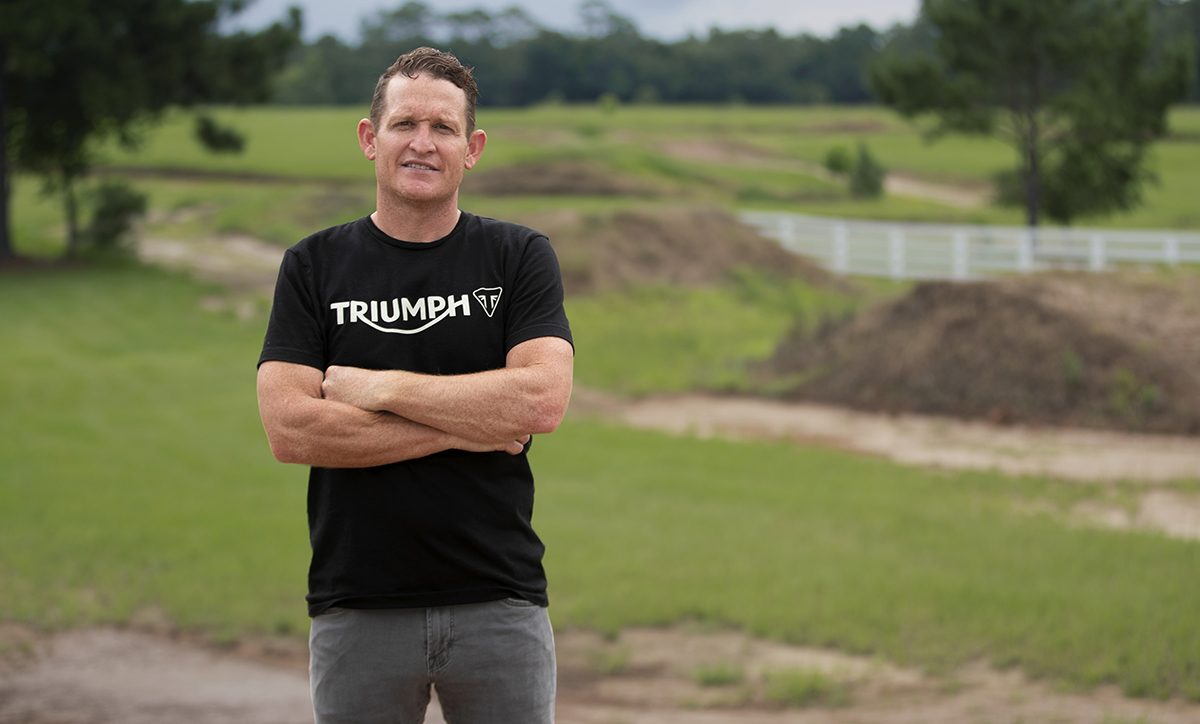
Ricky Carmichael, Triumph’s Global Off-Road Ambassador and himself a multiple world champion in MX and enduro, has been working closely with factory engineers and designers on the new models.
Image source: Triumph Motorcycles
“I’m really excited about today’s news. It’s been a long time coming. Since the start of this project with Triumph, I have been amazed at just how hard everyone has been working. It must not go without mentioning, the whole R&D and engineering group that has been a part of the development of the motorcycles have done an absolutely incredible job. From the first stages of the prototypes, I was really taken back by how well the performance was, since then, being in the UK testing the newest developments, I can tell you that it has the capabilities of winning at the highest level and I personally believe the riders, from professional to amateur, across the entire range of off-road models, will really like what has been developed!”
This is a massive move for Triumph: entering a field that already has many vastly experienced manufacturers and teams is not something to be undertaken lightly and Triumph certainly aren’t in this to fail. What will be interesting is how far the company is prepared to go to win. Only time – and competition – will tell.
I spent a fascinating couple of hours chatting with Stephen and Wesley Fischer. “Who may I ask is that?” I hear you ask. Well, the clue is in the header – SAC Raging Bull. This is ‘the’ Steve of Steve’s Auto Clinic fame and his son Wes. Steve has such an interesting story to tell if you have even a drop of High Octane in your veins.
From an early age, Steve has had a thing with bikes and cars. As a 15-year-old, he had the iconic poster of Peter Fonda and Dennis Hopper from the movie Easy Rider, riding their Harley choppers, “Captain America” and the “Billy Bike”, across the country. This was every schoolboy’s dream back in the day, and so it was with Steve. He swore that one day he too would ride a Harley far and wide. His passion for bikes manifested in tuning and modifying bikes for his school chums. It was thus no surprise that this was the course that his life followed.
Photo credit: Dave Cilliers / ZA Bikers
Steve is the epitome of a petrol head. Endowed with a huge affinity and understanding for things mechanical, he took his passion to the next level when he started a business in the Vaal Triangle, dedicated to tuning Alfa’s, way back in 1982. This was the original Steves’s Auto Clinic. Little did Steve know at the time, that this was the beginning of an automotive tuning success story perhaps unparalleled in the annals of South African automotive history.
When Alfa withdrew from the South African market during the turmoil of the apartheid years, Steve started to apply the lessons he had learned fettling Alfas, to other brands. With performance always a priority to Alfa owners and given his history of ‘modding’ bikes and the like, Steve tackled every new vehicle with the same questions foremost in his mind. How does it work and what can be done to make it work better without compromising driveability and reliability? “Dave, I started measuring everything!”
Photo credit: Dave Cilliers / ZA Bikers
To ‘measure’, as Steve puts it, requires some pretty sophisticated equipment. Putting values to Power, torque, air/fuel ratio, timing, drive train resistance, engine temperatures, barometric pressure, humidity, ambient temperature and geared speeds all help to understand what is required to get a motor into as good a state of tune as possible. The heart of this is a dynamometer. Steve’s time spent learning what to do and vitally, what not to do when it comes to modifying and tuning engines, has stood him in good stead. There is simply no shortcut to gathering experience.
Steve’s Auto Clinic became a household name in SA for tuning vehicles for more power without compromising reliability. The business expanded hugely over the years, with experience gained on race tracks countrywide, in partnership with leading motoring brands. An in-house engineering facility was birthed with the ability to do performance-enhancing engineering without compromise. Gas flowing cylinder heads, enlarging throttle bodies and fitting bigger valves if required, became all in a day’s work.
Photo credit: Dave Cilliers / ZA Bikers
Talking to Steve, I get the feeling that over time (30 odd years), as Steve’s Auto Clinic grew into an entity that he could never have imagined, he started feeling more and more as if he had a tiger by the tail. For a man who is at his absolute happiest when he is tuning a motor hands-on, SAC had become a huge, albeit successful, franchised entity that demanded too much of his time to manage, robbing him of the tuning work that is so much his happy place. And so a plan was hatched.
The work demands from the evolution of SAC also meant that Steve neglected what is perhaps his first love. Motorcycles. After almost 30 years, he has withdrawn, for all intents and purposes, from working on cars, Bakkies and things with four wheels, to focus on bikes. To this end, he has enlisted the assistance of his son Wesley who, no surprise, given the lifelong influence of Steve, shares his passion for performance-enhancing mods on bikes. Wes has proved a sponge to soak up and apply the years of knowledge that Steve has accumulated on engine performance enhancement.
Photo credit: ZA Bikers
The dream of riding a Harley far and wide became a reality for Steve as the success of SAC gave him the means to own his own Harleys. It was obvious from the outset that he would start to explore ways of making his Harleys run better. Over time this has probably made him arguably the top Tuner in the country for making products from The Motor Company fly. He tells me that in standard trim Harleys are generally in a mild state of tune, so extracting significant reliable power gains is possible, if you know what you are doing. This led to another step in his current activities.
It seems, from what he tells me, that many Harley owners also own BMW GS’s. Needless to say, he was asked about applying his unique tuning talents to the boxer-engined bikes too. What followed was typical of Steve. He began measuring the performance of the Bavarian twins with a view to how best to help them make more power, reliably. He is full of praise for the Boxer motor, but says that with the right tuning, significant gains are to be had. Especially on the air/oil-cooled twins. Without too much fettling they are able to extract LC-type power without in any way compromising reliability. They regularly service bikes that they have done, with around 200,000 reliable k’s on the clock.
Photo credit: Dave Cilliers / ZA Bikers
With electronic engine mapping playing such a huge role in engine performance these days, Steve has spent a lot of time and money to understand and optimise this aspect of tuning. He tells me that no one aspect of tuning is the magic bullet, but rather a complete approach looking at all aspects of what makes engines perform better. This has always entailed making the engine ‘breath’ better. Get the mixture into the cylinder head more efficiently, burn it better and then get it exhausted as well as possible and the result is inevitably a significant power increase, without stressing the engine unduly. Sounds simple, yet to achieve this in a seamless way without detracting from, but rather enhancing ride-ability, is the dark art.
The other pillar of success on which SAC was built, was the relationships that it fostered with its customers. It is no different from Steve’s current motorcycle endeavours. He listens to what his clients want and then delivers on his promises. This sometimes means managing clients’ expectations realistically. Steve believes that clients should get value for money. Just bolting on hugely expensive go-fast goodies often leaves clients disillusioned and frustrated. It is making everything work in perfect harmony that is the key. Measuring and understanding how to make everything best work together is what results in what we bikers refer to as a ‘sweet engine’.
Photo credit: Dave Cilliers / ZA Bikers
What we are going to do is ride some of the bikes that Steve has done and see for ourselves. I am particularly interested in the BMW’s. Steve is already widely supported by Harley riders who have got wind of the magic he makes with the big V-Twins. What isn’t appreciated is how he can make your airhead go like an LC, and your LC perform like a 1250 Shift Cam. The cost of upgrading your bike is significant, so why not let Steve and Wes do their thing for a smidgen of the cost of a model upgrade?
For example, I was able to see and hear the results of gutting and rebuilding the innards of a GS exhaust. Obviously, the pipe exhausts better, but it looks and sounds spectacular too. No need for a massively expensive slip-on when your stock pipe can be made to work and sound this good. I am really excited at the prospect of walking this road with Steve and his crew. 40 years of performance enhancement knowledge counts for a huge amount in my book!
Husqvarna Motorcycles has just thrown the wraps off their new ‘Heritage’ range of motocross and enduro bikes, paying homage to the Swedish-born brand’s 60-plus years of off-road competition. Combining retro graphics with a slew of tasty tech upgrades, these 2023 machines are designed to be, if you’ll pardon us borrowing a phrase from Husqvarna’s parent company, ready to race.
Husqvarna first tasted motocross victory in 1960, when ‘Buffalo’ Bill Nilsson bagged them their first FIM World Championship title. Since then, the brand has racked up 14 more motocross titles, 25 enduro World Champs titles, and multiple wins at prestigious races like the Baja 1000, Erzberg Rodeo and Red Bull Romaniacs. The Husqvarna Heritage range celebrates this storied history, with five motocross and seven enduro two- and four-strokes, and a range of accessories and apparel.
Husqvarna’s Heritage off-roaders are distinguishable by their special edition colour scheme. Resplendent in white, with blue and yellow graphics, blue seats and new black Excel rims, they hark back to 1980s Huskies like the CR250 and CR500. But both the motocross and enduro ranges also feature multiple updates to their engines, chassis, bodywork and electronics.
Heritage Motocross
Photo credit: Husqvarna
The motocross range includes Heritage versions of the FC 250, FC 350, FC 450, TC 125 and TC 250. All of them feature redesigned bodywork with improved ergonomics, hydro-formed chromoly frames, new die-cast aluminium swingarms and polyamide-reinforced aluminium subframes. These changes have helped to save weight and improve rigidity, plus Husqvarna have repositioned the shock mountings too, improving the chassis’ anti-squat characteristics.
Photo credit: Husqvarna
The four-stroke motocross bikes feature new quick-shifters, while the two-strokes are kitted with new fuel-injection systems and electric starts. All Heritage motocross bikes are equipped with Lithium-ion batteries for starting, and a new mapping selection system that also handles the quick-shifter, traction control and launch control.
The FC 250 and FC 350 Heritage models are sporting new engines too, featuring extensive changes to improve power delivery, responsiveness and durability. All the bikes have had their air boxes redesigned to improve airflow, and the air filters can be accessed without the use of tools.
Photo credit: Husqvarna
Other range-wide changes include new 48 mm WP XACT forks and CNC-machined triple clamps, WP XACT rear shocks with tool-free adjusters, and Brembo hydraulic clutch systems. You also get a bigger polythene fuel tank, Brembo brakes, bigger foot pegs, and ProTaper bars with ODI grips.
Photo credit: Husqvarna
There are a bunch of add-on parts available too if a ‘stock’ Heritage motocrosser isn’t swanky enough already. These include everything from small protection parts, to a high-end gripper seat, factory wheels with blue anodised hubs and DID rims, and blue anodised factory racing triple clamps. A high-end titanium exhaust system from Akrapovič is on offer too, and while it’s no doubt louder than stock, it’s been configured to be compliant with FIM and AMA noise regulations.
Husqvarna’s enduro Heritage models include the FE 250, FE 350, FE 450, FE 501, TE 150, TE 250 and TE 300. All of them get a boost in terms of handling, weight saving and comfort, starting with a new two-piece carbon fibre composite subframe that weighs a hair over a kilo.
The enduro bikes also wear WP XPLOR forks and XACT shocks, CNC-machined triple clamps, and hydraulic clutches and brakes from BRAKTEC. Husqvarna have also borrowed suspension linkage designs from their motocross bikes, to optimise control on the enduro bikes.
Photo credit: Husqvarna
Other upgrades include six-speed Pankl Racing Systems gearboxes with enduro-specific gearing. The four-strokes have two different fuel injection maps, plus traction control, while the two-strokes have two selectable ignition curves, plus automatic fuelling adjustment. Standard equipment includes ProTaper bars, ODI grips and Michelin tyres.
The smörgåsbord of add-on parts for Husqvarna’s Heritage enduro models looks much the same as the motocross set, covering protection, wheels, yokes, seats and the like. But it adds an upgraded LED headlight, hand guards, a special preload adjuster for the rear shock, racing sprockets and more into the mix, all identical to the stuff that Husqvarna fits to their race bikes. The Akrapovič system is specific to the enduro range; with a stainless steel silencer and a titanium muffler it not only looks fly, but improves throttle response and engine braking too.
Photo credit: Husqvarna
And if you’re the type of rider that absolutely has to match your gear to your bike, you’re in luck. Husqvarna have a new MIPS-equipped Bell Moto-10 helmet and a motocross jersey too, both decked out in the same white, blue and yellow colours as the bikes.
If any of Ducati’s top management are alive at the end of the season, it will be a miracle. For two consecutive races, factory rider and championship hopeful Pecco Bagnaia and Gresini rider Enea Bastianini have indulged in a last lap tussle that could so easily have ended in disaster for one or both of them. The stress levels in the factory pit must have been off the scale.
Maybe if it had happened six races ago, it wouldn’t have been so nerve-wracking. At that point, Bagnaia was 90 points adrift of championship leader Fabio Quartararo and the Yamaha rider was looking supremely comfortable not only at the head of the table but at the sharp end of the races.
Image source: www.motogp.com
Then, it all turned around as Bagnaia won four races on the trot and 120 points in the last five races, compared to Quartararo’s two DNFs and only 39 points.
Had Bagnaia won in Aragon, the points difference between the two would have been five! As it is, with Bastianini’s last lap lunge, the gap is ten points between first and second in the championship. Even better, Aleix Espargaro is only a further seven points behind Bagnaia. What was looking like a piece of cake for Quartararo is now a free-for-all between three riders.
Image source: www.motogp.com
The relative positions of Espargaro and Bastianini demonstrate the importance of consistency. Bastianini has won an incredible four races so far this year but sits 48 points off the top of the table in fourth spot. Espargaro has only one win but lots of podiums while Bastianini has been up and down like a yo-yo.
Consistency has also been Quartararo’s strong point but, in recent races, he’s been looking a little desperate. That was certainly the case in Aragon as he had to throw caution to the wind in order to stay at the sharp end and have a chance to fight for a podium, if not a win. He was where he was in turn four because of his qualifying position and that was his undoing. Had he qualified on the front row, Marquez would have affected someone else’s race, not Quartararo’s.
Image source: www.motogp.com
As Keith Heuwen, former GP rider talking on the crash.net website podcast, said: “I think to be honest, this kind of first lap incident was always going to happen to Quartararo sooner or later just because of the situation he’s in with that bike, and not being able to overtake.
“If he doesn’t qualify on the front row, he has no choice but to do these kind of flat-out first laps. Quartararo can’t wait until the back straight to pick people off, because of the top speed problem, so he’s got to go for it in the corners. And the start is the best chance to do that.
Image source: www.motogp.com
“But you can’t keep doing that race in, race out, at this level without an incident happening eventually. I just think Quartararo paid the price for having to get 110% out of that Yamaha all the time.”
The main problem for Quartararo now is that the next couple of races, at Motegi and Thailand, play to the Ducati’s strengths and, even if Quartararo can get in amongst the red army, he’ll be stuck with the same problem as before: an overheating front tyre and no way of attacking.
Image source: www.motogp.com
Of course, he has, in the past, got out front somehow and simply disappeared off into the distance but the psychological effect of watching his championship lead evaporate against a seemingly impregnable and numerous foe cannot be dismissed. He knows he’s fighting for his life and there’s not much he can do about it, especially with no wingman to cover his back. Bagnaia has seven wingmen!
Not that that matters too much if that wingman is Bastianini. I’ll admit I fully expected the Gresini rider to loyally sit behind Bagnaia, especially as any move would compromise his next year’s team and teammate’s championship, let alone risk-taking Bagnaia out completely as nearly happened in Misano, but it appears that, at present, there are no Ducati team orders: it’s a free-for-all. Of course, Bastianini has a mathematical chance of winning the championship but what he can’t do is skittle Bagnaia out of a race in his efforts to overtake which, as we have seen this year, isn’t that easy.
Image source: www.motogp.com
That doesn’t mean he’s not going to go for it while he has a chance of winning the title. Only once it becomes mathematically impossible or, at least, unlikely, will Bastianini help Bagnaia, as long as Bagnaia is still in the hunt. He too has not been perfect this year, despite the six victories. As we have seen, all it takes is one fall and everything is turned on its head.
(As an interesting aside, it was at the Aragon race last year that Bagnaia won his first race as a factory Ducati rider. From Aragon last year to Aragon this year have been 20 races and Bagnaia has won 10 of them!)
Image source: www.motogp.com
Until that last lap, the main talking point, of course, was Marc Marquez. Not only was he returning to racing after his operation, but his first (and only) lap was…eventful, to say the least.
What sickened me most was that, almost immediately, the Marquez haters crawled out of their smelly, Britney Spears-postered bedrooms in their mom’s house and started crying foul. Morons.
Image source: www.motogp.com
The first incident, which sadly overshadowed a meteoric start by Marquez as he rocketed from 13th on the grid to sixth, took out Quartararo. Marquez simply lost the back end as he accelerated out of the fourth corner and his natural reaction was to back off the throttle. Unfortunately, Quartararo was right behind him and couldn’t avoid clattering into the back of Marquez and suffered a really nasty-looking fall, chased and run over by his own bike. To the relief of all, he was all right but his race was over before it had even started.
Then, three corners later, Marquez’ ride height device briefly locked the back wheel, again when exiting a corner. This time it was Nakagami who fell foul in a bizarre accident that saw the Japanese rider and his bike sliding down the middle of the track, to be miraculously missed by the whole of the chasing pack. Marquez made it back to the pits but his race was run.
Image source: www.motogp.com
Neither accident was the result of bad riding on the part of Marquez: they were completely circumstantial and had nothing to do with aggression but to hear the Marquez haters bleating you’d think he’d pulled out a gun and shot the two riders. Of course, it was devastating for Quartararo’s championship but that’s racing.
Heuwen was also critical of the hysteria surrounding the incidents:
“When you’ve got a non-racing tubby journo behind his keyboard trying to emulate a 5 times, 6 times 7 times or in this case 8 times world champion, it just gets right up my nose!
Image source: www.motogp.com
“…there was one person speculating whether he did it on purpose! I mean, what goes on in these people’s heads? I’ve got no clue at all.”
What the second incident did do, of course, was break up the pack and, after it had all shaken out, it was Bagnaia in the lead. What was even better for South African fans was that Brad Binder was now in third after his own fast start that ensured he was ahead of all the carnage behind him. There he stayed for a long, long time, unable to match the pace of Bagnaia and Bastianini but resisting the attentions of Espargaro. A podium looked to be on the cards for Binder before Espargaro took it away from him with two laps left to run. Heartbreaking for Binder but it was nevertheless his best race for some time and shows what he can do if only he can qualify better.
Image source: www.motogp.com
Bastianini made his move on the last lap, the first last lap overtake since….Aragon last year! If overtaking is difficult in MotoGP this year, then someone forgot to tell the riders at Aragon!
All of a sudden, the championship has gone from a Quartararo Sunday stroll to the title, to a dog fight with five races left to run. The next two races might be Ducati territory but you can’t rule out Quartararo springing a surprise. He’s very much like Jorge Lorenzo: give him a clear track and the opportunity to do his own thing and he just disappears. The problem is finding that clear track.
Image source: www.motogp.com
Talking of Yamaha, Cal Crutchlow showed what a loss to the MotoGP grid he is as he returned to replace retired Andrea Dovizioso in the RNF Yamaha team. Despite not racing for a year, Crutchlow was able to run on the outskirts of the top ten before finishing 14th and taking two championship points. Not bad for a rusty old man on a bike that no-one but Quartararo can win on.
Four races in the next five weeks means a huge workload for everyone in the paddock. As it is, there will be no Friday morning running for any of the teams in Japan as the freight won’t arrive in time. All that does is make things even juicier for us, the fans, as we contemplate the prospect of a scintillating run to the championship flag in Valencia in November.
Image source: www.motogp.com
Forget what’s happened so far: the championship starts now.
The time has arrived for Honda South Africa to showcase the Africa Twin adventure bike as the Honda Quest True Adventure event kicks off with Road to Quest promotional events at Honda dealerships around the country.
In previous years, Honda has taken a very low-key approach to the Quest event in terms of exposure to the wider public but, for 2023, the company is determined to start making a bit more noise about it and the Road to Quest events are the first step.
Photo credit: Bjorn Moreira / ZA Bikers
Both Honda and non-Honda riders are invited to head to their nearest Honda dealer in order to sample the Africa Twin and encourage people to apply for inclusion in the event. A list of dealers and the dates of when the Quest team will be there is at the bottom of this story.
Honda will ship four fully-equipped Africa Twin bikes to each dealership which will be available to test ride throughout the week. Honda will also arrange advanced sessions at various training locations around the country, such as at ADA Training and Outdoor Centre near Johannesburg.
Photo credit: Bjorn Moreira / ZA Bikers
Quest is an adventure challenge designed to test both rider and motorcycle. Anyone can apply to take part and Honda then whittles the applications – they arrive in their thousands – down to 30 entries. These men and women then spend a weekend at what Honda calls a Boot Camp, which is, by all accounts, run on the lines of a military training camp, designed to test people to their limits to find out how they operate at those limits.
Photo credit: Bjorn Moreira / ZA Bikers
A further culling brings the number of entrants to 14 and these riders will then go on to the Quest event itself, which takes place over 8 – 10 days at some point yet to be determined in 2023.
Riaan Fourie, Head of Motorcycles at Honda SA, said: “Quest is not a race or a rally; it is an adventure to self-discovery, designed to test human endurance and adaptability. You need not be a hardened adventure motorcycle enthusiast to participate.”
Photo credit: Bjorn Moreira / ZA Bikers
This is a very important point: Quest is not solely for Roof of Africa or Dakar-quality riders. At previous events, there have been participants who have barely ever ridden an adventure bike, let alone ridden one off-road. The successful applicant is someone who exhibits a willingness to push him or herself to the limits and beyond and work as part of a team.
“We are looking for people who prefer to take the road less travelled. Those who are resourceful, independent, yet mindful of their fellow human beings – Honda Quest is for you,” continued Riaan.
Photo credit: Bjorn Moreira / ZA Bikers
Of course, the people are only half of the story. The other half – some might say the most important part – is the bike itself: the Honda Africa Twin. Honda supplies all participants with a brand new Africa Twin, in DCT form, and the event tests the bike’s abilities as much as it does the participants.
Riaan Fourie again: “It’s not often that the chance to ride a Honda Africa Twin in its ideal environment comes along, and with Honda Road to Quest, we will be bringing true adventure riding to a town near you.” Also present will be past Quest participants to share their experiences and fire up your enthusiasm.
Photo credit: Bjorn Moreira / ZA Bikers
Keep an eye on www.zabikers.co.za for the announcement that registration for Honda Quest 2023 has opened and all other news leading up to the moment when all the teams are flagged away at the start and updates throughout the event.
The following is a list of the remaining Road to Quest events taking place around the country. Having attended the event at Centurion Honda, we can recommend that you take a couple of hours out of your Saturday and get to the one nearest you. Booking is essential. For more information, keep an eye on Honda Wing SA on Facebook.
Photo credit: Bjorn Moreira / ZA Bikers
Upcoming Road To Quest Events:
20/09-25/09 | Honda Menlyn
24/09-25/09 | Honda Quest Event at ADA
27/09-02/10 | Honda Vaal
04/10-09/10 | Honda East Rand Mall
13/10-23/10 | Cape Dealers
15/10-16/10 | Honda Quest Event in Cape Town
25/10-30/10 | Honda George
02/11-06/11 | Honda Port Elizabeth
09/11-13/11 | Honda East London
16/11-20/11 | Honda Bloemfontein
23/11-27/11 | Honda KwaZulu-Natal
26/11-27/11 | Honda Quest Event in KwaZulu-Natal
30/11-04/12 | Honda Brits
We, South African motorcyclists, love warm weather and great company, so with spring making its return and bringing back our beloved warmth, so too does Biker’s Warehouse with the return of their successful and fun “Urban Commuter Run”. For those who may not know, this ride is part of an initiative created by the Biker’s Warehouse team to provide a safe and relaxed atmosphere for new riders and for those that have been off of two wheels for a donkey or two.
As mentioned above, this event is for riders who want to ease into motorcycling, and what better way to do so than on a light and nimble sub-250 cc bike or scooter? The ride will be taking place on the 25th of September, starting from Biker’s Warehouse at 8:00 for 8:30 AM and the end venue will be Linden Market.
Photo credit: Bjorn Moreira / ZA Bikers
Any road-legal bikes under 250 cc are welcome and pillions are welcome too.
To register for the ride please book HERE.
Tickets for The Linden Market can be bought in advance HERE.
Over the years MV Agusta has been famed for building a special breed of motorcycle, motorcycles that can only be described as rolling art—bikes that make you stop and stare a second time. Although often familiarised as the pinnacle of motorcycle art, MV’s successful racing heritage has always trickled down into the design and engineering of their motorcycles. Most of this is thanks to MV Agusta’s Castiglioni research centre, their R&D department which is passionate about the brand’s history, future and also focused on developing the high-performing motorcycles we all drool over.
Image source: www.mvagusta.com
It was in 2014 when MV tried something bonkers, something that the then traditional manufacturer wouldn’t even dare think of before. Yes, we’re talking about the short, stumpy, aggressive and very much so sexy-looking Dragster 800. Breaking all the rules, yet ticking almost all the boxes, the Dragster took the traditional Brutale to the next level and blew many minds with its ground-breaking numbers. We’re talking about a 798 cc inline triple that put out 140 bhp at 13,100 rpm (from gen 2 onward) well pushing a light 168 kg dry chassis—in other words, you’re looking at the same power as a Moto2 bike in a road legal package. Just crazy!
Photo credit: Bjorn Moreira / ZA Bikers
Although perfect on paper the original rebel was far from perfection, but rather a rough and ready beast. The rough and readiness only really became apparent when parked next to its newer siblings, which we got to see first-hand at Fire It Up! in Bryanston. After a quick chat with the MV importer, they scheduled for us three blind dates with the Dragster triplites to find out for ourselves how the Dragster has changed over the years.
2022 sees MV polish their uncut diamond by making tweaks to the engine, chassis and major electronic upgrades to make the new range of Dragsters more fun and easier to live with on a daily. Other than the hardware and software that’s wired into the background of this art piece, MV has focused a lot on the finer details and on sharpening the design.
Photo credit: Bjorn Moreira / ZA Bikers
On the early models, you’d see rushed paintwork, loads of exposed wiring and stickers instead of lacquered decals, which was painful to see on a bike that wore an MV badge. I’m happy to say that the same cannot be said about the current Dragsters, especially the RR and RC models, which are just unmatched in their class when it comes to paintwork, carbon fibre detailing on the RC and beautifully styled spoked rims on the RR. Gone are the days of exposed wiring and lazy finishing, and in with a new element of luxurious feel and almost “German-like” precision.
A stocky Crossfit model holding a sharpened arrow must have walked into the design room before the brush hit the canvas. The design of the latest Dragster is sharp, muscular and very attractive with its new triangular triple exhaust tips, sharpened tank intakes and new rear tail section. The bike flows like an arrow and gets sharper the further back it goes, starting off with the new LED cornering headlight to the sharpened stinger-like seat just above the extruding halo brake light.
Photo credit: Bjorn Moreira / ZA Bikers
The Dragster finally enters the 21st century with its new 5.5” full-colour TFT dash (the same one as the Superveloce 800) and electronic creature comforts, like turn-by-turn navigation (when paired with a phone), cruise control, lean-sensitive traction control, cornering ABS, cornering lights (powered by the IMU) and there’s even a factory installed tracker for improved security.
I found the TFT easier to understand and use compared to the old LCD and I think the main reason behind this is actually thanks to the new switchgear on the left and now right bar which works way better than before. Scrolling through the menu and selecting riding modes was easier on the fly, whereas before you’d just pull over out of frustration to take a closer look at what you were doing.
Photo credit: Bjorn Moreira / ZA Bikers
Once seated on the bike you are greeted with a low peg height, a roomier seat than before and a short yet wide stretch to the bars. The seat on our RC test bike was comfier than before, more accommodating to bigger riders and finished in beautiful outer leather and inner suede material, along with red stitching to finish it all off.
The passenger footpegs swivel neatly out of the way under the seat when you don’t need them, but with the very little room matching the aggressive nature of the Dragster, that’s where they’re likely to stay most of the time. All in all, the riding position and comfort levels get a 9/10 for my 175 cm frame size.
Photo credit: Bjorn Moreira / ZA Bikers
The Dragster is all about the X factor, from the crazy looks, to the way the ‘now’ Euro 5 motor makes you rev it out past 12,000 rpm, to get that full 140 hp hit. It’s really quick, but what takes the cake for me is the awesome sound that triple makes. Hold it wide open in Race mode and that triple roars with an explosive sound amplified by the smooth autoblipper—so sweet you’ll be constantly changing up and down, just for the fun of it.
Despite the “eco-friendly” change with an introduction to Euro 5, MV has managed to keep the beastly power and tame the Dragster’s suicidal throttle, making it smoother and more controllable right through the rev range in all the riding modes. MV has achieved this by making a few small changes in the motor, including new coatings, higher pressure injectors and different bearing shells to help reduce friction. In short, it just feels special and in a completely usable way.
Photo credit: Bjorn Moreira / ZA Bikers
What this all translates to on the road is a more ridable, just as fast if not faster and way more fun bike to ride. A feature that comes standard on the RR and RC Dragsters that I was sceptical about at first but grew to like was the ‘Smart Clutch System’ (auto-clutch or better known as a Rekluse clutch), which almost gets rid of all needs of the clutch. Pop the MV into gear with or without the clutch and pull away from the lights smoothly as ever, without assistance from the left hand.
What’s the point of that you say? For starters, it gets rid of wrist pain from pulling in the clutch when in high traffic situations, which I faced and I’m not embarrassed to say that it was awesome and I think it makes riding an MV in traffic super easy. But, don’t let this make you think the latest Dragster has gotten soft because it hasn’t, it’s still loud and proud. MV has, however, installed a foot brake so the SCS-equipped bikes don’t roll down the road whilst you enjoy your espresso.
Photo credit: Bjorn Moreira / ZA Bikers
Leaning in and out of the twisty and ‘potholy’ stuff we call tared roads have drastically and I mean drastically changed on the latest gen compared to the first and second gen. Where the first Dragster tied itself into knots as the twitchy throttle, under-damped suspension and head shake made for an arm wrestle of a ride and the second gens stiff suspension rattled your fillings out, the 3rd gen is just perfect. With its latest compact chassis and short wheelbase of just 140 cm, direction changes are just so precise, and its 200-section rear tyre keeps grip levels in check allowing you to simply look where you want to go, and the chassis will follow.
MV hasn’t just played with suspension setup and internals but has actually updated their frame with new side plates that improve the stiffness, while adding a new linkage for the rear Sachs suspension to improve comfort. The shock has been updated, while the front Marzocchi suspension has been tuned to match the updated rear. All these changes improve the comfortable on the road, get rid of the head shake (the updated steering damper on the RR and RC also helps) and make for a spot the apex and attack motorcycle.
Photo credit: Bjorn Moreira / ZA Bikers
While running the MV trademarked Marzocchi/Sachs combo is all good, you can’t help but think why haven’t they put something a little more special on their limited-edition RC that’s limited to 200 units and the same goes for the off-the-mid-shelf Brembos? That’s probably one of my only criticisms when it comes to differentiating between their bog stock Dragster Rosso and RC with the same suspension and brakes.
So, there you have it, MV has refined their thrilling Dragsters, making them more convenient and most importantly, a whole lot more attractive. Not that we needed a prettier Dragster. With the Dragster being Italian exotica it comes at a premium, but Fire It Up! makes the decision a little easier with major specials. The current specials on offer, include crazy discounts on demos, free helmets included in the purchasing of certain models and additional performance parts worth R100 000. So, take your pick and swing a leg over an MV Agusta Dragster, whether it’s the Rosso, RR or RC, I promise you won’t be disappointed.
For more information on the current specials on offer visit – www.fireitup.co.za
Photo credit: Bjorn Moreira / ZA Bikers
MV Agusta Dragster 800
For more information on the bikes featured in this article, click on the links below…
When BMW delivered the Bagger to me to review I confess to just ogling it for a good few minutes. The Bagger is certainly a thoroughbred hottie—it is stylish and beautiful to behold.
The bike is long and low, with muscular shoulders tapering into sleek haunches. The test bike was a classy metallic matte green, named: “Manhattan Metallic Matte”. The Bagger has ‘bags’ in the form of permanently mounted luggage boxes which conform to the flowing lines of the bike.
Photo credit: Dave Cilliers / ZA Bikers
The heart of the Bagger is, of course, the 1649 cc Straight Six DOHC 24-Valve motor, mated to a six-speed gearbox. My first experience with six-cylinder motorcycle engines was when I bought the first Honda CBX 1000 sold in Pretoria. The wonderful primary balance and smoothness of a straight six is trumped only by the sound that they emit.
BMW knows a bit about building straight sixes in some spectacular cars so it should come as no surprise that the motor in the Bagger is a peach. It churns out a velvet smooth 118 Kw of seamless power and 180 Nm of torque. The gearbox has ‘Shift Assist Pro’ which makes swapping cogs effortless at all speeds. One can’t but wonder why BMW has not yet developed an Automatic transmission for this bike. As good as the manual box is, the six would be insane with an auto box complimenting the seamless silky shove that builds from idle to a wailing crescendo in the upper rev range.
Photo credit: Dave Cilliers / ZA Bikers
Everything about the bike is effortless, once it is rolling that is. When you first climb aboard you are overwhelmed by the sheer bulk of the beast. This is one large motorcycle. Once you have got the 344 kg bike off of the side-stand, you bring it to life with a press on the dash-mounted button, which speaks to the key fob in your pocket or, as I prefer, hanging on a lanyard around your neck. You then hit the right bar-mounted starter button and experience the unique aural assault of the silky six.
The test bike was equipped with the ‘option 719’ seat which is handsome and super comfy for both rider and passenger. It is a mere 750 mm from the ground. Irene gave it a solid thumbs up, declaring it a perfect ‘to Cape Town’ perch. First gear engages with a typical BMW clunk. Ease out the clutch and you whisper away on a wave of six-cylinder power and torque.
Photo credit: Dave Cilliers / ZA Bikers
As is the case with so many big bikes these days, the weight fades away as the bike gets moving. This is helped by the use of BMW’s Duolever front suspension setup made famous on their GS’s, which separates the steering from the suspension action. Whilst the weight fades, you remain fully aware that this is a BIG motorcycle! Traffic is negotiated with caution, given the width both in front and at the back, courtesy of the Bagger bags.
It is on the open road that the Bagger starts to shine. It feels impossible to stress the motor. Whatever you ask of it, it delivers, in silky-six style. The bike offers the rider two-foot positions. Either the conventional footpeg positioned roughly amidships, or floorboards which are further forward, neatly hiding engine protection bars, and allow a comfortable leg stretch. I did a 150 k stint without interruption and found that the floorboards felt quite natural, without putting excessive pressure on my lower back, which can be the case with some ‘Cruiser’ like riding positions. This bike will devour long distances whilst pampering rider and passenger.
Photo credit: Dave Cilliers / ZA Bikers
Suspension is semi-active and electronically adjusted for preload and damping. The low stance of the Bagger provides less travel than the regular K 1600, with 115 mm of fork travel and 125 mm of shock travel. The suspension does a good job overall of keeping things in shape, however, you do at times, over dodgy surfaces, become aware of the limited wheel travel. Handling is good. The bike turns and steers reasonably intuitively for a bike of its size. Certainly adequately for the intended purpose and design parameters of the bike. Highway travel on smooth surfaces is certainly five-star. Backing up is made easy with a reverse button on the left handlebar which, once engaged and mastered, allows you to move the bike back effortlessly.
Photo credit: Dave Cilliers / ZA Bikers
The windshield is a slightly abbreviated version on the Bagger and is electronically adjusted. I found that riding on the highway with it all the way down left my helmet in perfectly smooth air with no windblast on my body. Raising the shield had the same effect as that on the R 1250 RT, in that it builds up negative pressure behind the screen which sucks you subtly forward. Other manufacturers negate this by a vent in the base of the screen. Harley Davidson, on their tourers, actually fit an adjustable vent, which can be opened and closed to rider preference. With their wind tunnel expertise, I am a little surprised that BM has not investigated this aspect further.
Photo credit: Dave Cilliers / ZA Bikers
The dash houses a typical modern 10,25” TFT display with all the modern functionality, including radio and speakers. Once you have figured out how it all works you can set the bike up to suit your particular pleasures. I didn’t try the radio, however, it is apparently effective up to about 110 km/h. To be honest, I think riders should use helmet audio rather than ride around on an R403k Ghetto Blaster.
The 26,5 litres of fuel gives you a decent range of over 400 k’s, given the 6 to 6,5 l/100 you should achieve at sane speeds. Climb consistently on the main jet and the fuel gauge will drop faster than a bride’s nightie. Engaging cruise control and letting the big Bagger loose on the open road is certainly one of the more pleasurable experiences of modern motorcycling.
Photo credit: Dave Cilliers / ZA Bikers
The brakes are excellent, especially when you consider the considerable bulk of the bike. They are powerful, with a good feel. The rear disc exhibits a subtle clunk at low speeds when applied lightly. It is hard to explain in that it is felt through the sole of your boot rather than heard. My R 1200 R does exactly the same thing though, so it is more a BM idiosyncrasy than a fault.
Photo credit: Dave Cilliers / ZA Bikers
Sadly the heated grips are no longer engaged by simply pressing the little button on the switchgear with a grip icon. It now requires a more complicated process via the TFT dash. Damn, I hate TFT displays and their unnecessary complexity with a passion. But maybe that is just me. After all, they are building these things for a Playstation Generation that gets their jollies from tinkering with electronic gizmos.
What you ultimately get in BMW’s K 1600 Bagger, is a beautifully built and devilishly handsome Cruiser-styled tourer, that will carry you and your significant other far and wide in comfort. It is not for town trolling, given its girth, but let it loose on the open road and you discover its true reason for being. It is a stylish and elegant motorcycle touring magnificence.
Kawasaki Racing enjoyed a weekend to remember at Rysmierbult’s sixth round GXCC Gauteng Cross Country Championship near Ventersdorp in the Northwest Province on Saturday.
“Kawasaki Racing came, saw and conquered the Rysmierbult GXCC,” Franchise Co. Tork Craft Kawasaki team boss Harry Grobler explained. “We took the overall victory and also won four of the seven classes we entered, with a few podium places elsewhere too.”
In a most successful day at the races, Mike Pentecost rode his Franchise Co. Tork Craft Kawasaki KX 450 X to overall and open class OR1 victory. 2022 SA champion Kenny Gilbert added to the success on his similar Pepson Plastics Scottish Cables Motul machine with the Seniors’ win.
Photo credit: Motosport Media
Not to be outdone, made it Warrick van Schalkwyk three Kawasaki victories in the open classes with Masters’ victory on his Franchise Co. KX 450 X. And on the other side of the generation void, young Jake Pretorius took the 65cc primary school class.
But as they say, that’s not all! Pentecost was backed by a strong open class OR1 Kawasaki performance, with Pepson Plastics Scottish Cables Motul lad Jaycee Nienaber a fine third and Tyron Beverley fifth on his Franchise Co. Tork Craft KX 450 X.
Photo credit: Motosport Media
Pepson Plastics pair Taki Bogiages and Wade Den meanwhile sandwiched Franchise Co. rider John Botha in a fine Kawasaki KX 250 X 2-3-4 in OR3 and Franchise Co. And Kawasaki juniors, Jaden Els rode home third in 85cc Juniors and Johandre Vermaak was fourth in 85 seniors.
Photo credit: Motosport Media
“Kawasaki is becoming the bike to ride in South African Cross Country racing,” Pepson Plastics Scottish Cables Motul team boss Iain Pepper concluded. “We’re finding continued success in every class we enter and that has to be worth considering when buying your next dirtbike.”
If some of you Vaalies don’t know who Flying Brick is, let me help you wise up. They say that “necessity is the mother of invention” and that is true for Flying Brick too.
Way back in 2010, the bossman, Chris Grinton designed a modular rectangular soft luggage system for large adventure bikes that was practical, functional and easily mounted on the passenger seat and carrier rack of large adventure bikes. In fact, when I did a weekend away on the brand new Husqvarna Norden, it was my Flying Brick system that carried my kit.
Image source: Flying Brick
Based in Paarden Eiland, Cape Town, Flying brick are pretty much a one-stop shop for adventure riding accessories, be it luggage, protective gear for both bike and rider, or whatever. Enter Safari tanks.
Safari Fuel Tanks are an Aussie-based concern that started making long-range fuel tanks for bikes competing in the Safari Rally down under. As with Flying Brick, which started with a single product and morphed into a business, Safari found that their fuel tanks became sought after worldwide.
Image source: Flying Brick
They now manufacture tanks for most enduro, dual sport and adventure bikes. They have built a solid reputation as a quality, dependable product, which is no surprise, considering their racing heritage. It is something of a coup therefore for Flying Brick to have secured the South African rights to import, distribute and retail their products as of the 1st of September 2022. You can now visit their site at – www.safaritanks.co.za
Image source: Flying Brick
So, if you want to “go harder for longer” on your GasGas, KTM, Husqvarna, Suzuki, Yamaha, Honda, Triumph or whatever, chances are they have or are developing, a long-range tank for you.
25-litres for your Yamaha Tenere’ T7? No problem, just call the guys at Flying Brick on 021 510 6455 or mail them at [email protected] and they’ll make it happen. If you are in the Cape Town area, even better, pop into the shop, chat with the knowledgeable staff and see what else is new at 8 Shropshire Street, Paarden Eiland.
There is an inherent problem with buying a Jimny. It is nigh on impossible to leave it standard. Now don’t get me wrong, Jimnys work well and look the goods straight out of the box. Till a pimped one drives past, that is. There is a camaraderie amongst Jimny owners that strikes a chord with what we experience as bikers. Jimny drivers greet each other with a flash of the lights in passing.
We obviously needed to do the ZA Bikers logos. This is subtle, but looks insane (in our considered opinion) with the red ZA matching the red mud flaps to a T. Then came the General Grabber AT3 All-Terrain tyres. Now our Jimny has the hiking boots it needs for its intended use. The interior is protected with custom seat covers, load liner and floor mats by Takla Products, complete with the ZA Bikers logo embroidered into the front seats. Load Bars were fitted initially to accommodate our Thule pod. Good to go, or so we thought…
Photo credit: Bjorn Moreira / ZA Bikers
Enter Des Sol
This is a Durban-based company that builds bits for the Suzuki Jimny that they export worldwide as well as sell locally. It says reams about the Jimny that a viable business can be built around accessorising these fantastic little beasties. The peace of mind that comes from buying locally produced products is a no-brainer. All the development was also centred around South African conditions.
They make a Rack-Tech Roof Rack that is wonderfully slim yet brilliantly functional. A roof rack gives you the option of loading all sorts of goods that you may need for an extended trip, be it cargo, fuel, water or whatever. The rack is aluminium and coated with a high-strength 5-stage ‘military-grade’ coating process for maximum durability. Various mounting brackets are available from Des Sol, however, we have also found that our Thule pod and Front Runner cargo box/mounts also fit onto the rack.
Photo credit: Bjorn Moreira / ZA Bikers
I personally prefer this rack to other racks on the market as it sits much lower down on the Jimny’s roof, which gives it a sleeker look in my opinion. The aerodynamics of the rack is excellent—wind noise/drag is almost non-existent.
Accessing the goods on the roof is made easy by fitting a Rack-Tech Roof Rack ladder which mounts adjacent to the spare wheel on the back of the Jimny.
Photo credit: Bjorn Moreira / ZA Bikers
It didn’t end there… After much soul searching and consideration and bearing in mind what we would be asking of the Jimny, we went the whole hog. On went Des Sol’s Gen 4 Suspension upgrade. Now please understand, there is nothing wrong with the standard suspension on the Jimny. The vehicle is extremely capable straight out of the box. What we are talking about here, is the equivalent of fitting Öhlins or Wilbers suspension to your bike.
The suspension kit is totally engineered, utilising replacement springs and lumo green Gabriel HDP shocks together with all the supporting hardware to marry them to the Jimny perfectly. It should be noted that there is no cutting or drilling required. Everything is a bolt-on.
Photo credit: Bjorn Moreira / ZA Bikers
As good as the standard kit is, as, with the bike analogy, an immediate difference is felt in the general ride quality and behaviour of the Jimny, especially over poor surfaces.
Oh yes, it looks frikken’ spectacular too!
Photo credit: Bjorn Moreira / ZA Bikers
Important to note: You typically void your vehicle warranty as pertains to the parts that you change, however, Des Sol and Gabriel do warrant these bits.
We would love to say we are done with our Jimny, but you just never know. The Jimny is the kind of car that you engage with in a way that you typically only see amongst bikers. We just love to pimp our rides. It is part of the joy of owning a motorcycle. So it is too with this iconic little Jimny.
Our Jimny is raring to go on its first assignment. Watch this space…
We all want our kids to take their first steps on two wheels as soon as possible but it’s not always possible to find the time to take them to the MX track or the enduro park. By the same token, people don’t always take kindly to noisy two-strokes buzzing around on any open ground near residential areas.
One area where electrically-driven motorcycles are already making a lot of sense is in the off-road world. Yes, re-charging of batteries is always going to be a problem when out in the countryside but how about if you live a stone’s throw away from some open ground where your kids can play without “a” annoying the neighbours and “b” involving a whole day out just for a couple of hours riding?
Image source: KTM
KTM has already dipped its toes into the electric off-road world with the Freeride EX-C model and the SX-E5 junior MX bikes. Now, both KTM and Husqvarna have launched their 2023 electric minicycles.
KTM adds the SX-E3 to its line-up as a true entry-level motorcycle. The SX-E 3 delivers the same high-quality and advanced technology as its more powerful counterpart. Featuring the same chromium molybdenum frame, durable WP suspension, and advanced lightweight construction, the KTM SX-E 3 retains all the “big bike” attributes, but in more user-friendly packaging.
Image source: KTM
Powered by the same permanent magnet electric motor in the KTM SX-E 5, the KTM SX-E 3 has an output of 3.8 kW, with the 60 Li-Ion cells providing a capacity of 648 Wh in a low 48 V configuration. This results in approximately 2 hours of ride time between charges.
Upfront, 35 mm non-adjustable WP XACT USD forks take care of the bumps, providing 144 mm of wheel travel. On the rear, a WP monoshock is mounted directly to the swingarm, offering 133 mm of travel, and is perfectly matched to the front forks.
In keeping with its smaller dimensions, the KTM SX-E 3 is fitted with 10″ black-anodized lightweight aluminium wheels front and rear, wrapped in MAXXIS MX-ST tires. This complements the stock seat height of 600 mm.
Image source: KTM
The KTM SX-E 3 also features an adjustable seat height, which can be reduced to 555 mm by lowering the bodywork/seat, mounting the rear shock in an alternative position, and lowering the front fork in the triple clamps. From a safety standpoint, the KTM SX-E 3 is fitted with a roll-over sensor, which will cut power as a result of a crash or tip-over. This is supported by a wrist-worn lanyard key, which also stops the motor in the event of an uncontrollable riding scenario. Additionally, the low noise emissions make the KTM SX-E 3 more accessible to younger riders by being less intimidating and more accepted in areas where noise emissions are restricted.
Keeping the KTM SX-E 3 charged is easy, thanks to an external charger supplying up to 900 W. This can be connected to any 110- or 230-Volt socket and plugs directly into the battery pack for easy charging, with a full charge from empty taking approximately 70 minutes.
Image source: Husqvarna
Husqvarna offers a choice of two models, the EE 3 and EE 5, both of which have performance that matches a 50cc petrol-driven motorcycle, making them perfect for young riders. The EE 3 will allow kids to learn off-road skills while the EE 5 is more competition-focused.
Mechanically similar to the KTM models, the Husqvarna EE 3 and EE 5 fulfil the same rôles: EE 3 for learning the basics and EE 5 for the next level up, which is competition riding. Both offer six power modes so that Junior can work his or her way up to full power as skills develop.
Image source: Husqvarna
The EE 5 replaces the EE 3’s 10-inch front wheel with a 12-inch item, and power goes up to 5kW, from the EE 3’s 3.8kW. You’ll still get up to two hours of ordinary riding or 25 minutes of flat-out competition riding, with a recharge time of 70 minutes. Suspension on the EE 5 is top-of-the-range WP XACT.
If your kids are serious about learning off-road riding techniques, there can’t be a better way of helping that ambition find a toe-hold, on quality motorcycles built by two companies that know a thing or two about building winning off-road bikes.
Image source: Husqvarna
For more information contact your nearest KTM or Husqvarna dealer, or click on the links below…
If, like Ricky Bobby, you “wanna go fast,” we’ve got just the bikes for you. Aprilia and Yamaha have just dropped two drool-worthy track-ready machines, while Ducati has partnered with Lamborghini to release a luscious limited-edition Streetfighter V4. Which one would you pick?
Aprilia RSV4 XTrenta
Image source: Aprilia
Superbikes are like pub lunches—they’re always better with wings. And the Aprilia RSV4 XTrenta, built to commemorate the 30th anniversary of Aprilia’s first world title, has wings aplenty.
They’re not just for show either. The track-only XTrenta borrows much of its tech from Aprilia’s MotoGP programme, which means those wings form part of a bonafide aero package. The setup even includes a pair of tail fins and a ‘spoon’ by the swingarm; these are common in MotoGP, but they’ve never featured on a production motorcycle.
Image source: Aprilia
That’s not all that the XTrenta borrows from the RS-GP. It’s wrapped in a carbon fibre fairing, courtesy of PAN Compositi, and is tuned using a number of race-derived components.
You get Andreani-equipped Öhlins suspension, top-shelf Brembo brakes and forged Marchesini wheels. SC-Project were responsible for the exhaust system, while Sprint Filter supplied an air filter made with race-spec materials. The radiators come from Taleo Tecnoracing, the custom-tuned ECU is from Magneti Marelli and the XTrenta’s electronics package is controlled via a JetPrime racing panel.
Image source: www.aprilia.com
All this adds up to a race-ready machine that pumps out 230 hp—but weighs just 166 kilos. It looks fast too, wrapped in a similar livery to the one that Aprilia GP test rider, Lorenzo Savadori, was riding with at this year’s Austrian GP. And if you’re a true racing nut, you’d know that that paint job was inspired by the one that the Noale factory won their first title with, in the 125 cc class in 1992.
Aprilia are only building 100 units of the RSV4 XTrenta, at the not-so-modest price of €50,000 each (excluding VAT). You can book yours online at factoryworks.aprilia.com, and even have the option of picking it up from Aprilia Racing’s HQ, with a complimentary tour of the facilities.
Yamaha R1 GYTR
Image source: Yamaha
The Yamaha R1 GYTR’s DNA is baked into its name; GYTR stands for “Genuine Yamaha Technology Racing.” GYTR is Big Blue’s special racing parts division—which makes the R1 GYTR their version of a race-spec track bike.
As its primer white fairing implies, Yamaha pitch the R1 GYTR as a blank canvas for enthusiasts and semi-pro racers to create their perfect track weapon. Not only does it come with a race-specific windscreen and seat, but it also features a number of GYTR parts that make it faster and more agile than a stock R1.
Image source: Yamaha
You get swish parts like racing clip-ons, and an Akrapovič muffler and link pipe. Most of the electronics, including the ECU and wiring harness, are upgraded parts, as are the spark plugs, engine covers, ABS controller, and even the chain and sprockets. The brakes feature GYTR piston upgrade kits for the callipers, Brembo pads, and braided stainless steel hoses.
Smaller details include a GYTR filler cap and GYTR rear sets that can be configured for reverse shifting. Some protective parts round out the package, along with race stand hooks and a Yamaha racing stand.
Image source: Yamaha
The parts spec is all in line with FIM Stock 1000 regulations, making the R1 GYTR ready to race in a number of race series. And if you want to get it closer to a WSBK-spec Yamaha, there are an additional 400 GYTR parts that you can bolt on. The list is impressive, with everything from an upgraded swingarm to a carbon fibre subframe on offer.
Yamaha haven’t announced pricing for the R1 GYTR yet, but they have said that it, and the additional parts, will only be available from official GYTR PRO shops…of which there are none in South Africa. Boo!
Ducati Streetfighter V4 Lamborghini Edition
Image source: www.ducati.com
Ducati and Lamborghini go together like Marmite and cheese. After all, both are Italian performance brands—and, if you didn’t know, Ducati is owned by Lamborghini (which is owned by Audi, which is owned by the Volkswagen Group).
The Ducati Streetfighter V4 Lamborghini edition celebrates that association. Limited to 693 units, it takes the Streetfighter V4 and doses it with Lamborghini Huracán STO style.
Image source: www.ducati.com
The changes go beyond just the retina-searing paint job though. This Streetfighter features its own forged wheels, mimicking the hoops on the Huracán STO. Parts like the front mudguard, tank cover, belly pan and tail section have all been trimmed with grills, vents and intakes that recall the Huracán’s aesthetic.
All the carbon trim on the Streetfighter shows the same weave that you’ll find on Lamborghini’s cars, and even the seat’s been upholstered to match the Huracán’s interior.
On top of the Streetfighter’s punchy 1,103 cc mill and Öhlins suspension, you also get adjustable footpegs, billet aluminium levers, and upgraded heel guards, dash and ignition trim, and sprocket protection. A titanium and carbon Akrapovič can round out the list.
Image source: www.ducati.com
Ducati are making 630 numbered units of the Ducati Streetfighter V4 Lamborghini edition for public consumption, and an additional 63 exclusively for Lamborghini owners. The first set will all wear the Verde Citrea/Arancio Dac colour scheme shown here, ripped straight from the Huracán STO. But the others, dubbed the ‘Speciale Clienti’ series, will be painted to order.
If you’d like your own Ducati Streetfighter V4 Lamborghini edition, you’re out of luck. All 693 bikes were spoken for within mere hours of pre-orders opening.
Summer is closing in, that is clear. More riders are heading out on early morning rides with buddies to enjoy a hearty breakfast at their favourite local spots, and what a perfect day Saturday was to host the Ladies Learn To Ride event.
What can I say…it was the most exhilarating experience I have ever had. I had no idea what to expect walking into the event, I was nervous and excited at the same time. Motul SA was there in full effect along with Honda Wing SA to welcome us at registration with a gift bag filled with goodies and coffee to start off the day.
Photo credit: Bjorn Moreira / ZA Bikers
I was surprised to see so many women eager to learn to ride, it was heart-warming to see that ladies are starting to open themselves up to new experiences. In our group of 30 ladies, more than half have never ridden a bike before!
ADA started off by splitting us into groups according to our skill levels. These groups ranged from; never ridden a bike, knowing how to ride but still new to it, and then my group which was ladies who already know how to ride.
Photo credit: Bjorn Moreira / ZA Bikers
The first group was dedicated to teaching the basics such as where the controls are, how to pull away, braking and changing gears. The second group was more on-road focused and dedicated to improving the skills that the riders already had, and then there was my group, which was more adventure-riding based where we learnt adventure-based manoeuvres.
Photo credit: Bjorn Moreira / ZA Bikers
I am solely an on-road rider, never having done any form of off-road riding other than the short gravel road to my house. However, when I was given the option to either head to the on-road group or the adventure-riding group, I opted for the latter. I thought “if I’m going to learn something, it might as well be something out of my comfort zone”.
Photo credit: Bjorn Moreira / ZA Bikers
I’m not going to lie, my heart was racing as though I had just consumed 30 cups of coffee infused with Red Bull. My biggest fear was my height-to-bike-height ratio. At a mere 5ft tall these semi-adventure bikes were a tad bit intimidating. I was already envisioning myself toppling over the moment the bike came to a stop. But then again, I am a bit dramatic…
Our ADA instructor, Jacque, started our training off with some practical advice before jumping onto the bikes. It is safe to say that he did a great job at making us laugh as well as cooling down the nerves.
Photo credit: Bjorn Moreira / ZA Bikers
Even though our group knows how to ride, our style of riding was completely different to that of off-road bikes. It took some time to get to know the body positioning, but once we got the hang of it, we were doing emergency braking and riding circles around those cones.
I was amazed at how well the instructors explained every little detail and made things, that would otherwise be impossible to achieve, seem like second nature. At the beginning of the day, the most daunting task for us all was standing whilst riding, by the end of the day, we were all riding in a standing position the entire time—and it felt comfortable.
Photo credit: Bjorn Moreira / ZA Bikers
Jacques even threw in a little ‘badass’ manoeuvre called a pivot turn. This was one of the most challenging things I have ever done, but with a little support from him, I managed to get it right, however, doing it by myself I wasn’t quite strong enough to keep the bike upright to do the full spin. That being said, I think with a bit of practice and some extra weight training I might just be able to master it.
When the training concluded we walked away wanting more, and to me, that is the best kind of experience. I had a good chat with the instructors and they advised that I attend some of the additional riding courses that ADA offer to build on what I have learned at this event.
Photo credit: Bjorn Moreira / ZA Bikers
Bikewise had a stall with accessories and cleaning products available to everyone that attended, my favourite part was their helmet cleaning station. After a long sweaty day, it was such a relief to have my helmet cleaned for me with some amazing and highly recommended Motul products; “it also smells good” as they said.
Photo credit: Bjorn Moreira / ZA Bikers
I personally think that this event is an amazing initiative to introduce riding to all ladies. It is a safe environment to get you out of your comfort zone and learn something new. Whether you are someone who has never ridden before or a rider looking to learn a new skill like myself, then this event is something you should invest your time in. I promise you’ll walk away with a newfound confidence in yourself and on a bike. Not only did I overcome my fear of turning sharp corners, but I can now take each one with confidence in knowing that I have the skill to do so safely.
Photo credit: Bjorn Moreira / ZA Bikers
One of the ladies in my group had a terrible accident involving the use of her front brakes on dirt prior to the event which led to her having PTSD when it came to using front brakes. Our ADA instructor guided her through the process of the emergency braking exercise and at the end of it, she was able to use her front brakes in a safe manner with confidence.
So, in my opinion, after completing this event, I can vouch on behalf of the group by saying that we all learnt a heap load of new stuff, but in the end, it was so much more than that. Many of us walked into the event at the beginning of the day feeling anxious whilst others had baggage from mishaps in the past, but with a bit of help and guidance, we can all now ride more confidently than before—situations that were previously daunting are now fun.
Photo credit: Bjorn Moreira / ZA Bikers
I cannot begin to thank everyone involved, Motul SA, ADA and Honda SA, for creating this amazing opportunity for us ladies. It is an experience that I will never forget, and will certainly carry with me on every adventure I embark on.
Photo credit: Bjorn Moreira / ZA Bikers
If you would like to join the next Ladies Learn To Ride event email [email protected], or you can join one of the many courses that ADA offer.
Surely, after four consecutive victories in this toughest of adventure competitions open to teams from around the world, the title of the BMW GS Trophy should be changed to South Africa’s BMW GS Trophy!
To make South Africa’s week even better, the South African Ladies Team also took top honours in their class, narrowly beating Germany into second place by just one point.
Image source: www.press.bmwgroup.com
The South African men’s team (one of fifteen teams in the men’s class) of Gerrit Du Toit, Dalton de Bruin and Warren Venter consistently ran in the top four on days one to four, before levelling with Team UK on day five to share the lead. Day six saw Team South Africa move into the lead, with Team UK in second place, a situation that continued to the end of day seven, the final day.
The ladies’ team consisted of Hanneli Zondagh and Christelle van Der Meulen and, just like the men, were never out of the top three (out of six lady teams) before coming out on top on day seven.
Image source: www.press.bmwgroup.com
Both teams performed brilliantly and their rides were, by any measure, as polished and skilful as you are ever likely to witness.
This, the eighth edition of the competition was held in Albania. Seven days and 1230km of some of the toughest, most challenging adventure riding lay ahead of the teams as they congregated at Kavaje, on the Adriatic coast.
Image source: www.press.bmwgroup.com
While the total mileage was shorter than on previous events, that was merely an indication of how technical the riding was going to be, taking in, as it did, everything from the sandy beaches at the coast to high mountains inland, via every conceivable obstacle and terrain.
As event director, Ralf Rodepeter, said, “Varied landscapes with high mountains, plateaus, deep forests, beaches along the Adriatic coast, fantastic riverbeds to cross and deep mountain lakes provide the ideal backdrop for what we believe to be one of the most exciting GS Trophies ever staged.” Previous editions of the event have taken place in Tunisia, South Africa, Patagonia, Canada, Thailand, Mongolia and New Zealand.
Image source: www.press.bmwgroup.com
Right from Day One, the teams were awed by the countryside through which they were riding.
Warren Ventner of Team South Africa said, “It’s been brilliant, more than we expected, and it’s our type of riding, with hard rock sections and challenges along the trails that have been awesome – a nice little warm-up! There was a great hill climb in the middle of the day. When we got there it looked like a war scene, but we helped clean it up and then got through ourselves. A great start.”
Image source: www.press.bmwgroup.com
“The country is amazing, around every corner is a new view, stunning landscapes, and little gems of restaurants or hotels in the middle of nowhere – we wonder how they even exist. The farming is, how do we describe it, ‘manual’ perhaps: men with picks, shovels, wheelbarrows, horse carts. Wives herding cows. We’ve not seen farming like that, it’s a whole different pace of life here. Their culture is very different.”
Not that there was much time for sightseeing, as the teams all had their work cut out to avoid gaining penalty points during the long, long days of riding. The GS Trophy is a team event and the members of each team must work together closely to get to the end of each day.
Image source: www.press.bmwgroup.com
Even when the day’s riding was over, the competition did not stop, for there were special ‘tests’ for team members, such as a Water Showdown in the Adriatic Sea at the end of day five, which involved the teams (not ungratefully) running across the beach and into the water to swim out to a buoy and back with a BMW tank bag aboard a paddle board. It was the perfect end to a very hot day.
Another day saw the teams competing in a slow race and also a navigation test – on foot into the woods! Teams even had to submit their best photo from the event, along with a minute-long video describing their experiences, both of which gained points for the teams.
Image source: www.press.bmwgroup.com
But at the end of the day, it was impossible to separate the team personnel from the incredible R 1250 GS motorcycles they were riding to acknowledge which was the more important element in their success. Some might even say that it was Albania itself that was the vital ingredient and there would be few competitors who would argue with that.
So it was that Team South Africa, men and women, came away with the spoils of victory and it must have been difficult to shake off the sadness that the event was over for another year, despite the joy and satisfaction of winning. There will be firm friendships that will have been formed amongst the various countries’ team members, united through overcoming adversity.
Image source: www.press.bmwgroup.com
On their victory, Warren Venter, Team South Africa, had this to say: “This is amazing, we didn’t expect this, last night (end of day six) we were doing the numbers and we knew it wasn’t a certain thing. It came down to the last challenge. So we are really stoked. And to take the fourth win is great, there was that pressure not to be ‘that’ team – the ones who didn’t win – but we said to ourselves we’ll do the best we can and whatever comes up, comes up. Also, we want to thank everyone who’s supported us back at home, they really help make this happen.”
Image source: www.press.bmwgroup.com
Hanneli Zondagh, Female Team South Africa was equally happy: “It’s unbelievable. We were only leading Germany by one point yesterday and we didn’t have the best last stage so until the result was announced we didn’t know which way it had gone, but somehow we still kept that one-point advantage, I feel truly blessed. It just shows what teamwork can do if you just don’t give up. It’s been a great competition, we’ve really enjoyed our times with the other female teams, they’ve been incredible, and so much fun. And what a great thing to do; once women have been exposed to this great sport and pastime of adventure motorcycling they see how fantastic it is, how liberating, that you ride, you see the world, you meet new people, see different places, even in your own country. It’s a wonderful thing.”
Four wins out of eight! It would be a foolish person who would bet against it being five out of nine when the event returns next year.
This coming November, The House of Machines together with BMW Motorrad South Africa is closing down Shortmarket Street for the return of The Lightning Bolt. The biggest winner-takes-all bike building competition on the continent, it invites builders from across Africa to compete for a prize of R250 000.
Photo source: The Lightning Bolt
Not only is The Lightning Bolt the premier motorcycle builders challenge, but, it’s also one hell of a good day out for the whole Family.
Headlined by none-other-than Fokofpolisiekar, Jack Parow & PHFat, supported by newcomer Angie Oeh and The House favourites; Jak Tomas, The Ghouls, Sam Turpin, Laliboi, Julian Place & Murray Band, this event is not to be missed.
Photo source: The Lightning Bolt
In Jack Parow’s own words, “This is such a [FIRE] line-up, I’m _______ excited”
The party doesn’t stop there, the night will be closed by Synth Peter & Cake Kidd will keep you dancing until the last bell rings.
Tickets can be purchased exclusively on Howler and the event will run a cashless system throughout for Food & Beverages.
On a scale of 1 to 10 of ‘nice guys’, Joey Evans is an 11! Under his affable exterior, however, hides a steely will and level of grit and determination that is truly mind-boggling. We (ZA Bikers) were instrumental, in a small way, in getting Joey to Dakar 2017. Against all odds, Joey triumphed and came away from Dakar with an incredible story to tell.
This was after being paralysed in a hare scramble in 2007 and being given a 10% chance of ever being able to walk again. Joey’s hugely inspirational book, “From Para to Dakar“, which documents this journey, is an absolute must-read. I caught up with Joey recently over a brekkie to find out what has happened in his life post-Dakar.
Typical of Joey, his first thought was how he could in some way repay KTM and the KTM Dealers, who had been so instrumental in getting him to Dakar. He started doing talks at dealerships and also at the SA launch of the KTM 1290 and 1090 at Arabella in the Cape. At this point, in typical humble Joey fashion, he saw no commercial value in telling his remarkable story. This was about to change radically!
Also attending the Arabella event was the KTM (and Mazda, Ford, Bajaj and Moto Guzzi) Importer from Lebanon. This chap was so captivated by Joey’s incredible story that he arranged for Joey to come to Lebanon to tell his story. A prominent member of the Public Speakers Association of South Africa, Steph Du Plessis, a successful public speaker in his own right, hooked up with Joey and helped him to fine-tune his story. “Joey, you’ve got this” he encouraged.
What followed was a growing book of engagements as a motivational speaker at corporate events. The likes of Old Mutual, Sanlam, ABSA, FNB and Nedbank Wealth, to name a few, were all wowed and inspired by his story. In the years that followed, Joey spoke at events in 20 countries on 6 Continents. And then along came Covid…but first the African Eco Race.
Joey met Lyndon Poskitt, well known in Dakar circles, at Dakar, and they became firm friends. Lyndon invited Joey to be on his team to contest the African Eco Race. Joey’s first thought was “I’m retired from hectic races”. As we all tend to do, the fear of failure was a disincentive to do it all again, thinking that if things didn’t go well it would reflect negatively on him. And in some way detract from his Dakar success story. Little did he know… Learning that the Eco Race followed the original Dakar route from Monaco to Dakar he overcame his apprehension and agreed to race. He would then have ridden both the South American and North African Dakar routes.
Now for any of you that have followed Joey’s race endeavours, you will know that he has a thing for second last day drama. He managed to get run over by a car at Dakar on the second last day and the Eco Race threw him another curved ball on the penultimate day.
Joey originally delayed his Dakar race by a year due to injuries suffered after hitting a cow in a training race. Feeling that he should up his game, he, together with two other competitors, hit a camel on a liaison section on the second last stage of the Eco Race. His injuries were seriously debilitating. A huge gash on the forehead, a broken left wrist and a torn rotator cuff in his shoulder. Injuries that make riding a motorcycle almost impossible. For most of us, that is, but this is Joey Evans we are talking about.
His bike was recovered by the team while he was hospitalised for his injuries. To cut a long story short, he fled the hospital in the early hours of the next morning, got to the start and rode along the beach for 22 k’s to the finish. For Joey, it’s never over till it’s over!
Thankfully Covid is also getting to a point where it is generally over, and the latest variants are far less severe. As such, Joey is again going full steam with his motivational talks, which take him all over the globe. One of his recent engagements had him speaking at the UK Adventure Bike Rally attended by over 10,000 Adventure bikers, where he got a standing ovation.
In December 2020, the Evans family went through a particularly harrowing experience, when their daughter Jenna was the victim of a horrific head-on motor accident, with the driver of the other car dying from his injuries. Jenna fought for her life, with the doctors treating her giving her little chance for her survival. By God’s grace, she survived against all odds and is slowly but surely putting her life back together again.
With her life hanging in the balance, Joey was able to elicit essential help from one of the doctors who he had met when he visited the spinal unit to encourage spinal injury patients. When I asked him if, with the wisdom of hindsight, he would choose to walk the path that his life has taken all over again, his answer is a resounding ‘NO’. Having said that, his positive attitude, even when faced with impossible adversity, has stood him in really good stead. Without his spinal injury, many doors would never have opened for Joey and, in hindsight, it may have cost him the life of a precious child. We just never know the direction that our lives will take…but so much depends on how we handle adversity.
After having his bike run over in the Dakar, Joey faced riding through the inky blackness of a South American night on a badly damaged bike, getting to the Bivouac at 2:15 in the morning. He recounts that as daunting as that was, lying paralysed in his hospital bed after his spinal injury, facing the prospect of a shattered life, he sobbed just thinking that “he just needed to make it through that night”. So he has learned that we all face trials that seem overpowering. The fact is that in most cases, no matter what the challenge, we “just need to make it through that night”.
The new day will inevitably bring new hope. Being grateful for what he does have, is one of Joey’s mantras. “Gratitude is a muscle. The more you work it, the stronger it becomes, and the higher the probability that you will pick yourself back up and keep going”. Such is the impact of his incredible story, as well as his personal charisma, that KTM has appointed him as one of their brand ambassadors. And rightfully so. Joey has always flown the Austrian manufacturers’ flag with pride.
Joey has a new initiative. It’s called ‘Those That Ride’. When he visits places to deliver his life-changing address, he takes a little time out to go riding with the guys in the country he is visiting. The rides are documented and posted on YouTube as the Those That Ride series. Check out his Amman, Jordan and Kenyan rides.
This is just so typical of the man. He grasps life at every opportunity, by choice, making new friends everywhere. Students at Harvard Business School were once asked what the definition of a good business is. After any number of suggestions, they settled on this one. “If you have a product or a service that is so good, that if people could, they would pay money for it”. What is so awesome about Joey is not that he does what he does because people will pay money for it. He does it because it is what and who he is!
Spending time with Joey has you re-evaluating your outlook on life and your attitude in general. Quitting should never be an option for any of us. With enough guts and determination, we can face and overcome most things. Do yourself a favour, try and get to hear him speak. Encourage your employer to cough for his services. The message he brings is one of general human appeal. Literally, everyone who hears it, irrespective of their station in life will feel inspired and motivated.
We live in a world that desperately needs this kind of motivation. We seem to be staring at the blackest of nights. Spending time with Joey just reminded me that we must just hang in there and surely we will start to see the glimmer of a new dawn… Thank you bud, you are an incredible inspiration!
Consistency: that’s what the results tell us wins championships. Look at Joan Mir’s title in 2020; one victory, yes, but a string of second and third places that just quietly racked up the points. True, 2020 was an unusual season, truncated due to all the lockdowns, but it proves my point. As does this season. Almost. Actually, maybe not!
Image source: www.motogp.com
Right now, Francesco Bagnaia is in the driving seat, after four back-to-back victories, bringing his tally to six for the season. This has brought him to within 31 points of Fabio Quartararo when the gap had been over 90. Those four wins have netted him 50 points more than Quartararo and all the momentum is with Bagnaia, especially as the next race is Aragon, where the long straight has Quartararo worried, as well he might be.
But hang on: this is the same Bagnaia who crashed out of three out of four races earlier in the season? Had he not done that, would he now be leading the championship? After all, he crashed out while at the sharp end of the race.
Image source: www.motogp.com
Because his consistency seems to come in blocks – three crashes, four victories – you don’t tend to notice it in the overall picture until you look back and analyse. But it’s there. Even Quartararo has been consistently inconsistent, with three victories and four-second places, but also retirement and some lacklustre performances out of fourteen rounds so far.
Behind all this, Aleix Espargaro is a model of consistency, with six podiums (including one win) and lots of top ten finishes and has only just been overtaken in the championship by the hard-charging Bagnaia. But Espargaro doesn’t seem at all worried. Maybe he’s just happy to be in this position, regularly running at the front?
Image source: www.motogp.com
But he just seems so calm. He knew before the start of the season that America, Austria and Misano would be difficult races for the Aprilia. America he was right about but Austria and Misano both netted him sixth-place finishes: useful points. Especially in light of Quartararo’s scoring. After the race at Assen, where Quartararo failed to finish and Espargaro battled from last to fourth in one of the best rides of the season, Espargaro was 32 points away from Quartararo and now he is still only 33 points away. Not bad after getting your three worse tracks out of the way!
However, he needs to be doing more than merely maintaining the gap if he is to challenge for the title. The number of races left is dwindling, meaning that at each race, he has to outscore Quartararo and Bagnaia by an ever larger margin and with those two at their respective peaks, that won’t be easy.
Image source: www.motogp.com
Maybe Aprilia should simply rejoice in what has been their best season by a long way. But, of course, that won’t happen – they’ll be completely gutted if they don’t take the title: they’re racers, what would you expect?
As Espargaro said after Misano: “In the past when I finished sixth, we had a party in Aprilia.” If they don’t do that anymore, then it’s a sign of how far they have come and what their expectations are from this year forward. No longer are they the also-rans but the step from finishing second or third in the championship to actually winning it is as big as from the back to the front of the grid, if not bigger, especially when you are up against teams that are in the habit of winning championships or, at the very least, races, consistently.
Image source: www.motogp.com
Towards the end of the Misano race, we had an interesting taste of what 2023 could look like as Enea Bastianini closed relentlessly on Bagnaia. The two will be teammates, of course, in 2023 and it was interesting to see what Bastianini would do to his future teammate who is currently fighting for the championship.
Bastianini would be keen to prove his worth with a win but, by the same token, he would not want to take Bagnaia out with a risky lunge up the inside. Nor would he want to harm his future team’s chances of the title by taking a few points off Bagnaia.
Image source: www.motogp.com
The fact that Bastianini couldn’t get past Bagnaia, even though the factory rider’s rear tyre was all but shot, harming his acceleration out of corners, was another indictment of Michelin’s front tyre. If anything, the Misano MotoGP was a bit of a procession, the top three or four running close together but no one having the extra grip for a banzai braking manoeuvre. Michelin is working on new tyres but these won’t be around until 2024 at the earliest. Until then, are we to be subjected to Formula One-style racing, without the benefit of pit stops providing the ‘overtaking’ excitement?
On Tuesday and Wednesday after the race, all the teams remained at Misano for the last test of the season. Of course, the main talking point was the fact that Marc Marquez would be making an appearance, his first time on track since his operation to finally fix the right arm break which had been so poorly fixed the first (several!) times.
Image source: www.motogp.com
That he is on the mend was evidenced by the fact that he completed 61 laps on Wednesday, finishing 12th on the timesheets. While that might not be the best news for Honda, they were trying out dozens of variations on a theme, including a preliminary 2023 bike, so it was clear they were not out for outright lap glory but looking forward to the development of next year’s bike, something that Marquez will be keen to have a hand in.
Also, a subject of scrutiny was the Yamaha. Quartararo has been vocal about the lack of straight-line speed compared to the Ducati and Aprilia and it is known that one of his conditions for signing a contract extension with the team was getting more top speed out of the Yamaha for 2023.
Image source: www.motogp.com
This they seem to have achieved, Quartararo’s best top speed is only 2 km/h slower than Jorge Martin’s Ducati. Yes, this speed was achieved with the aid of a tow from another rider, but the overall fastest lap time on Wednesday will give the Frenchman hope for next season, not to mention a boost for the remainder of 2022: the Yamaha team tried a new chassis and team manager Massimo Merengalli stated that it could appear in time for the next race in Aragon.
As usual, the post-Misano test asked more questions than it answered. For those answers, all we can do is wait for the remaining six races to run their course. What we all want, of course, is a championship that is in doubt right up to the last corner of the last race. On the current evidence of the form of Bagnaia, Quartararo and Espargaro, that’s not such an outrageous hope.
A fast-growing segment in personal transport is the E-bike or electrically-assisted bicycle. Whether for practical purposes or pleasure, the range of E-bikes grows daily, with many of the major motorcycle manufacturers getting in on the act, as well as independent and unfamiliar brands. The only problem is that many of their products are priced at the higher end of the scale.
Southern African Motorcycles, importers of Big Boy, GoMoto and Jonway, have identified a market for an affordable, but still high-quality, E-bike and, to that end, have partnered with A Dece Oasis, or ADO, to bring the brand to South Africa.
The ADO range of E-bikes is unique, affordable and reliable, designed not only for the urban commuter market but also for recreational riding.
There are four models in the ADO range, with 20”, 26” and 27.5” wheel sizes. The A20F XE, A26+, DECE 300C and DECE 300 models are perfect for any type of riding, from tackling dirt trails to low-cost, Eco-friendly daily commuting and even the cost-effective delivery market. All models are 100% road legal and require no driver’s license to operate.
Image source: www.adoebike.co.za
But it is the price that is really going to revolutionise the E-bike market. With many E-bikes costing R50,000 or (much) more, the ADO E-bike range starts at R20,999 for the A20F XE and even the range-topping ADO DECE 300 at R32,999 is still a bargain in E-bike terms. Those low prices do not mean a reduction in quality, however. The ADO range provides outstanding performance, excellent build quality and features that even E-bikes costing twice the price can struggle to match.
Image source: www.adoebike.co.za
In terms of practicality, owners can expect a range of between 90 and 100km. In a recent test conducted around the Cradle of Humankind, a DECE 300 recorded 86km at an average speed of 26km/h and the battery was still showing 29% charge.
Image source: www.adoebike.co.za
In keeping with the low carbon footprint of the range, ADO E-bikes can be purchased through a new E-commerce website, www.adoebike.co.za. Owners can also sign up for a newsletter and follow the brand on Facebook.
With fuel prices and living costs rising almost daily, a switch to a greener, healthier mode of transport is a decision that many people are making and the arrival of the ADO range of E-bikes is sure to ignite the personal transport market by the simple expedient of being affordable.
If the Harley-Davidson Low Rider S is the Milwaukee firm’s idea of a sport bike in cruiser guise, then the Low Rider ST is their take on a sport-tourer. And the new Low Rider El Diablo? That’s Harley’s idea of a sport-tourer cranked up to eleven.
Resplendent in a retina-searing pearlescent red livery, the El Diablo is part of Harley-Davidson’s Icons Collection. The Icons Collection bikes are limited edition models that are only released once, each paying homage to a legendary bike in Harley’s back catalogue. The El Diablo harks back to the 1980s FXRT, and to the Californian custom motorcycle culture of that era.
Image source: Harley-Davidson
“[It’s] a modern expression of the iconic 1983 Harley-Davidson FXRT and a representation of the creative times it was born in,” says H-D design head, Brad Richards. “It embodies the spirit of counterculture in Southern California in the 80s in a contemporary package that features meticulously crafted custom paint, including pinstripe trajectories that nod directly to those of the original FXRT.”
At a glance, the El Diablo looks like a regular Low Rider ST with a fancy paint job (and a bigger price tag). In many ways it is… but the devil is in the details.
Image source: Harley-Davidson
For starters, the El Diablo’s paint is truly gnarly. It takes cues from the classic FXRT, but adds a fresh spin to it. And it’s no factory job either—each El Diablo is hand painted by Gunslinger Custom Paint in Colorado, the same team responsible for Harley’s stunning CVO paint jobs.
It’s an intoxicating mix of bright red, ‘sunglo’ red, dark red and dark red pearl. That’s complemented by pale gold pin striping, matte dark bronze wheels and black finishes almost everywhere else. Each El Diablo is individually numbered too.
Image source: Harley-Davidson
The bike sports the same fork-mounted fairing, and removable high-riding panniers, as the Low Rider ST, but with one notable addition. Peak behind the El Diablo’s fairing, and you’ll spot a complete Bluetooth-capable Rockford Fosgate sound system. The system includes a 250-watt amp, a pair of 5.25” woofers and two remote tweeters, along with a smartphone app to configure it.
Like the Low Rider ST, the El Diablo is propelled forward by Harley’s gutsy Milwaukee-Eight 117 V-twin, good for 168 Nm of torque at 3,500 rpm. It comes with a high-performance camshaft, dual counter-balancers, a bigger air filter system and a two-into-two shotgun exhaust system.
Image source: Harley-Davidson
There’s a set of 43 mm inverted forks up front, and the 19F/16R wheels are wrapped in Michelin Scorcher 31 tyres. Ergonomically, the El Diablo runs a deep solo seat with moto-style bars on pull-back risers, and footpegs that are slightly forward of mid. LED lighting, a stealthy handlebar-mounted speedo, a USB charger, ABS and cruise control are all standard equipment.
That leaves only two burning questions: how many are Harley-Davidson making, and what’ll one set you back? 1,500 units, and a mere R455,100. For comparison, that’s R64,500 more than a Low Rider ST, but R181,800 less than a CVO Road Glide. Tempted?
Brett Swanepoel made sure Husqvarna Racing had a special weekend as the National Enduro championship culminated in the sweltering hot and dusty Lowveld town of White River. Swanepoel surged to an unprecedented 8th National Championship title on Saturday after what he described as a real testing weekend of racing.
“It was a really tough track and the heat was brutal,” he said. “We only had one goal this weekend and that was to bring home the championship title, it was a great team effort and I’m pleased to claim the E2 class title” he commented and went on to say that the team and his bike were faultless for the entire season.
Image source: Husqvarna SA
Kyle Flanagan who raced alongside Swanepoel for the last couple of rounds after joining the team mid-season said: “Saturday I made a mistake at the beginning of the race and went on the Junior loop for a bit so I played catch-up for the majority of the 1st lap, I was feeling pretty good until about halfway through the 3rd lap when the heat caught up to me.”
Image source: Husqvarna SA
He added that the heat was really a killer and that by the end of the race he was dehydrated. “I am happy with the ride and result on Saturday considering but glad I made it to the finish line after another scorcher of a day and all in all happy with the weekend and pumped for Brett with winning a well-deserved championship.”
Husqvarna Racing extends their thoughts and support to the family of Evert Grobbelaar who passed away this weekend at the event.
Since the company came under the umbrella of the KTM group, GasGas’ profile has shot through the roof. Participation in the Moto3 World Championship has taken the company in a new direction and is already paying dividends, while next year’s entry into the MotoGP class will bring the brand to an even wider audience.
However, it is in the off-road world that GasGas made its name and that dominance continues, capped by an incredible win for Sam Sunderland in the 2022 Dakar Rally, the toughest of all competitions.
Image source: www.press.gasgas.com
Dakar Rally bikes are extremely specialised machines but that doesn’t mean that they shouldn’t be available to everyone. To commemorate the Dakar victory, GasGas has announced the RX 450F Replica, a limited run of motorcycles assembled with many of the same high-performance components that can be found on Sunderland’s Dakar-winning machine. This is no imitation: this is as close as you can get to the real deal.
Whether you are a weekend off-road warrior or a serious competitor, the RX 450F needs absolutely nothing added to it to give you the best ride of your life. Each bike is hand-assembled with a long list of rally-spec components. The following is just part of the specification:
Carbon fibre navigation tower
WP XPLOR PRO forks and rear shock
Red anodised X-TRIG triple clamps
Red Supersprox Stealth rear sprocket
Neken handlebars
Akrapovic exhaust
Oversized Brembo brakes
Hinson clutch cover
Continental TKC 80 tyres
Black anodised Excel rims
Optional sticker kit
The engine is the powerful 450 cc unit from the MC 450F MX bike, with a strengthened clutch and gearbox. The suspension – WP XPLOR – is the best that money can buy and has been specially tailored internally for this application, giving a consistent performance on even the worst terrain.
GasGas has equipped the RX 450F to be competitive right out of the box, the lucky owners needing to add nothing to the already impressive spec sheet to run at the sharp end of any competition.
For more information on this brilliant addition to the GasGas line-up, head to www.gasgas.com or talk to your nearest GasGas dealer.
Anyone who has ridden the Suzuki V-Strom 1050XT knows that it is one of the best adventure bikes on the market and, for 2023, Suzuki has announced big changes to almost every aspect of the bike.
The new ‘DE’ model replaces the XT and is much more off-road focused than before. The first thing you will notice is the 21” front wheel which replaces the 19” cast wheel on the standard V-Strom 1050. Wheels are wire-spoked on the DE.
Image source: www.suzukipress.co.uk
What might not be immediately obvious is the slightly stretched wheelbase (up by 40mm), the taller suspension (KYB fully adjustable) and more ground clearance. The overall length has risen to 2,390mm from 2,265mm and the width has grown 20mm. The foot pegs are large steel items and the tapered handlebars are 40mm wider.
Ground clearance is up by 25mm, although overall height has shrunk by 10mm, thanks to a new, lower screen. Seat height is up by 25mm and there is 10kg more weight.
Image source: www.suzukipress.co.uk
The engine remains the same 1,037cc V-twin, producing 105bhp but the gearbox is now fitted with a two-way quick shifter. A centre stand comes as standard, as well as hand guards and a USB and 12V socket.
Image source: www.suzukipress.co.uk
The electronics have been upgraded with a six-axis EMU, allowing lean-sensitive traction control and ABS along with Hill Hold. There’s a ride-by-wire throttle, cruise control and three-stage traction control, including a new G (for Gravel) setting that allows more rear wheel slip before intervention.
All this is controlled through a now-ubiquitous full-colour TFT dash, which replaces the old LCD item.
Image source: www.suzukipress.co.uk
That’s a lot of highly significant changes and, typical Suzuki, they are all extremely sensible, designed to properly enhance the off-road experience and are not ‘changes’ for changes’ sake. The V-Strom was already exceptionally good, the new 1050DE will be a formidable competitor in a highly competitive category.
Suzuki SA expects the new V-Strom 1050DE to arrive in the country in the second quarter of 2023. No prices have been announced as yet, however, chatting to Suzuki SA, they have suggested to us, that you can expect the new 1050DE to cost in the ballpark of around R260 000 (dependant on exchange rates closer to the time).
Image source: www.suzukipress.co.uk
Suzuki V-Strom 1050DE
For more information on the bike featured in this article, click on the link below…
Fire It Up! is focusing on their incredible ‘Summer Sale’ from the 12th of September to the 15th of October, to increase foot traffic, brand awareness and to build strong relationships with their clients. All customers will have their hands full before they even get through the door, with free drinks and boerie rolls being served every Saturday to all Fire It Up! customers. So, what’s so incredible about this “Summer Sale?” During the said period the following mega discounts and specials will be on offer:
Fire It Up! Cape Town and Bryanston will have a pre-owned motorcycle special, where a free Nolan Helmet (while stocks/colours/sizes last) or pair of Style Martin boots will be included in the deal, along with a free service plan and warranty upgrades.
Photo credit: ZA Bikers
Hero Bryanston and Hero Paarden Eiland will be offering Hero buyers a Free Nolan N605 Helmet with every Xpulse 200 sold or a 1-year 24,000 km service plan. Test rides on the Hero XPulse 200 or Dash 125i will be available—the test riders will qualify for the December Hero Motorcycle Giveaway.
Purchasing a Hero Eco Deluxe or Hero Eco 150 from Hero Bryanston will allow riders to enjoy a free 1-year/12,000 km service plan.
Photo credit: ZA Bikers
Fire It Up! will be offering big summer specials on one of the world’s most exclusive brands, MV Agusta! Get up to R100 000.00 cash back or trade-in assistance on your ‘MV’. Choose an MV Agusta Race Kit or build your own kit worth up to R100 000.00 including exhausts, race ecus, clothing, and accessories.
MV fans will also be able to save thousands of rands on Demo MV Agustas and still receive an X-Lite Full Face X-803 RS Ultra Carbon helmet free of charge (while stocks/colours/sizes are available).
Photo credit: ZA Bikers
If going green and exotic is your thing then the new MV Agusta E-Bikes and E-Scooters will tick that box from R24 900 to R59 900 respectively or get one free when purchasing selected MV Agusta motorcycles.
To round things off Dimsport will be offering motorcycle tuning, OTS Maps and a Flash & Go from R1950 (Dyno not included).
Photo credit: ZA Bikers
So, there you have it, a busy and fun time ahead. For more information, contact Fire It Up!
Some motorcycle topics will be fiercely debated until the end of days. What’s the best tyre for a particular bike? Do loud pipes really save lives? KTM versus BMW?
Then there’s the perennial argument: how much should you spend on a helmet? It’s a pertinent question because you’re reading a review of a motorcycle helmet with a recommended retail price of R11,215. It’s the new Shoei NXR2—and while I can’t tell you whether it’s worth it or not (that’s your choice to make), I can tell you what you get for the money.
Photo credit: Wes Reyneke
Full disclosure: I’m a big fan of Shoei’s helmets. Most of them conform to an intermediate oval shape, which suits my pip perfectly. And their sizing is extremely consistent—so I can order them in my usual size with confidence, without trying them on first.
Such is the case with the NXR2. Straight out of the box, the XL lid was both comfortable and snug, without any hotspots. Shoei makes the NXR2 in a wide range of sizes, with five different outer shell sizes spread across the range. There’s a variety of cheek pad sizes too—and you can swap them out to fine-tune your fit.
Photo credit: Wes Reyneke
The interior uses Shoei’s standard-issue plushy and moisture-wicking material, which is also removable and washable. There are cutouts for speakers if you want to fit a comms system, and a pair of tabs that help paramedics remove the cheek pads quickly and safely in case of an accident. You also get a breath guard and chin curtain in the box (both are a cinch to install), while a tried-and-trusted D-ring strap secures the helmet.
Shoei claims an approximate weight of 1,39 kilos for a medium NXR2, while my XL tips the scales at a respectable 1.57 kilos. The main shell is an AIM affair, lined with a multi-density EPS liner. It all sounds very run-of-the-mill, but the NXR2 is sporting one major feature—it’s one of few helmets on the market right now that meets with the stringent new ECE 22.06 standard.
Photo credit: Wes Reyneke
That’s a big deal because the ECE 22.06 testing process is a far more accurate simulation of how your brain can get damaged in a real-world accident. With the previous standard (ECE 22.05), helmets had to be subjected to a top-down drop test—but research has shown that side impacts are a major cause of brain injury. With ECE 22.06, helmets are dropped at various angles and various velocities, and the number of impact points that are recorded is dramatically increased.
TL:DR; ECE 22.06-certified helmets are safer. And while that’s not the only reason I’d pick the NXR2, it sure is a factor.
Photo credit: Wes Reyneke
One thing I really love about the NXR2, is its looks. My job has me riding a wide variety of bikes, so I tend to gravitate toward helmets that are visually versatile. This one rides the line between understated and sporty perfectly, and I’ve worn it on everything from my SYM Jet14 200 daily runner to a big ol’ Harley-Davidson Road Glide.
Shoei makes the NXR2 in a number of solid colours, and graphic options ranging from mild to wild, so there’s something for everyone. Again, I like to keep it simple with plain black or white lids, but all Shoei Europe had in stock at the time, in my size, was this ‘Shine Red’ finish. And once I had it in my hands, I fell in love with it. The high-gloss finish is a little 90s, looks incredible, and has the added benefit of being extremely visible on the road.
Photo credit: Wes Reyneke
But my favourite aspect about the NXR2, hands down, is how well Shoei has nailed its aerodynamics. Of all the helmets I’ve owned and tested, it’s been the best for riding naked bikes, or bikes with really short windscreens, by a long shot. There’s very little wind buffeting, which makes for a more comfortable ride all-round.
It’s well-ventilated too, with operable vents at the chin, brow and on either side of the top of the shell, and a big exhaust vent tucked under the helmet’s integrated rear spoiler. They’re easy to reach and operate with gloves on too, and do a good job of circulating air around your head.
Photo credit: Wes Reyneke
The NXR2 also comes with a Pinlock visor insert, which works a treat for keeping things fog-free on stuffy days. Shoei were kind enough to throw a dark smoke visor in the box for me; swapping it out was a walk in the park. The visor has a great field of view too, and a really positive feel when opening and closing it.
There is one feature that has me scratching my head though. Rather than putting the visor’s locking tab on the left like they normally do, Shoei opted for a centre-lock system that uses a push button. It works well enough, but I’m still not used to reaching for it there, and I wonder how long the button mechanism will last.
Photo credit: Wes Reyneke
It’s literally one of only two gripes I have with the NXR2—and the other one is really minor. A section of the mesh lining that runs across the brow area doesn’t fit as snug as it does on my other Shoei helmets. It’s not pulling apart and doesn’t affect comfort, but it doesn’t gel with my perfectionist tendencies. In fact, it probably wouldn’t even be worth mentioning, if not for the fact that the NXR2 does everything else so damn well.
Taking all that into consideration, I’d still score the NXR2 a solid 9.5/10. It’s good-looking, comfortable and well-designed, and a helmet that I wouldn’t hesitate to recommend to friends and family.
And no… Shoei didn’t pay me to say that.
Photo credit: Wes Reyneke
Shoei NXR2
For more information on the product featured in this article, click on the link below…
It has been suggested that a great sporting rivalry needs both protagonists to enter into a bitter loathing of each other, while still maintaining often well-hidden respect for their talents.
It is true that there has been the case in a large number of some of the great rivalries in racing – Prost/Senna, Fogarty/Slight, Schwantz/Rainey, Rossi/Gibernau, Rossi/Stoner, Rossi/Lorenzo, Rossi/Marquez. There have been just as many that have not been rancorous – Hailwood/Agostini, Marquez/Dovizioso for example. But it is the angry ones that we largely remember because the off-track animosity just adds more spice to the on-track war.
Image source: www.motogp.com
The telling point, however, is that, after their retirement, the once mortal enemies are often pleased to see each other in the pits when all the dust has settled on their rivalries. The scales of competitive enmity fall away and, even if they are never going to be bosom buddies, they can at least see someone who is just like themselves, one of the few who could ever do what they themselves did to an equal measure: there is a bond of ability.
They might even be able to look behind all the competitive bluster necessary to succeed and like the rival for who they are as a person.
Image source: www.motogp.com
Nevertheless, the fact of the matter is that, while they were racing, they hated each other with all the passion they could muster and we, as fans, only want to remember them as wanting to kill each other on the track, however much the post-retirement bromances in pit lane might warm our hearts…!
So, how do we cope with the scenes at the end of the Austrian MotoGP race when the top three finishers – Bagnaia, Quartararo and Miller – and sixth-placed Aleix Espargaro all stopped together on the slowing-down lap and proceeded to have a chat about the race with an obvious passion for what they had all achieved, respect for each other and genuine pleasure for the guys who beat them. These are the guys who are leading the championship, for crying out loud: first, second, third and fifth in the overall standings and all with a strong chance – if a little mathematical in Miller’s case – of being crowned world champion.
Image source: www.motogp.com
Some will obviously bang on about how the fire has gone out of the sport and wish a rider would start a fight in the gravel trap after another rider took them out of the lead or make some barbed comment in the pits after the race.
Image source: www.motogp.com
But, in a world which is seemingly ever more bitter and angry, it is important for everyone to see just a bit of honest empathy and friendship in a sport which involves the competitors choosing to put their lives on the line and fight tooth and nail to beat the others and afterwards doing the equivalent of sitting down for a pint and having a good laugh about it. Ego has to come into the equation of their talent but I’d wager there’s a lot less in a motorcycle racer than in many other sports. Or, if there is a lot, it’s kept very much at bay.
Does the off-track friendship take away from the on-track action? Definitely not, because as soon as the lights go out, they’ll forget everything and want to kill each other anyway.
Ladies Learn to Ride a Motorcycle began life three years ago as a training opportunity aimed at women who’d never ridden a bike before. Since that first event, there has been a remarkable growth in interest from ladies who want to enjoy the independence and freedom that motorbikes offer.
Some of the ladies who took part in 2020’s inaugural event, and many other women, have gone on to purchase their own bikes and become regular riders. In turn, they have inspired more novice riders to want to get into the saddle.
Photo credit: Kevin Sanders
As a result of the rise in popularity of this event, Ladies Learn to Ride a Motorcycle has increased the number of spots available this year to 30. So even more novice riders can participate and benefit from skilled trainers and the small groups that will be segmented according to skill level. The aim of the day is to offer all the riders the chance to learn at their own pace and get comfortable with riding a motorcycle so that it becomes less intimidating.
Photo credit: Kevin Sanders
“Riding motorbikes has always been a very important part of my life, and this event is a real passion project for me. I’m delighted that with the growth of this event, more ladies will get to experience riding bikes,” commented Mercia Jansen, Motul Area Manager for Southern and Eastern Africa and the Indian Ocean. “It’s wonderful to see how this event has progressed, and just how many past participants have become regular riders. I love being part of this growing community of female riders,” she added.
Photo credit: Kevin Sanders
Feedback from past participants has been overwhelmingly positive, with Sharne Jacobs, who took part in the first year’s event, commenting: “A fun and safe space for women to ride and learn a lot about technique as it isn’t just getting on a bike and riding, it’s so much more than that. Would definitely do it again now that I have my own bike, I’d like to learn more and meet more women on wheels.”
Conny Oberrauter, a 2021 graduate of Ladies Learn to Ride, was similarly enthusiastic about her experience: “I always wanted to learn how to ride but I was very scared and nervous. The Motul Ladies Learn to Ride day was the best day ever. The instructors were incredible. They were patient, and attentive and made sure we all felt safe and secure. From not knowing how to even start a bike in the morning to drag racing with my fellow learners by the end of the day, that’s how awesome everyone was. It was the best day and so brilliantly put together by Motul.”
Image source: www.zcmc.co.za
This year’s event details:
Date: Saturday 10th September 2022.
Time: 8 am – 2 pm, with registration between 8 am and 8:30 am. The event will conclude after lunch is served at 1 pm and guests can then leave at their leisure.
Dress code: Recommended clothing includes long-sleeved shirts, long pants and closed shoes (hiking shoes or trainers). Helmets are compulsory.
Cost: The fee has been held at 2021 levels, and the day represents excellent value at just R1 090.00 per person, including training, equipment and refreshments. Bikes will be provided by ADA’s training partner, Honda SA.
Booking: Ladies are advised to book their places as soon as possible, by emailing [email protected] with “Ladies Learn to Ride a Motorcycle 2022″ in the subject line.
The day offers fun for the whole family with SA’s leading distributor of motorcycle accessories, Bikewise, supporting this year’s event while Motul’s pedal cars will be available to keep children entertained as moms start their motorcycling journey.
Photo credit: Kevin Sanders
For more information, visit Motul South Africa on Facebook or Instagram.
To learn more about Motul’s product range and commitment to safer, more inclusive motorbike riding, visit www.motul.com
There can be no doubt that BMW when launching the R18, had the American market firmly in its sights. Here was a cruiser with the largest boxer-twin engine BMW has ever produced, coupled with classic lines and unmistakable style.
Equally, without doubt, is the fact that BMW had plans for the R18 beyond a simple, stripped-down cruiser and the Transcontinental is one of the results. What is not so clear is whether the new model is sufficiently effective as a touring model to turn buyers away not only from equivalent Harley-Davidson and Indian models but also from its own very well-established touring models in the R 1250 RT and K 1600 GTL.
Photo credit: Bjorn Moreira / ZA Bikers
In creating the Transcontinental, BMW has gone down the familiar route of assuming bigger is better. Let there be no doubt, the R18 Transcontinental is big: very big. It’s also heavy.
But we are getting ahead of ourselves. At the heart of the R18 T (I really can’t type out Transcontinental every time) is the 1802 cc version of BMW’s boxer-twin, now with extra added torque reaction to catch out the unaware. It’s a massive engine, not unattractive and certainly distinctive, with huge torque and impressive smoothness: those balancer shafts must be working overtime and do seem to run out of influence over 120 km/h when vibrations can intrude on the experience.
Photo credit: Bjorn Moreira / ZA Bikers
The Transcontinental is more than simply an R18 with luggage and fairing: the frame is new and the front wheel is now 19-inches and the rake and trail of the forks are designed for stability and the overall wheelbase has been shortened slightly to enable the bike to be good in the corners as well as in a straight line.
The fuel tank has also thankfully grown by around 8 litres over the standard R18, offering a much more suitable range for touring.
Photo credit: Bjorn Moreira / ZA Bikers
Added to the recipe is a huge batwing fairing, panniers and a top box which add to the practicality but also the weight. Actually, the panniers are really too small to be completely practical and the top box seems rather over-engineered and heavy which is certainly an argument that could be levelled at Honda, Harley and Indian top boxes as well. If you opt for the sound system, then the speakers mounted in both the panniers and the top box eat into the available space.
Photo credit: Bjorn Moreira / ZA Bikers
The cockpit is a satisfying place in which to sit, with good visibility over the bat-wing fairing. However, the small clear screen is unadjustable and thick, the top edge leaving a solid dark line right in the rider’s eye line, which seems to affect forward vision no matter the height of the rider. The omission of any sort of adjustment for height is surprising. Of course, there are different screen options in the catalogue but my feeling is at this price, an adjustable screen should be present without having to shell out more money.
You expect bikes such as this to be heavy but the BMW T feels incredibly heavy, to the point where you sometimes wonder if you will be able to pick it up off the side stand. Slow-speed manoeuvring is fraught with worry, especially if the surface is loose. It might not be any worse than an equivalent Harley or Indian but I just don’t remember feeling that insecure on a Chieftain or Road Glide. Indeed, the Road Glide is actually several kilograms heavier but it just doesn’t feel like it.
Photo credit: Bjorn Moreira / ZA Bikers
In traffic, the R18 T feels unwieldy and you are constantly aware that even the slightest lean angle when coming to a stop could result in overbalancing and laying the bike over. Thankfully, it doesn’t fall far thanks to the exhausts but you are not picking it up without assistance. And before you ask, yes, it did happen to me when my foot slipped on gravel where I stopped. Embarrassing? Not a little and it hardly helps confidence or nerves.
But to concentrate on such matters is to criticise the bike unnecessarily: this is a bike for the open road and, in that setting, it has impeccable manners. The weight that is such a handicap at low speeds simply steamrollers imperfections in the road surface and the suspension is remarkably well dialled to both cope with the weight and prevent the machine from feeling wallowy. Choose a line through long sweeping corners and the R18 T tracks round confidently. The steering is heavy and needs a healthy push on the bars but, once turning, the stability is impressive.
Photo credit: Bjorn Moreira / ZA Bikers
The engine has huge amounts of lazy torque, so much so that the bike feels slower than it actually is. A glance at the speed tells you that you are making very good progress indeed, even though the engine seems to be turning over at not much more than tick over. The standard silencers mute engine noise to the point of lack of character but it does make for very relaxed cruising.
The gearbox has, in line with most of these large touring bikes, a solid, clunky action that leaves you in no doubt that you have changed gear but the clutch action is light and, once on the move, the gearbox has to be stirred minimally due to the huge torque of the engine, which sits at 158 Nm (Power, incidentally, is 67 kW (or 90 bhp in old money).
Photo credit: Bjorn Moreira / ZA Bikers
The gear lever is unusual in that it is far easier to stamp down with your heel on the rocking gear lever to change up than it is to try to insert your toes under the front of the lever, thanks once again to those enormous cylinders and the foot boards. It’s something you get used to quite quickly and is more comfortable than you at first think.
Comfort can not be faulted, for both rider and pillion and the fairing and screen do a good job of creating a bubble of calm air for both. Seats and grips are heated but, while the pillion has a rocker switch to turn the heated seats on or off, the rider has to perform a complicated process of menu selections which means too much time spent looking at the screen and not enough looking at the road ahead.
Photo credit: Bjorn Moreira / ZA Bikers
Of course, it could well be that the owner can create a shortcut for the heating so perhaps my criticism is unfounded.
The dash is well stocked not only with dials but also the huge 10-inch TFT screen as seen on the R 1250 RT. Unless you are using navigation, the screen feels a little under-utilised. One rather pointless dial records the percentage of power used and, therefore, the percentage of power available. I simply can’t imagine a situation where the rider might need to look at it, never mind that it sits at the far right of the instrument cluster and too far out of the rider’s line of sight. It’s a gimmick for the sake of it, not for any practical purpose.
Photo credit: Bjorn Moreira / ZA Bikers
The configuration of the engine precludes any form of foot-forward riding position which won’t bother everyone but it does keep you locked in one riding position and stretching the legs occasionally is an exercise in contortion. It’s a consequence of the boxer engine that is common to all BMWs so-powered, so it would be unfair to concentrate unnecessarily on the R18 T. But it is something to consider if you are a rider who likes to stretch out when on the open road. (BMW includes cylinder-top leg rests in the parts catalogue, although getting your legs onto them might be beyond some riders!)
Similarly, it would be unfair to criticise the R18 T for its eye-watering price. The test bike, with the options of Marshall sound system (which you can’t hear – again nothing that isn’t the same for any large touring bike) and different wheels tops half a million Rand. If that sounds a lot – and it is – then it’s certainly in line with equivalent Harley-Davidsons and Indians.
Photo credit: Bjorn Moreira / ZA Bikers
With the R18 Transcontinental, BMW has decided to attack Harley head-on, not something that a manufacturer undertakes lightly. In the heavyweight cruiser market, Harley-Davidson Street Glide, Road Glide, Electra Glide, Sport Glide and Road King models accounted for 84% of global sales in 2020! 73% of those were US sales, exactly the market BMW is targeting with the R18 T.
So, the R18 T needs to be good and it is. In terms of comfort, performance, handling, equipment, fit and finish, it can hold its head up high in the established company. For a first attempt at a traditional, large touring cruiser, BMW has performed miracles and created a convincing alternative to the standard bearers Harley and Indian. Whether the buying public thinks the same is another matter.
I have been toying with the issue of panniers of late. Hard luggage is brilliant for tar road travel in that it is secure from the elements as well as from thieving hands. It also stays put. What I mean is that it doesn’t shift around while you ride, giving you total peace of mind.
Travelling on dirt, however, is another story. The vibration inherent in off-road riding can play havoc with hard luggage. It also becomes a liability in the event of the inevitable spills that will happen if you ride off-road a lot. The luggage can damage you, and itself. A dented or broken pannier presents a difficult-to-solve problem. Around the world, travellers have almost exclusively gravitated to soft luggage.
Photo credit: ZA Bikers
When considering soft luggage you have to decide on rackless panniers or those that affix to pannier racks. Again we have pros and cons. The biggest issue that I have had to contend with is how to secure the panniers in such a way that they do not shift around. I travelled with a buddy to Vic Falls years ago. Near Palapye in Botswana I checked my rear-view mirror to check that he was line astern, only to see his bike trailing a plume of smoke.
I initially thought that his motor was giving up the ghost and that the exhaust was billowing smoke. As it turned out, his rackless soft luggage had shifted, allowing his pannier to rest on his exhaust and ignite. His blow-up mattress was still the rubberised variety so it smoked like a steam train on an incline. Watching him stop and try to detach the burning pannier before his bike caught alight was something to behold indeed. We had a good chuckle over our first St Louis Lager that night as he relived what was actually a harrowing experience. Ever since that episode I have preferred affixing soft luggage to a pannier rack, as that does a better job of making sure it goes nowhere.
Photo credit: ZA Bikers
The GoGravel Trans Karoo’s are their latest version of soft luggage. I had the opportunity to test them thoroughly on a recent trip to the ‘slowveld’. I fitted Givi Pannier brackets to my Suzuki DL650 XT V-Strom. Givi stuff is proper! I have used their quality products over the years and have always been happy with how they worked. I watched the handy GoGravel video on how to secure the panniers to the bike and found it simple and easy to follow. The design is brilliant. The securing straps are easily adjusted to any pannier bracket, and once tightened they are properly secure. The pannier body has loops which allow you to tuck excess straps away without subjecting yourself to flapping strap ends.
Typical of most soft panniers there are two broad straps which go across the bike, either over or under the saddle. If you have a passenger it is better to route the straps under the seat so that they do not have to be sat on. These are the main weight-bearing straps. Now, this is where the Trans Karoo’s are fiendishly clever. They have a rigid back, bottom and front. This allows them to keep their rectangular form, which makes them easier to pack and maintain their form.
Photo credit: ZA Bikers
As for packing, here is their other huge benefit. The panniers themselves are made from a tough rip-stop material with re-inforcing at all the stress points. The ‘lid’ zips closed so they are pretty weather and dust-proof but it is the ‘inner’ bag that they supply that is the kicker. Two of GoGravel’s excellent 30-litre stuff bags do duty as inner bags for the panniers. These are designed to do duty as independent bags with tie straps, air valves and tie points. With their velcro roll tops they are totally water and dustproof, so any dust ingress you may suffer into the outer pannier will not get into the inner bags. I have used the previous GoGravel travel bag for years now with brilliant results.
Our trip required us to take clothing and food, so the bags were pretty chockers’ when we left home. Two adjustable exterior straps attach to the seat straps from the outside of the bag, which is clever because it negates the bag’s tendency to sag inwards under load. In addition, these straps spread the load across the bag and not just on the inside strap. The end result is a neat, secure and totally weatherproof soft luggage solution which stays exactly where it is mounted.
Photo credit: ZA Bikers
Travelling behind me, my son, also Dave, reported that they do not move an inch, but remain mounted, at all speeds. As the classic ads go, “that is not all!” With a removable inner bag, you simply take your luggage to where you require it and then fold the sides of the pannier inwards and up, bringing the floor flush with the backing plate whereupon you fold the lid down over the fold floor and side, tuck it in and secure it in place with the two side clips. Your pannier is now flat and flush with the pannier bracket and totally out of the airflow.
I picked up a couple of extra groceries the next day. I simply undid two clips opened the pannier, popped the grocery bag inside and zipped the lid shut. Sorted. There is thus no need to remove the panniers at all. You just fold them flat when not required and pop them open when you need them. Brilliant.
Photo credit: ZA Bikers
The next day’s riding was with the panniers folded and totally out of harm’s way. The GoGravel logo on the lid looks classy, with the folded panniers in no way detracting from the looks of the bike, but rather bringing an extra cool factor. We rode home into a severe headwind. I found that my panniers were pretty empty, so I packed all my kit, plus the other empty inner bag into the other inner and put it on the back seat, secure and out of the wind. The panniers could then be folded up for a sleek, wind-cheating profile.
Kudos to the fellow who designed these chaps. I was totally won over by the amount of thought and subsequent clever design that has gone into every aspect of these panniers. The real mind-blower is that they retail at a mere R5000 (suggested). Two state-of-the-art motorcycle all-weather travel bags and the panniers for that. Bargain!
Photo credit: ZA Bikers
I am so impressed with every facet of the performance of these bags that I will pay them the ultimate compliment. I am going to buy a set. There is no more meaningful endorsement than that. Good job GoGravel, good job!
GoGravel “Trans Karoo” Soft Pannier System
For more information on the product featured in this article, click on the link below…
Sometimes bikes just don’t work as pack-horses. Creating decent content requires transporting camera equipment and the like to some weird and wonderful places. This is where our newly acquired Suzuki Jimny ‘go-anywhere’ support vehicle fits the bill.
With the Jimny not having a traditional boot space, to maximise packing space, we needed to fold down the rear seats, which then provided us with decent packing space for all of our equipment (groceries & school bags also apply here).
Photo credit: Bjorn Moreira / ZA Bikers
We needed to figure out a way to protect the inside of the vehicle. On our first attempts, we found that our equipment slid around in the back, which would cause damage to the inside of the vehicle in the long run, if a solution was not found. After many hours of researching the internet, a potential solution presented itself…
Enter Takla Products
This is a South African company that is based in Kyalami, these guys are the best in the business in manufacturing high-quality interior protection solutions. After consulting with them, we decided to go with their ‘signature range’ Cantech fabric throughout the vehicle, this is a more expensive option, however, it comes with a Lifetime Warranty—so it’s worth the extra spend.
Photo credit: Bjorn Moreira / ZA Bikers
This is a high-quality, fully waterproof fabric which has been designed to withstand whatever a typical African adventure throws at them. So yes, they are extremely durable. Our seat covers are diamond-stitched and have a luxury feel to them. Our ZA Bikers logo is embroidered onto the front seats, which really finishes them off nicely.
At the back, we went with their fully integrated load liner, which completely protects the loading area of the Jimny. We can now load pretty much anything we like into the back of the Jimny with peace of mind knowing that our vehicle is fully protected. We’ve tested this now several times and can report that the padded fabric of the load liner provides enough friction so that our equipment no longer slides around as before. This is exactly what we needed to convert our Jimny’s unconventional boot into a practical pack-horse.
Photo credit: Bjorn Moreira / ZA Bikers
One of the most overlooked areas of any vehicle is the footwells, when in fact, this area gets more wear and tear than anywhere else in your vehicle. Takla Products has a solution for this too with their fully integrated TakMats. Unlike traditional floormats, the TakMats cover every square inch of the footwells, providing protection from muddy boots, etc… We now have even more possibilities for additional ‘protected’ packing space behind the front seats. Yay!
Photo credit: Bjorn Moreira / ZA Bikers
Overall, we have been really impressed with Takla Products, their customer service has been excellent so far…
The Porterville leg of the Cross Country National Championship which took place in the Western Cape this weekend turned out to be a weekend rather be forgotten. The trouble-riddled event saw what can only be described as a disastrous turn of events and was a tough day for the team.
Grant Frerichs from KTM South Africa said: “The guys showed real character fighting all the way to the end no matter what, we really had some serious gremlins to deal with but we managed to pull through and score valuable championship points.” He added that the team are now looking towards the last round in a few weeks’ time and will make sure they are all ready and come out swinging.
Image source: www.zcmc.co.za
Matthew Wilson salvaged some hope and did enough to go into the final round with an eight-point lead. “I felt very confident coming into round 5 of the National Cross Country series, my day started off very good for myself qualifying P3 overall and P1 in class. I had a great first lap but disappointingly my day went downhill from there when I got sick during the 2nd lap and couldn’t seem to shake it off, the track got super rough making it a long day in the saddle.”
He went on to say ”All in all I finished 4th on the day in my class, heading into the final round with an 8-point lead hungry to be back where myself and the team are supposed to be… on top! ”
Image source: www.zcmc.co.za
Scott Heygate commented: “Round 5 in the bag started off well qualifying P4 overall and first in OR 2 which set me up for a good start. In the main race, a few early mistakes cost me slightly but I regathered in lap two and had to conserve fuel as the track was longer than anticipated, and on lap 3 I moved into the lead and led for a bit and had an awesome battle with Brett Swanepoel.” He will go into the final round in P2 overall and class and will be looking for a strong finish to the season at the last round.
Image source: www.zcmc.co.za
Fuel frustrations ruined the day for Kerim Fitz-Gerald but still remained positive saying: “My day started off well and went downhill from there running into problem after problem, that said all things considered I am glad I am healthy and will be ready for the last round.”
Brad Cox had to abandon his hopes of a podium due to a race-ending crash which forced him to get evaluated for a concussion injury as a precaution. “I felt really good on my bike in terms of comfort and I had good pace throughout the time trial until a small error resulted in a massive crash and I hit my head pretty hard, I had to make the mature decision to sit out the main race because I will never play with a head injury and my championship is already over after my bad luck earlier in the year, that said I look forward to some redemption at the final round.”
Kawasaki’s Cross Country Racing Team Green excelled once again at the Porterville, Western Cape fifth round of the Trademore Feeds South African National Cross Country Motorcycle Championship. Pepson Plastics Scottish Cables Kawasaki duo, King Kenny Gilbert wrapped up the 2022 Senior Cross Country championship with his fifth win in five races on his KX 450 X this year, while right on the other side of the spectrum, young teammate Jake Pretorius took the baby IPC 65cc win. Both riders consolidated their championship advantages.
CIT Tork Craft Kawasaki duo, OR1 title leader Michael Pentecost rode his KX 450 X home second to consolidate his open class championship lead, while Warrick van Schalkwyk moved into a close second in the Masters class title chase with second at Porterville. Teammate Tyron Beverley’s and Pepson lad Jaycee Nienaber fifth and sixth in OR1. Kawasaki KX 250 X duo John Botha’s Franchise Co Tork Craft machine and Pepson Plastics Kawasaki man Taki Bogiages fought home fifth and seventh in a tough OR3 class outing to keep well in the tight fight for that 250cc title.
Image source: www.motorsportmedia.co.za
“Yesterday was definitely the hardest Cross Country National we have raced so far this year,” Kenny Gilbert admitted, as he caught his breath after another tough day at the office. “But that’s the championship! “It was very fast and relentless, it was 80% sand and 20% rocks. “I had a lot of fun but I’ve got to be honest, five laps of that was not easy! “The Trademore SA Cross Country Championship put on another great event and huge thanks to my incredible team Pepson Plastics Scottish Cables Kawasaki Racing with Motul for a splendid KX 450 X today!”
Championship leader Jake Pretorius took the baby IPC 65cc win from title rival Werner Kleynhans. “Today was a very important win for us,” Jake pointed out. “I now have an extra three points in my tight Interprovincial Championship lead heading into the final round. “Thanks so much to Iain and the whole Pepson Plastics Kawasaki team for all the support!”
Image source: www.motorsportmedia.co.za
It was another good day for Mike Pentecost, who is now just five points away from a back-to-back SA Cross Country OR1 Championship win on his Franchise Co Tork Craft KX 450 X. “I got to the finish and put some valuable points in the bag,” Michael confirmed.” My Franchise Co Tork Craft Kawasaki team was amazing this weekend keeping me positive and doing the best for me as always. “I struggled in the first half with bike set up and had some mechanical issues, but we made a few changes in the pits and charged hard from the back.”
Team Green now takes a breather until the Trademore Feeds South African National Cross Country Motorcycle Championship at the season finale at Virginia Hills on KwaZulu Natal on 15 October with three riders leading the championship and another three right in there to stake their claim.